IDB: the president was dismissed and the possibility opens for a Latin American woman
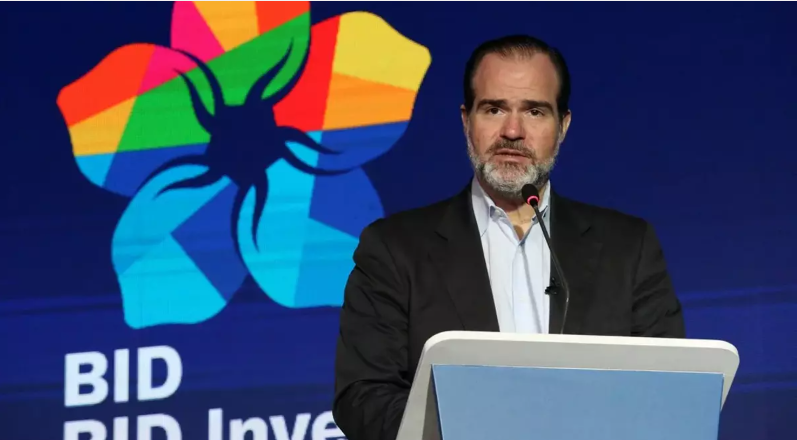
On Monday, September 26, following the recommendations of the IDB’s Board of Executive Directors, the Board of Governors decreed the termination of Claver-Carone’s functions as President of the Bank after the violation of various ethical standards of the institution, which marked the opening of a period of 45 days for the countries to propose their candidatures. During this period, the executive vice president, Reina Irene Mejía Chacón, will act as president under the direction of the Executive Board.
“Below, we offer a google translate version of the original article in Spanish. This translation may not be accurate but serves as a general presentation of the article. For more accurate information, please switch to the Spanish version of the website. In addition, feel free to directly contact in English the person mentioned at the bottom of this article with regards to this topic”.
Two years ago, in October 2020, Donald Trump promoted the American Mauricio Claver-Carone to the presidency of the IDB. The context was advantageous for Washington as it was the first American presidency since the organization’s creation.
It should be remembered that although the IDB Constitutive Agreement does not establish any conditions in relation to the nationality of the person who should hold the presidency, there is an unwritten rule since its very creation by which the organization must be directed by a person from the region. It was even one of the conditions for which it was finally accepted that the Bank’s headquarters be in Washington DC.
In terms of geopolitics, this strategy constituted the IDB as a vehicle through which the United States could increase its influence in the Latin American region and achieve a balance of institutional power: it could discern regarding the granting and destination of credits by the institution and thus dissipate the presence of other powers in the region, as is the case of the Chinese giant.
The origins of the Claver-Carone impeachment
The Board of Governors’ decision dates back to an anonymous misconduct complaint filed against Claver-Carone. From this, the board hired the legal firm Davis Polk to investigate the facts. As a result of the results of the investigation, the decision was made to dismiss the leader of the institution. Claver-Carone is accused of having maintained a romantic relationship with an employee and of having benefited her financially, which implies the violation of several internal ethical standards of the agency, while the IDB prohibits intimate relationships of superior personnel with direct dependents. The complaint was aggravated by Claver-Carone’s refusal to cooperate fully with the investigation and by creating a climate of fear of retaliation among Bank staff.
In this way, the deficit of legitimacy that accompanied the origins of the Claver-Carone presidency, was combined with a deficit of legitimacy, and today they lead to a crisis of leadership.
In this context, while waiting for the candidacy proposals for the presidency of the IDB, it is worth asking what are the alternatives at the regional and institutional level?
In terms of regionalism, this is an excellent opportunity to renew the (deteriorated) intra-regional dialogue in Latin America and the Caribbean and deepen consensus-building practices. In order for the region to obtain an advantage in the presidential elections of the international organization, it should achieve consensus and convergence when choosing candidates. In this way, it would prevent a repetition of the 2020 scenario where having offered several candidacies eroded the chances of winning the elections.
In particular, Brazil could take advantage of this scenario to renew its regional leadership role, as it is one of the Bank’s largest shareholders along with Argentina and the United States, together with almost 53% of the voting power. In any case, the country is currently immersed in the campaign for the presidential elections, the result of which may influence the position it adopts regarding the transition in the IDB.
In institutional terms, it is an opportunity to renew the strategies through which the institution promotes its main objective: to achieve the development of Latin America and the Caribbean by improving the quality of life, reducing poverty and inequality. In this sense, participation in the IDB should encourage regional integration in Latin America and the Caribbean and allow the development of the Bank as a bridge between the region and the world. Increasing regionalism and the participation of the countries that make up the region would strengthen the development paths and the insertion of Latin America and the Caribbean in the international context. In addition, it would allow the IDB to stand out as a Bank, not pro-American or pro-Chinese, but pro-Latin American, allowing a convergence between globalization and regionalization when it comes to pursuing development.
Finally, in terms of the qualities that the person designated for the presidency of the IDB should have, this is a great opportunity for a Latin American woman to take charge of the leadership of the institution.
In fact, the names of three Latin American women are beginning to resonate as potential candidates. Among them: Michelle Bachelet, former president of Chile, Laura Chinchilla, former president of Costa Rica; and Alicia Bárcena, head of the Economic Commission for Latin America and the Caribbean (ECLAC).
In this sense, some aspects are key: 1) that the person has outstanding training and experience and an effective modernization proposal for the Bank with an emphasis on social and environmental issues; 2) to adopt a clear and express commitment to multilateralism and the vindication of the legitimacy of the presidential position; and 3) that it complies with transparency, accountability and the participation of civil society in the actions of the Institution.
More information
- The United States candidate, Mauricio Claver-Carone, was elected as the new president of the IDB – Fundeps
- Regional statement regarding the IDB presidential elections – Fundeps
- The end of a historical tradition in the presidency of the IDB? – Fundeps
Author
Victoria Marquez
Contact
Gonzalo Roza – gon.roza@fundeps.org