• ES
  • EN
Fundeps
  • About Fundeps
  • Team
  • Working areas
    • Environment
    • Democracy
    • Gender
    • Global Gorvernance
    • Health
  • News
  • Publications
  • DONATE
  • Click to open the search input field Click to open the search input field Search
  • Menu Menu
Global Governance, News

We participated in a webinar on the IDB Information Access Policy
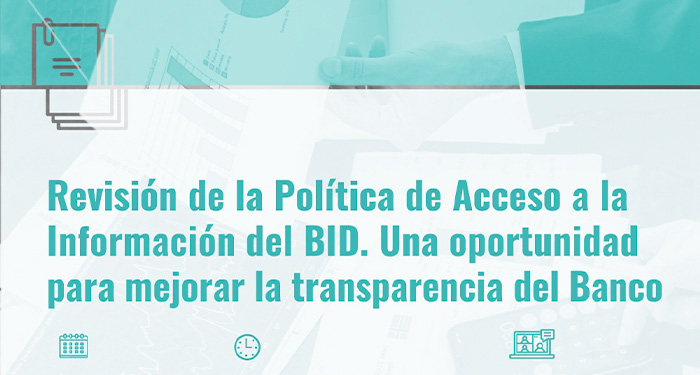
Within the framework of the current review process of the IDB Access to Information Policy, Fundeps, the Environment and Natural Resources Foundation (FARN) and the CAUCE Foundation: Environmental Culture – Ecological Cause held, on September 29, the webinar “Review of the IDB Access to Information Policy. An opportunity to improve the transparency of the Bank”. The event discussed the shortcomings of the current policy under review, the difficulties in its implementation and the priorities regarding the ongoing public consultation process.

“Below, we offer a google translate version of the original article in Spanish. This translation may not be accurate but serves as a general presentation of the article. For more accurate information, please switch to the Spanish version of the website. In addition, feel free to directly contact in English the person mentioned at the bottom of this article with regards to this topic”.

The Access to Information Policy (PAI) of the Inter-American Development Bank (IDB) has become outdated. It dates from 2010 and its entry into force is dated 2011. So far it has not been modified, despite the fact that the current context is far from the rights acquired by people from the regulatory advances in terms of citizen participation and access to information and justice. At the end of 2019, the IDB began a review process of its Access to Information Policy that was suspended months later and has recently been reactivated.

In this context, it is necessary to underline that the right to information is a fundamental human right, as a necessary condition for people, communities and organizations to be informed and actively participate in decision-making processes, as well as being a pillar of transparency and accountability.

Based on the above, the webinar was structured in 3 main moments: to begin, the report “Flaws in the Inter-American Development Bank’s Access to Information Policy” was presented, prepared jointly by the 3 organizations mentioned above, which Its objective is to analyze the normative aspects contained in the current PAI and the difficulties in its implementation, the review process initiated and the intended policy profile. Likewise, its shortcomings and recommendations for strengthening the PAI were identified, with the ultimate goal of effectively guaranteeing the right of access to information. Second, the current status of the PAI review process was emphasized. Finally, from the Chilean organization Sustentarse, they commented on experiences and practical cases in Latin America in which it is possible to perceive the shortcomings that the IDB still has in terms of access to information. The webinar ended with questions and reflections from the people who spoke and attended the event.

To view the recorded webinar, click here

More information

  • Política de Acceso a la Información de 2011 – BID 
  • Participamos de la consulta pública sobre la revisión de la política de acceso a la información del BID – Fundeps
  • Joint Submission on IDB Access to Information Policy Profile
  • The IDB updates its access to information policy in 2020
  • Plan de Consulta- BID
  • Actualización de la Política de Acceso a la Información- BID
  • Informe “Falencias en la Política de Acceso a la Información del Banco Interamericano de Desarrollo”

Author

Camila Victoria Bocco

Contact

Gonzalo Roza, gon.roza@fundeps.org


17 de October de 2022
Tags: Access to Information, BID, Global Governance, IFIs, Social and Environmental Standards, Transparency
Share this entry
  • Share on Facebook
  • Share on X
  • Share on WhatsApp
  • Share on LinkedIn
  • Share by Mail
https://fundeps.org/wp-content/uploads/2022/10/nota-gg-1.jpg 375 700 Sofia Rubiano Eckert https://fundeps.org/wp-content/uploads/2026/04/logo-2026-300x120.png Sofia Rubiano Eckert2022-10-17 18:34:422024-11-14 13:14:36We participated in a webinar on the IDB Information Access Policy
You might also like
Concern and uncertainty regarding the progress of the works of the Villa Carlos Paz Environmental Center
What is the Green Climate Fund and how does it work?
The IDB and the IDB Invest review their environmental and social policies
The role of the AIIB in the New Route of the Green Headquarters
A Key Year for the Transparency in BNDES
Why does Argentina still not have a National Action Plan on Business and Human Rights?
HLAC presented a report to the IACHR on HR and companies
Transparency and participation of civil society in the CONAL decision-making process | Report

Tags

Access to Information Access to Justice BID Chinese Investments Citizen Participation Democracy ENTs Environment Environmental Democracy Gender Global Governance Health Healthy nutrition IFIs Infrastructure Financing Legal Interruption of Pregnancy Sexual and Reproductive Rights Social and Environmental Standards Tobacco Control Transparency
See all tags

Acuerdo de Escazú

Emergencia Agroquímica

MOCI - monitoreo ciudadano en proyectos de infraestructura

{el entramado} Contamos historias. Acercamos Realidades.

Instagram

fundepsargentina

Trabajamos para que se garanticen los derechos humanos 🌱⚖️🗣️🌈💜🚭🍎
Promovemos la equidad de #genero, el derecho a la #salud y un #ambiente sano.

La Legislatura de Córdoba otorgó a Fundeps un bene La Legislatura de Córdoba otorgó a Fundeps un beneplácito por el Tercer encuentro Redes de compromiso y cuidados: “Acceso a la salud sexual integral. Debates urgentes”. El encuentro se realizó el pasado 20 de junio y reunió a más de cien profesionales de toda la provincia.

La mención (aprobada por unanimidad) fue iniciativa de la Legisladora Karen Acuña, en coautoría con las legisladoras Silvina Jurich, Ariela Szpanin, Doris Mansilla y Julieta Rinaldi. La misma expresa: “iniciativas con estas características, impulsadas por organizaciones de la sociedad civil, resultan fundamentales para fortalecer la protección y el ejercicio efectivo de los derechos ciudadanos, al tiempo que contribuyen a la construcción de una sociedad más justa, inclusiva e igualitaria".

Recibir este reconocimiento nos llena de orgullo y fortalece sin dudas los vínculos y el camino conjunto en pos del acceso a derechos en nuestra provincia.
Este viernes 31 de julio realizamos un nuevo encue Este viernes 31 de julio realizamos un nuevo encuentro de formación en derechos sexuales y (no) reproductivos. 

En articulación con el Consultorio de Salud Integral y con el aval de la DAJA, compartimos la jornada de capacitación con profesionales del Hospital Vicente Agüero de Jesús María.

Más de 15 profesionales de diversas disciplinas se dieron cita, para conocer diferentes aspectos de la práctica de AMEU y fortalecer su trabajo diario, en pos del acceso al aborto legal, seguro y gratuito.

Como en cada instancia, celebramos el compromiso de cada participante y agradecemos especialmente a la Dra. Kenia Torres y al Director del Hospital, Dr. Javier Díaz, por la predisposición para recibirnos.
La información como herramienta ya está disponible La información como herramienta ya está disponible en Aprender con Fundeps.

Aprendé a ejercer el derecho de acceso a la información pública y a usarlo para defender derechos, monitorear decisiones e impulsar procesos de incidencia.

En este curso vas a aprender:

📌 Cómo hacer solicitudes de acceso a la información pública.
📌 Qué hacer cuando un organismo no responde.
📌 Cómo acceder a información sobre proyectos financiados por organismos internacionales.

💻 Curso virtual, gratuito y autoadministrado.
🔗 Inscribite en aprender.fundeps.org
🌎 Hace un año, la @corteidhoficial emitió su histó 🌎 Hace un año, la @corteidhoficial emitió su histórica Opinión Consultiva sobre la emergencia climática.

✊ Una victoria para quienes defienden el ambiente en América Latina y el Caribe: la Corte confirmó que proteger a las personas defensoras del ambiente no es opcional. Es una obligación legal.

⚖️ Para explicar qué exige esa protección, la Corte se apoyó en el Acuerdo de Escazú. Resultado: la gran mayoría de Estados de América Latina y el Caribe no pueden ignorar los estándares de Escazú, incluso si aún no han ratificado el tratado.

🔎 La implicación es clara: los países de la región deben fortalecer el acceso a la información, la participación pública, la justicia ambiental y la protección de quienes defienden el ambiente. 

📝 La Opinión abre nuevas rutas para frenar la criminalización de personas defensoras, responder a las restricciones al espacio cívico y defender la participación pública en países como Costa Rica, Guatemala y Perú. Compartimos el análisis de  @manizalmigrante del @ciel_org

📣 La discusión ya no es si los países de América Latina y el Caribe deben proteger a quienes defienden el ambiente. Eso ya está claro. Ahora hay que usar la Opinión: en tribunales, reformas, debates públicos y procesos de movilización para exigir mejores garantías y mayor protección.

🔗 Lee el análisis completo en el link en www.ciel.org/corte-idh-escazu-personas-defensoras/
Follow on Instagram

Twitter

Tweets por @fundeps

Newsletter Subscription

    Fundeps. Córdoba (CP X5000JZH), Argentina. info@fundeps.org
    • Link to X
    • Link to Facebook
    • Link to Instagram
    • Link to Mail
    • Link to Youtube
    • Link to LinkedIn
    • Link to TikTok
    Link to: IDB: the president was dismissed and the possibility opens for a Latin American woman Link to: IDB: the president was dismissed and the possibility opens for a Latin American woman IDB: the president was dismissed and the possibility opens for a Latin American... Link to: IDB began public consultation for the new Access to Information Policy Link to: IDB began public consultation for the new Access to Information Policy IDB began public consultation for the new Access to Information Policy
    Scroll to top Scroll to top Scroll to top