• ES
  • EN
Fundeps
  • About Fundeps
  • Team
  • Working areas
    • Environment
    • Democracy
    • Gender
    • Global Gorvernance
    • Health
  • News
  • Publications
  • DONATE
  • Click to open the search input field Click to open the search input field Search
  • Menu Menu
Global Governance, News

IDB began public consultation for the new Access to Information Policy
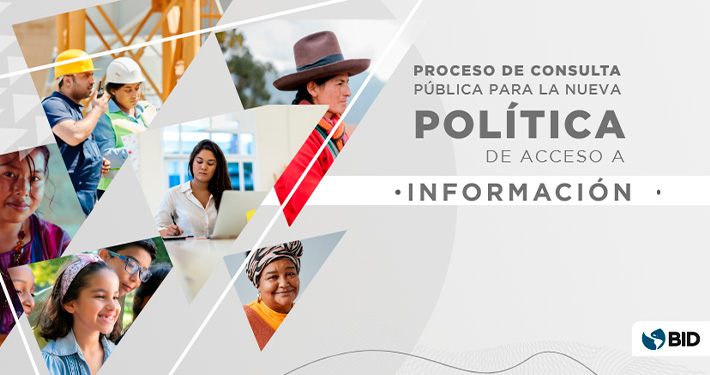
The Inter-American Development Bank (IDB) announced in August the opening of the public consultation process to receive input on the proposal for the new Access to Information Policy (PAI). This process will last 150 days and will include asynchronous queries and direct exchanges.

“Below, we offer a google translate version of the original article in Spanish. This translation may not be accurate but serves as a general presentation of the article. For more accurate information, please switch to the Spanish version of the website. In addition, feel free to directly contact in English the person mentioned at the bottom of this article with regards to this topic”.

The Inter-American Development Bank is one of the main multilateral institutions that finances projects in a large part of the Latin American countries. In the IDB’s field of work, transparency and integrity are essential. It is in this area where reforms are promoted that seek to improve the quality of regulations and institutions, as well as expand access to information.

In this sense, the IDB announced a new Access to Information Policy Proposal, which will replace the Bank’s current Access to Information Policy, in force since 2011. It is around this new draft that the public consultation is carried out. , which was launched on August 29 of the current year and will last 150 days.
The objective of the public consultation lies in the possibility of receiving, either in written or verbal form, opinions and inputs from those parties that want to contribute to enriching the quality of the document and the organization’s understanding of the perspectives and perceptions of the various civil society actors regarding access to information on Bank activities in the region.

The period of time stipulated by the procedure is divided into three phases. Initially, in September, three virtual synchronous dialogues were established (in English, Spanish and Portuguese), which will allow the Bank to collect opinions and identify new references that can enrich the new PAI. As of October, the second part of the procedure began, we are talking about the asynchronous consultation phase, which will be available for a period of 90 days, where the final version of the new PAI document will be strengthened. Face-to-face meetings will also be held in Costa Rica (October 25), Uruguay (November 15) and in a Caribbean country not yet defined (November 3). In principle, to participate in the virtual consultation instances, it will be necessary to register in advance on the Virtual Platform for Public Consultation Processes and request access to the consultation. Finally, regarding the third phase, it has a stipulated duration of 30 days throughout the month of March and seeks to inform the participants about the closure of the consultation process and the inputs received and considered, both those that were included as those that were not included in the final version of the policy approved by the Board of Executive Directors.

Since one of our main pillars of work is based on transparency, we have sent a letter, along with other regional civil society organizations, detailing our concerns and recommendations to strengthen and improve the consultation process. They are structured in seven main pillars, among which we can mention: update and organize the information regarding the consultation process in a single place on the IDB website to ensure that all interested parties and affected communities are effectively informed ; incorporate a 30-day public period to submit comments and recommendations to a second draft of the IAP; proactively solicit input from stakeholders to facilitate their participation in consultation processes, so that civil society has the opportunity to shape the debate; eliminate the barriers that exist in the consultation plan to guarantee effective participation, barriers that revolve around, above all, the electronic platform, which is a condition to be able to participate in this instance; confirm and disseminate in advance the calendar with the dates and places of the face-to-face consultations planned for the second phase; open a public comment instance for the implementation guidelines of the future PAI; and, finally, meeting with civil society at the Annual Meeting of the IDB Group in Panama 2023.

In this way, we hope to be able to collaborate with the IDB’s management to ensure that the consultation process is truly fruitful and participatory and that it enables the Bank’s new Access to Information Policy to be strengthened and perfected.

To access the draft of the new policy that is being submitted for public consultation, click here. Comments and suggestions on the draft can be sent to the following email: consultapai@iadb.org

More information:

  • Consultation Plan- IDB
  • Update of the Access to Information Policy- IDB

Author
Valentina Raso

Contact
Gonzalo Roza – gon.roza@fundeps.org
24 de October de 2022
Tags: Access to Information, BID, Global Governance, IFIs, Social and Environmental Standards
Share this entry
  • Share on Facebook
  • Share on X
  • Share on WhatsApp
  • Share on LinkedIn
  • Share by Mail
https://fundeps.org/wp-content/uploads/2022/10/acceso-info-bid.jpg 375 710 Sofia Rubiano Eckert https://fundeps.org/wp-content/uploads/2026/04/logo-2026-300x120.png Sofia Rubiano Eckert2022-10-24 17:59:042024-11-14 13:14:36IDB began public consultation for the new Access to Information Policy
You might also like
We present amparo action against the Province due to lack of information
Approaches in the Sino-Argentina relationship: the incorporation to the AIIB and the Belt and Road Initiative
New 2015 Annual Report
Argentina-China: cooperate in adverse times
Sergio Díaz-Granados was elected the new Executive President of CAF
Regional statement regarding the IDB presidential elections
The BRICS Bank designed its new president: the Brazilian Marcos Prado Troyjo
A decree cannot limit access to public information

Tags

Access to Information Access to Justice BID Chinese Investments Citizen Participation Democracy ENTs Environment Environmental Democracy Gender Global Governance Health Healthy nutrition IFIs Infrastructure Financing Legal Interruption of Pregnancy Sexual and Reproductive Rights Social and Environmental Standards Tobacco Control Transparency
See all tags

Acuerdo de Escazú

Emergencia Agroquímica

MOCI - monitoreo ciudadano en proyectos de infraestructura

{el entramado} Contamos historias. Acercamos Realidades.

Instagram

fundepsargentina

Trabajamos para que se garanticen los derechos humanos 🌱⚖️🗣️🌈💜🚭🍎
Promovemos la equidad de #genero, el derecho a la #salud y un #ambiente sano.

La Legislatura de Córdoba otorgó a Fundeps un bene La Legislatura de Córdoba otorgó a Fundeps un beneplácito por el Tercer encuentro Redes de compromiso y cuidados: “Acceso a la salud sexual integral. Debates urgentes”. El encuentro se realizó el pasado 20 de junio y reunió a más de cien profesionales de toda la provincia.

La mención (aprobada por unanimidad) fue iniciativa de la Legisladora Karen Acuña, en coautoría con las legisladoras Silvina Jurich, Ariela Szpanin, Doris Mansilla y Julieta Rinaldi. La misma expresa: “iniciativas con estas características, impulsadas por organizaciones de la sociedad civil, resultan fundamentales para fortalecer la protección y el ejercicio efectivo de los derechos ciudadanos, al tiempo que contribuyen a la construcción de una sociedad más justa, inclusiva e igualitaria".

Recibir este reconocimiento nos llena de orgullo y fortalece sin dudas los vínculos y el camino conjunto en pos del acceso a derechos en nuestra provincia.
Este viernes 31 de julio realizamos un nuevo encue Este viernes 31 de julio realizamos un nuevo encuentro de formación en derechos sexuales y (no) reproductivos. 

En articulación con el Consultorio de Salud Integral y con el aval de la DAJA, compartimos la jornada de capacitación con profesionales del Hospital Vicente Agüero de Jesús María.

Más de 15 profesionales de diversas disciplinas se dieron cita, para conocer diferentes aspectos de la práctica de AMEU y fortalecer su trabajo diario, en pos del acceso al aborto legal, seguro y gratuito.

Como en cada instancia, celebramos el compromiso de cada participante y agradecemos especialmente a la Dra. Kenia Torres y al Director del Hospital, Dr. Javier Díaz, por la predisposición para recibirnos.
La información como herramienta ya está disponible La información como herramienta ya está disponible en Aprender con Fundeps.

Aprendé a ejercer el derecho de acceso a la información pública y a usarlo para defender derechos, monitorear decisiones e impulsar procesos de incidencia.

En este curso vas a aprender:

📌 Cómo hacer solicitudes de acceso a la información pública.
📌 Qué hacer cuando un organismo no responde.
📌 Cómo acceder a información sobre proyectos financiados por organismos internacionales.

💻 Curso virtual, gratuito y autoadministrado.
🔗 Inscribite en aprender.fundeps.org
🌎 Hace un año, la @corteidhoficial emitió su histó 🌎 Hace un año, la @corteidhoficial emitió su histórica Opinión Consultiva sobre la emergencia climática.

✊ Una victoria para quienes defienden el ambiente en América Latina y el Caribe: la Corte confirmó que proteger a las personas defensoras del ambiente no es opcional. Es una obligación legal.

⚖️ Para explicar qué exige esa protección, la Corte se apoyó en el Acuerdo de Escazú. Resultado: la gran mayoría de Estados de América Latina y el Caribe no pueden ignorar los estándares de Escazú, incluso si aún no han ratificado el tratado.

🔎 La implicación es clara: los países de la región deben fortalecer el acceso a la información, la participación pública, la justicia ambiental y la protección de quienes defienden el ambiente. 

📝 La Opinión abre nuevas rutas para frenar la criminalización de personas defensoras, responder a las restricciones al espacio cívico y defender la participación pública en países como Costa Rica, Guatemala y Perú. Compartimos el análisis de  @manizalmigrante del @ciel_org

📣 La discusión ya no es si los países de América Latina y el Caribe deben proteger a quienes defienden el ambiente. Eso ya está claro. Ahora hay que usar la Opinión: en tribunales, reformas, debates públicos y procesos de movilización para exigir mejores garantías y mayor protección.

🔗 Lee el análisis completo en el link en www.ciel.org/corte-idh-escazu-personas-defensoras/
Follow on Instagram

Twitter

Tweets por @fundeps

Newsletter Subscription

    Fundeps. Córdoba (CP X5000JZH), Argentina. info@fundeps.org
    • Link to X
    • Link to Facebook
    • Link to Instagram
    • Link to Mail
    • Link to Youtube
    • Link to LinkedIn
    • Link to TikTok
    Link to: We participated in a webinar on the IDB Information Access Policy Link to: We participated in a webinar on the IDB Information Access Policy We participated in a webinar on the IDB Information Access Policy Link to: An industry that does not give up Link to: An industry that does not give up An industry that does not give up
    Scroll to top Scroll to top Scroll to top