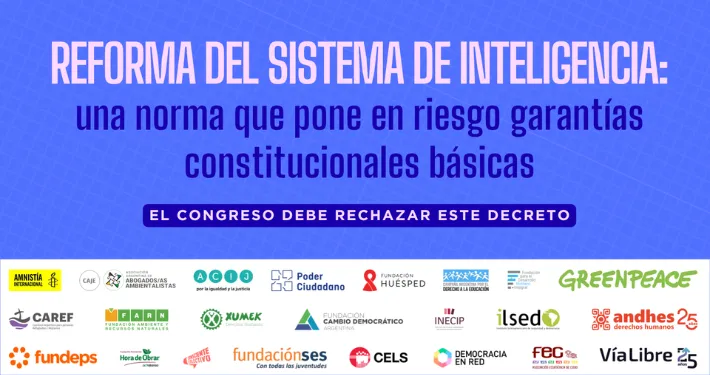
Reform of the Intelligence System: A Regulation That Puts Basic Constitutional Guarantees at Risk
On December 31, the Executive Branch issued Decree of Necessity and Urgency (DNU) 941/2025, through which it reformed the functioning of the Argentine intelligence system. This reform was not enacted through a law debated in Congress, but rather unilaterally, during the legislative recess.
Why should this matter to you?
Because it changes the way in which the State can monitor you, directly affecting your freedom, autonomy, and privacy.
You have no way of knowing how your personal data are used
The DNU requires more than 15 public agencies to share citizens’ personal data with the State Intelligence Secretariat (SIDE), without establishing specific procedures or oversight mechanisms. The decree thus becomes a tool for mass surveillance. Moreover, the accumulation of large volumes of data within a single agency is even more dangerous given the State’s lack of an adequate information security policy and the frequency of data breaches.
The decree provides for no form of citizen oversight of SIDE’s activities and further concentrates power within this agency. SIDE may request information from provinces and municipalities, approve secret budgets, and share personal data with foreign agencies without judicial authorization—all under absolute secrecy. No one will know how your information is used or to whom it is disclosed.
No one oversees those who oversee
The decree establishes that intelligence activities are, by definition, covert. This means that you will not be able to know whether you are being investigated, why, or what information is being held about you. The covert nature of these activities can frustrate potential investigations aimed at establishing State responsibility. There is no way to seek redress if mistakes are made or abuses occur. Secrecy becomes the rule.
An intelligence agency with the power to detain you
For the first time in democracy, intelligence agents are granted the power to detain individuals. SIDE may carry out the “apprehension” of persons without clear criteria, without defined guarantees, and without judicial authorization. This opens the door to arbitrary detentions, persecution, and intimidation. It effectively transforms intelligence services into a kind of secret police operating without oversight.
The military would return to internal security tasks
For decades, Argentina worked to clearly separate national defense (the military) from internal security (the police). This separation was a lesson learned from the dictatorship: the armed forces should not exercise control over the civilian population. This decree allows the Armed Forces to carry out intelligence activities on “non-state organizations”—without clarifying which organizations fall under this category or what criteria would apply—and removes civilian oversight. This represents a dangerous historical regression.
The return of the “internal enemy” doctrine
This DNU significantly expands the concept of counterintelligence to include the prevention of infiltration, espionage, sabotage, influence, interference, or external intervention detrimental to the decision-making processes of public authorities, national strategic interests, and/or the population at large, including “multidimensional approaches” involving state and non-state actors.
By amending Article 4 of Law No. 25,520, the prohibitions designed to prevent intelligence agencies from engaging in political intelligence (such as influencing political, social, or economic life, political parties, or public opinion) are rendered irrelevant due to the inclusion of an extremely broad exception: counterintelligence activities are authorized to carry out practices that were previously prohibited. In practice, this relaxes legal limits on domestic intelligence and enables political espionage in the name of counterintelligence.
The vagueness of certain terms raises serious questions about how these provisions will be applied in practice. This concern is heightened by the dissemination, in December, of an alleged National Intelligence Plan (PIN), which explicitly identified anarchists, Indigenous peoples, environmental activists, and journalists who “misinform” or “delegitimize” the government as “internal enemies.”
As a result, the rights to freedom of expression, association, and petitioning the authorities are placed at serious risk. Demanding legislation (such as the Glaciers Law or funding for disability programs) could turn individuals into intelligence targets, making them subject to surveillance, infiltration, and even detention.
Why now? Why in this way?
This manifestly unconstitutional DNU breaks basic democratic consensus, expands the scope of State discretion, weakens oversight mechanisms, and enables practices that were believed to be part of the past. By authorizing tools for surveillance, persecution, and detention, it sends a direct signal to those who defend rights, territories, and democracy.
Once again, decisions of extreme importance are made without legislative debate. The constitutional requirements for issuing decrees of necessity and urgency are clearly not met: there are no exceptional circumstances preventing Congress from enacting legislation, and reforms of this magnitude, far from being adopted unilaterally, should be carried out only with broad political consensus. Congress must reject this decree.
Signatories:
Amnistía Internacional Argentina, Asociación Argentina de Abogados Ambientalistas / CAJE, Asociación Civil por la Igualdad y la Justicia (ACIJ), Poder Ciudadano, CELS, Democracia en Red, Fundación SES, Fundación Vía Libre, Campaña Argentina por el Derecho a la Educación (CADE), Fundación Ambiente y Recursos Naturales (FARN), Fundación para el Desarrollo de Políticas Sustentables (Fundeps), Fundación para el Desarrollo Humano Integral, Fundación Protestante Hora de Obrar, Xumek- Asociación para la Promoción y Protección de los Derechos Humanos, Fundación Cambio Democrático, Instituto de Estudios Comparados en Ciencias Penales y Sociales (INECIP), Instituto Latinoamericano de Seguridad y Democracia (ILSED), Comisión Argentina para Refugiados y Migrantes (CAREF), Abogados y Abogadas del Noroeste Argentino en Derechos Humanos y Estudios Sociales (ANDHES), Consciente Colectivo, Fundación Huésped, Greenpeace, Federación Ecuménica de Cuyo (FEC).
Contact:
Mayca Balaguer, maycabalaguer@fundeps.ord