• ES
  • EN
Fundeps
  • About Fundeps
  • Team
  • Working areas
    • Environment
    • Democracy
    • Gender
    • Global Gorvernance
    • Health
  • News
  • Publications
  • DONATE
  • Click to open the search input field Click to open the search input field Search
  • Menu Menu
Media

Federation wants 1.9 million hectares less
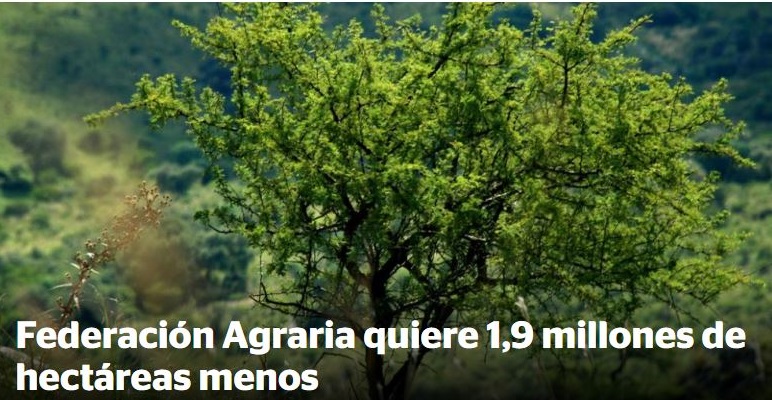
The Province called a table to update the map of law 9.814. The different positions of the rural sectors and the environmentalist and ecological NGOs do not reach an agreement that allows to raise a project. According to expert studies, the province has 3.6 million hectares of native forest.

“Below, we offer a google translate version of the original article in Spanish. This translation may not be accurate but serves as a general presentation of the article. For more accurate information, please switch to the Spanish version of the website. In addition, feel free to directly contact in English the person mentioned at the bottom of this article with regards to this topic.”

As in 2009, when the law that created it was enacted, the territorial planning of the native forests (OTBN) of Cordoba continues to pose irreconcilable differences between the rural sector and environmentalism.

This year, the Province convened a table to update the map of Law 9.814, which paints these ecosystems in three colors, according to their state of conservation and permitted activities. But in this space, the different positions of the rural sectors and environmentalist NGOs and environmentalists do not reach an agreement that allows to raise a consensual project for the Legislature to approve.

A few days ago, the Argentine Agrarian Federation (FAA) made clear its position that Cordoba’s OTBN is “oversized” and requires a sincere.

“We believe that the forest cover ‘native forest’ in the province should not exceed two million hectares, corresponding to the red category between 500 thousand and 600 thousand, and to the yellow category around 1.5 million hectares,” a document Presented at this dialogue table. But according to expert studies, the province has 3.6 million hectares of native forest, or 1.6 million hectares more than the FAA.
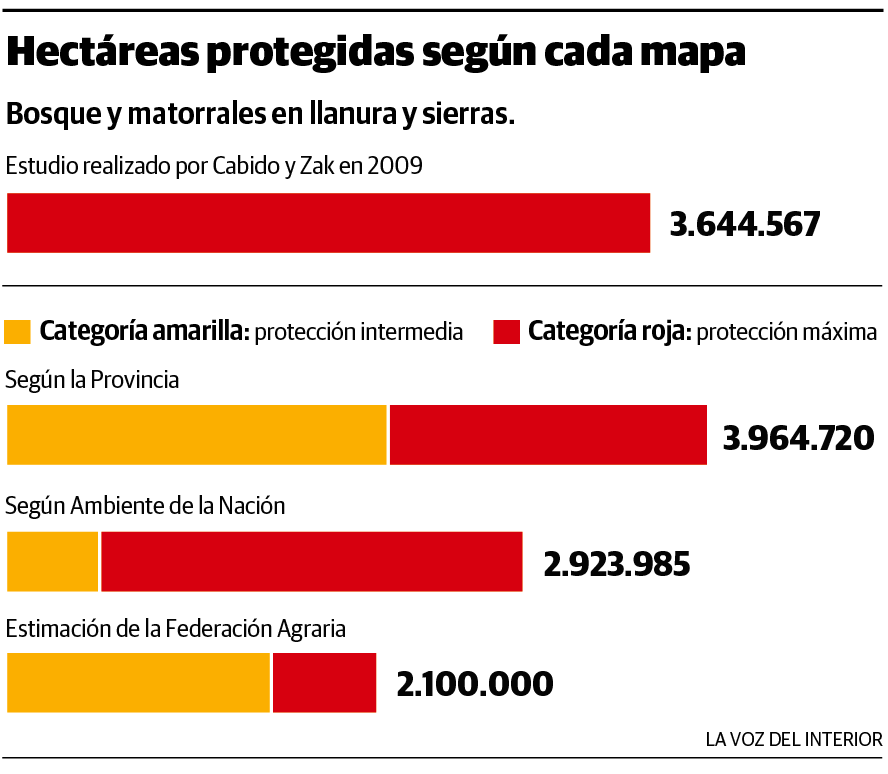
The work was carried out in 2009 by the ecologists Marcel Zak and Marcelo Cabido, and it is the scientific study of the native forest more detailed Cordobés to date. The count includes open forest, scrub in different states and halophyte ecosystems (saline environments).

The current provincial map adds four million hectares, that is 1.9 million hectares more than the idea of ​​the FAA. “The very serious distortions that originated in the initial map and throughout the regulatory stage of the law plus arbitrary and discretionary management by the enforcement authority resulted in a misclassification of conservation categories,” they point out from the FAA.

One of the FAA’s arguments for reducing the protected area is the same as the one outlined by the Confederation of Rural Associations of the Third Zone (Cartez) a few weeks ago: the human being must manage the land with degraded autochthonous environments such as scrubland, For the forest to return.

Environmentalists argue that these shrubs provide most of the ecosystem services by which the law decided to protect forests such as maintaining soil fertility, regulating water and climate and sequestering carbon dioxide responsible for climate change.

“To want to exclude vegetation structures from the OTBN simply because they have not reached their state of maximum tree development is not correct, according to the criteria proposed by the different resolutions,” said a document signed by members of the Cordoba Environmental Forum, the Peasant Movement of Cordoba , The Foundation for the Development of Sustainable Policies (Fundeps), several institutes of the National University of Córdoba and the Conicet. They also argue that the law does not allow recategorization to classifications of lower value, as they propose from the rural sector.

The ruralists want silvopastoral production. Environmentalists argue that silvopastoral activity in the yellow zone should be subject to an environmental impact assessment process and that the law does not allow the selective clearing or implantation of exotic pastures.

Fuente: La Voz del Interior

30 de November de 2016
Share this entry
  • Share on Facebook
  • Share on X
  • Share on WhatsApp
  • Share on LinkedIn
  • Share by Mail
https://fundeps.org/wp-content/uploads/2016/09/Federacion-Agraria-quiere-19-millones-de-hectareas-menos-1.jpg 400 772 Fundeps.org https://fundeps.org/wp-content/uploads/2026/04/logo-2026-300x120.png Fundeps.org2016-11-30 13:29:252024-06-30 17:35:21Federation wants 1.9 million hectares less

Tags

Access to Information Access to Justice BID Chinese Investments Citizen Participation Democracy ENTs Environment Environmental Democracy Gender Global Governance Health Healthy nutrition IFIs Infrastructure Financing Legal Interruption of Pregnancy Sexual and Reproductive Rights Social and Environmental Standards Tobacco Control Transparency
See all tags

Acuerdo de Escazú

Emergencia Agroquímica

MOCI - monitoreo ciudadano en proyectos de infraestructura

{el entramado} Contamos historias. Acercamos Realidades.

Instagram

fundepsargentina

Trabajamos para que se garanticen los derechos humanos 🌱⚖️🗣️🌈💜🚭🍎
Promovemos la equidad de #genero, el derecho a la #salud y un #ambiente sano.

TE NECESITAMOS 🧡 Para seguir de cerca el Plan de TE NECESITAMOS 🧡

Para seguir de cerca  el Plan de Saneamiento del Lago San Roque, hay que mirar de cerca todo el proceso. Revisamos información técnica, hacemos seguimiento de la causa y elaboramos informes públicos sobre el cumplimiento del Plan.

Sostener este trabajo en el tiempo requiere recursos. Tu aporte hace posible que continúe.

Doná hoy! (link en bio)
Y todo esto quedó en un papel? No. Ya hay avances. Y todo esto quedó en un papel? No. Ya hay avances. Pero tampoco está resuelto.

Hay plantas de tratamiento que comenzaron a funcionar, obras de cloacas terminadas y establecimientos que fueron auditados por posible contaminación.

➡️ También quedan medidas por cumplir y avances que necesitan seguimiento. Porque mostrar lo que se hizo también sirve para saber qué falta.

Para seguir acompañando este proceso y sosteniendo el trabajo que todavía queda, necesitamos tu apoyo.

Doná hoy.
La Justicia no solo dijo que el lago está contamin La Justicia no solo dijo que el lago está contaminado. También ordenó qué tiene que hacer el Estado para empezar a sanearlo.

La sentencia establece medidas concretas, con plazos y obligaciones que involucran a la Provincia y a los municipios de la cuenca.

Entre ellas: avanzar con las obras cloacales, controlar los vertidos contaminantes, fortalecer la fiscalización y garantizar espacios de participación y transparencia.

Deslizá para conocer qué tiene que pasar para que el saneamiento avance.

Ayudanos a seguir trabajando para que estas medidas se cumplan. Doná hoy.
Hoy, 4 de septiembre, es el Día Mundial de la Salu Hoy, 4 de septiembre, es el Día Mundial de la Salud Sexual. Una fecha que nos invita a volver sobre las discusiones que atraviesan el acceso a la salud sexual y (no) reproductiva: condiciones de acceso para que sea integral y de calidad, desde un enfoque de derechos y con perspectiva de diversidad.

En el mes de junio nos encontramos en el 3° Encuentro Provincial de Redes de Compromiso y Cuidados: Salud sexual Integral con Perspectiva de Diversidad para poner en común experiencias y preguntas sobre estos desafíos.

Hoy recuperamos algunas de las voces que fueron parte de las exposiciones de ese encuentro para volver sobre dos preguntas que siguen abiertas:
¿Cuál es hoy el debate más urgente cuando hablamos de salud integral y diversidad?
¿Por qué es importante encontrarnos en este contexto?

Porque garantizar el derecho a la salud también implica seguir encontrándonos para pensar, discutir y construir respuestas colectivas.
Follow on Instagram

Twitter

Tweets por @fundeps

Newsletter Subscription

    Fundeps. Córdoba (CP X5000JZH), Argentina. info@fundeps.org
    • Link to X
    • Link to Facebook
    • Link to Instagram
    • Link to Mail
    • Link to Youtube
    • Link to LinkedIn
    • Link to TikTok
    Link to: Participating in the ESCR-Net’s Global Strategy Meeting Link to: Participating in the ESCR-Net’s Global Strategy Meeting Participating in the ESCR-Net’s Global Strategy Meeting Link to: Comentarios al Proyecto de Ley de Ordenamiento Territorial de Bosques Nativos – December 2016 Link to: Comentarios al Proyecto de Ley de Ordenamiento Territorial de Bosques Nativos – December 2016 Comentarios al Proyecto de Ley de Ordenamiento Territorial de Bosques Nativos...
    Scroll to top Scroll to top Scroll to top