
Córdoba has a non-punishable abortion
After a judicial process of more than 6 years, the Superior Court of Justice of Cordoba rejected the action of amparo filed by the Portal de Belén association that objected the guide that regulates non-punishable abortions, confirming its constitutionality and providing its full force.
“Below, we offer a google translate version of the original article in Spanish. This translation may not be accurate but serves as a general presentation of the article. For more accurate information, please switch to the Spanish version of the website. In addition, feel free to directly contact in English the person mentioned at the bottom of this article with regards to this topic”.
Background
On March 30, 2012, and following the guidelines of the Supreme Court in the FAL ruling, the government of the province of Córdoba, through the Ministry of Health, approved Resolution 93/12 and the Guide to the care of non-punishable abortions. with the purpose of guaranteeing a fast and safe access to the practice of non-punishable abortions in the provincial public health services.
On April 12 of that year, the Asociación Civil Portal de Belén filed a collective action against the government of the Province of Córdoba. He requested that the ministerial resolution be declared inapplicable as unconstitutional and that the legal figure of non-punishable abortion contained in art. 86 of the Criminal Code. As a provisional measure, he also requested that the suspension of the application of the guide be ordered. The Civil Association for the Right to Decide (Catholics for the Right to Decide) appeared in the case as a third co-defendant in defense of women’s human rights.
The precautionary measure
On April 13, 2012, the first instance judge, Federico Ossola, partially granted the provisional measure requested by Portal de Belén ordering the suspension of the application of the guide, but only for the case provided for cases of violation. On October 3 of the same year, the Third Chamber of Appeals confirmed the precautionary measure.
However, because the application of the Guide was suspended, even in that only case, women and pregnant persons in Córdoba could not access any kind of non-punishable abortion in provincial hospitals, since the judicialization of the protocol generated misinformation in professionals of health and public opinion.
The background: the constitutionality of the resolution and the guide
On the other hand, in the argument for the unconstitutionality of the ministerial resolution (main file), in the judgment of August 24, 2012 Judge Ossola ruled in favor of the constitutionality of the resolution and the procedures provided by the guide, but he questioned the presentation of an affidavit of the rape victim to access the abortive practice without other collection. He argued that, being an exception, the sworn statement was insufficient to guarantee that punishable abortions are not committed. In May 2013, the Appeals Chamber held that the resolution and the guidance were unconstitutional for contradicting local public law.
In May 2014, the file was sent to the Superior Court, which had to decide on the constitutionality, conventionality and application of the ministerial resolution and the non-punishable abortion care guide. In 2016, on the second occasion that the Court arranged for it, FUNDEPS presented itself as amicus curiae together with other organizations supporting the defense of the sexual and reproductive rights of the women of Córdoba and contributing arguments of international human rights law.


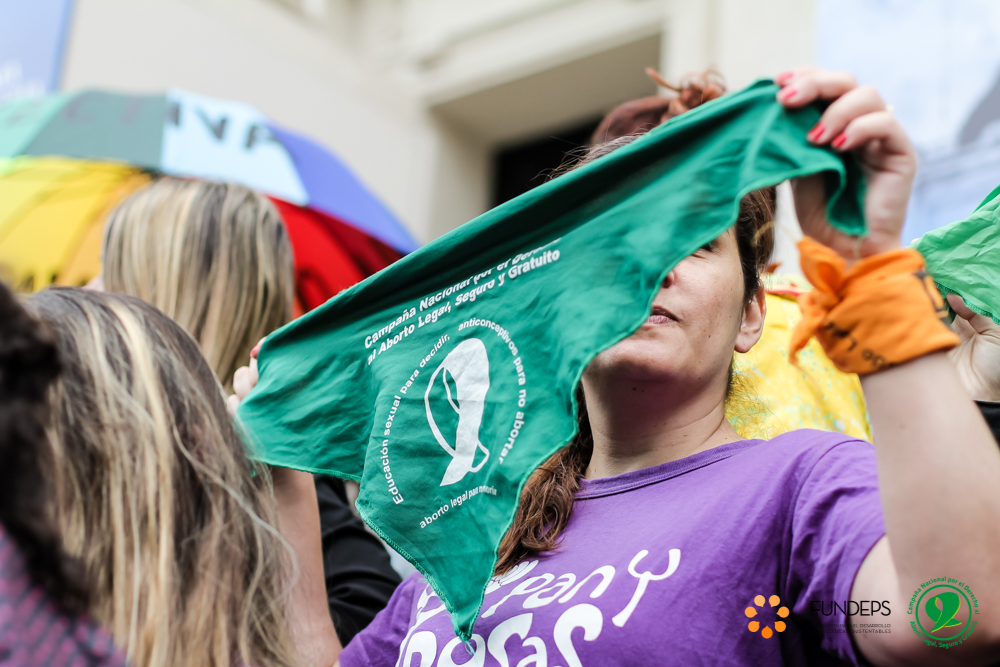

Sentence
The Superior Court of Justice considered that there was no judicial case that allowed it to examine the constitutionality of Resolution No. 93/12, since Portal de Belén had only raised a “mere subjective discrepancy” with the provisions of the Criminal Code in the art. 86, which grants exceptional permission to abort without punitive consequences for women.
He considered that Portal de Belén wanted the State to ignore said article, based on “the only support of his personal opinion“, with the aspiration that “the Province does not recognize the authorization or permission recognized by the basic law to every woman victim of a violation (according to the interpretation made by the CSJN), which would imply establishing a prohibition-against legem-where criminal law does not institute it. “
The majority vote, dictated by Aida Tarditti, Domingo Sesin, Mercedes Blanc de Arabel and Silvana María Chiapero, gave rise to the cassation appeal promoted by the Province and revoked the judgment of the House that had declared the ministerial resolution unconstitutional. Consequently, it rejected the amparo action promoted by Portal de Belén, which sought what the Chamber had resolved at the time, a decision that has now been annulled, so that the resolution remains fully valid.
In summary, he concluded that there is no collective judicial case in the terms proposed by Portal de Belén for the following reasons:
1) The National Legislative Power is the only one with competence to sanction substantive norms with general reach and has already resolved the constitutional dilemma between fundamental legal rights at stake that involves any violation that leads to the victim’s pregnancy through art. 86, subsection 2, of the Criminal Code. The same can be said when the interruption of pregnancy is enabled if there is danger to the life or health of the woman (Article 86, paragraph 1, of the Penal Code).
2) It is not possible to address the analysis of the guide without first doing the same with regard to the Criminal Code that serves as support for the guide, which far exceeds the procedural margins of an amparo. But, also, because this would mean republishing what has already been resolved in the case “F., A. L.” by the Supreme Court.
3) It is not possible to collectivize, in block, non-transferable situations in their configuration and significance without affecting the personal rights of the victims of said unlawful act.
4) An indivisible collective good is not at stake, nor can one hypothesize about how each woman could react and decide about the possibility provided by article 86, paragraph 2. That is why there is no collective legitimacy with repercussions on a right of personal exercise for which the guide aims to establish a procedure to guarantee this exercise.
The implementation of the protocol: a debt with equality
In this context and after years of waiting, it is necessary to ensure the effective implementation of the provincial protocol. From FUNDEPS, we celebrate this judicial decision and the statements of the highest authority of the Ministry of Health of the Province.
More Information
Authors
Virginia Pedraza
Mayca Balaguer
Contact
Mayca Balaguer maycabalaguer@fundeps.org