Tag Archive for: Care

In Argentina, legislation and public policies on care have made progress but also obstacles. Within the framework of the International Day of Domestic Workers and the 8th anniversary of the enactment of Law 26,844 on the Special Regime of Work Contract for Personnel of Private Houses, we highlight the importance of the legislation and regulation of the work of those who they take care of it in a remunerated way, although we recognize that there is still a lot of hard work in pursuit of its effectiveness and expansion.

“Below, we offer a google translate version of the original article in Spanish. This translation may not be accurate but serves as a general presentation of the article. For more accurate information, please switch to the Spanish version of the website. In addition, feel free to directly contact in English the person mentioned at the bottom of this article with regards to this topic”

In the 1950s, the first laws related to domestic work appeared, in order to define labor relations and their rights as workers.

But it was not until 2013 when Law 26,844 was enacted, which established a special work contract regime for paid workers in private homes. This law regulates the labor relations that are established within private homes or in the sphere of family life and that do not generate a direct profit or economic benefit for the employer. It defines this work as any provision of cleaning, maintenance or other typical household activities services, personal assistance and accompaniment to family members or those who live in the same home with the employer, and the non-therapeutic care of sick or disabled people.

In this process, activism and later the union organization of private house workers, has been key in the fight for their rights. The Union of Auxiliary Personnel of Private Houses (UPACP), which encompasses the workers of private houses, “carries out its tasks of defense and representation of the workers in the sector since the beginning of the last century. Today the workers have a law that regulates the activity, No. 26,844, which equates, as appropriate, the work of domestic service to that of workers from other unions. Now the workers of private homes have the right to vacations, maternity leave, among all labor rights. ”

This law tries to put the rights of private house workers on an equal footing with those of any other worker in a formal and dependent relationship. However, the characteristics of domestic work, related to the private sphere, the invisible, with the duty assigned to women to care for and give love in a disinterested, selfless way and without any type or with little remuneration and recognition, It makes it difficult for these activities to be considered as work and those who perform it, as workers.

Labor market of private house workers

Law 26844 not only establishes the regime of private house workers but also different categories according to the type of work that was developed in the domestic sphere. These categories translate into salary scales:
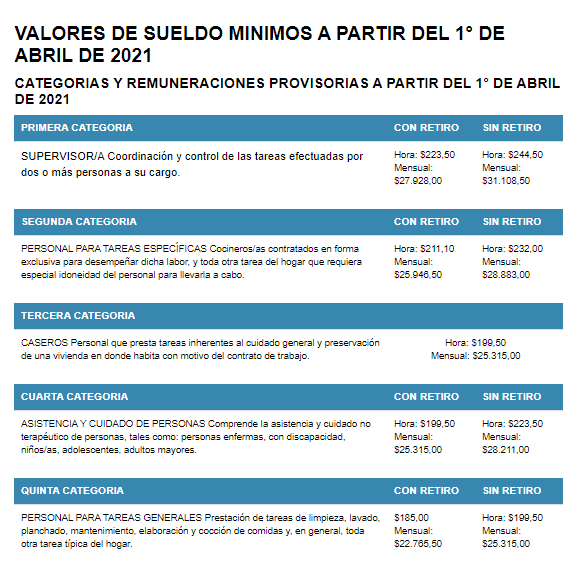
www.upacp.org.ar


However, this recognition is far from meaning the realization of their labor rights.

According to a report by the National Directorate of Economy, Equality and Gender, in Argentina, the main occupation of women is paid domestic service: it represents 16.5% of the total employment of employed women and 21.5% of wage earners. It is the most feminized activity in the market (96.5% are women), the one with the highest informality rate (72.4%) and the one with the lowest average income in the market, constituting the poorest workers of the entire economy. This means that a domestic worker earns 46 pesos for every 100 that a private sector employee receives and 30 pesos for every 100 that a formal worker receives. Compared to men, they earn 26 pesos for every 100 pesos that one of them earns. According to the ILO, this informality and precariousness generates the breach of rights and a space for labor exploitation, even of girls and adolescents.

For Candelaria Botto: “In our country, where the State does not satisfy these needs, the role of domestic workers becomes essential for a large number of households. However, this work takes place mostly in precarious conditions and with low remuneration, which shows the little social value that is given to reproductive work. ”

Even with all these limitations on access to rights, it is likely that a registered employee, whose labor relations are regulated by a legal framework, is in better working conditions.

That the autonomy of some does not take it away from others

Now, who are the women that make up this group of domestic workers?

Mercedes D´Alessandro, in her book “Economía Femini (s) ta”, affirms that the “fairy godmothers” who sustain the lives of those who inhabit the households with the highest income are women in situations of vulnerability and poverty. Many of them have dependent children and most have not been able to complete secondary school (only 2% of them completed a tertiary degree or university). As a result, 40% of poor mothers are private house workers.

They are women who need to work but are not qualified to access other types of employment. In addition, it is usually one of the first job options for women from other countries, although the percentage of internal migrants among these workers is more remarkable. Many young women see this job as a way out of poverty, but end up living in a utility room of a wealthy family that does not pay them a Christmas bonus, vacation or sick days.

At this point, it is important to think about the tense link between paid and unpaid forms of care. Given the unjust social organization that distributes care, paid and unpaid care work falls mainly on women. That is why it is always necessary for a woman to take care of, to “free” another of these tasks. And here, it is not only the stubborn persistence of the sexual division of labor that undermines advances in favor of a more just and equitable society, but it is also other factors of inequality and oppression that overlap with gender. The class and powerful processes of racialization that still persist go through caregiving.

As domestic work is, to a great extent, carried out by poor women, peasants, migrants, representatives of various ethnic groups, with low education and little education, who find in this activity a means of subsistence, it is one of the most devalued jobs not only in economic terms but also in social terms. Thus, families with higher incomes can turn to the market to free up time, which implies hiring another, poorer woman to do domestic and care work.

As D’Alessandro says: “behind every great woman, there is another great woman.”

This invites us to think about care in a feminist and intersectional way, which puts care work at the center of the scene and de-romanticizes it. Because the lack of decent wages and real access to labor rights is not compensated with gratitude and love.

As Sol Minoldo says: “How feminist can a process be in which some women emancipate themselves at the expense of others, leaving the sexual distribution of domestic work intact?

If there is exploitation, it does not stop there because the worker is treated with affection and the trust of our intimate life is opened to her, although it may be noticed a little less. It is time to question the way in which “love” has been used to make it invisible that domestic work is work, whoever does it. That love is not an excuse to deny workers their rights. ”

Although the importance of care and of those who care – especially during the pandemic – has become increasingly visible, this has not yet translated into salary improvements in the case of paid domestic and care work. We still owe a debt to the people they care for. With domestic workers, there are still huge social, cultural and economic gaps to fill. They perform essential work but in precarious and irregular conditions, with miserable wages that are barely enough for them to access the basic food basket.The gaps and obstacles that these workers face every day are an impediment to real access to their rights as workers, as women and as people.

Author

After a year of research and collective work together with the Espacio de Economía Feminista de Córdoba, we published a report that reveals the self-managed experiences of the city of Córdoba and Valle de Punilla related to Feminist Economy, Ecological Economy, Popular Economy and Social Economy and Solidarity.

“Below, we offer a google translate version of the original article in Spanish. This translation may not be accurate but serves as a general presentation of the article. For more accurate information, please switch to the Spanish version of the website. In addition, feel free to directly contact in English the person mentioned at the bottom of this article with regards to this topic”

In Córdoba, self-management, cooperative and entrepreneurial spaces made up of dissident feminities and identities have developed in recent years, starting from the visibility of the feminist struggle, and with their collective organization. Its existence, strategies and forms of organization, production and consumption, have gained essential importance in local economies, and are presented as a real alternative to the hegemonic capitalist model.

This research makes a reading from the Feminist Economy of these experiences, which allows (de) constructing practices that reproduce inequalities and violence against women and dissident sex-generic identities within the spaces in which they develop, and expand the horizon towards a socioeconomic equity that is nothing more than gender equity.

In this line, it is intended to explore, learn about and analyze various self-managed and community experiences of the City of Córdoba and the Punilla Valley, and make visible their contributions to the construction of an alternative to the neoliberal model and investigate the actions of the State in development of public policies that contribute to this alternative. The place from which this report is intended to be narrated is from the perspective of the territorialized experiences themselves in dialogue with the perspective built from a diverse interdisciplinary field full of nuances and a dynamic construction generated in the exchange of Feminist Economy with the Popular Economy, the Ecological Economy and the Social and Solidarity Economy.

To this end, together with the Feminist Economy Space and with the support of the Heinrich Böll Foundation, we interviewed 16 community organizations, cooperatives and self-managed spaces in the area. The visibility of these practices enriches the dialogue between the theoretical proposals about them and will collaborate in the construction of new knowledge. At the same time, it offers first-hand information, necessary to promote public debate on the needs, views and contributions of these organizations to economies founded from paradigms that put life at the center, instead of profit and exclusion. Knowing these experiences allows us to identify their concrete contributions to the construction and maintenance of other economies, which propose alternatives to neoliberal capitalism and hetero-patriarchy, and seek to sustain human and non-human lives.

Questions that open up others: Do community organizations and self-managed enterprises constitute an alternative to the neoliberal capitalist model?

This first approach, achieved through this research, leads us to conclude that most of the community organizations, cooperatives and self-managed enterprises interviewed constitute, or at least try to establish themselves, as an alternative to the neoliberal and heterocispatriarchal model, putting in the center the lives and care that make them possible.

On the other hand, it is shown that, in practice, and from the perspective of the organizations analyzed, the contribution of the State to the development of these alternatives is insufficient, characterized by ineffective public policies and in some cases nonexistent, in line with the role that the State is expected to occupy in a neoliberal economic model.

Se espera que el presente trabajo, aporte a la visibilización, reconocimiento y fortalecimiento de espacios autogestivos cuyas prácticas apunten a poner a la vida en el centro, desde una necesaria mirada local y a la vez crítica. Se sostiene —y en el contexto actual está evidenciado— que la sostenibilidad de la vida debe estar en el centro del debate. Se debe seguir pensando y construyendo colectivamente la economía que se desea y necesita para que todas las vidas que habitan este planeta lo hagan de una manera digna. Por esto queremos aportar a la visibilización de las organizaciones que apuestan cada día a otro mundo posible.

Together with the Córdoba Feminist Economy Space, we present a report that rereads the self-managed experiences of the city of Córdoba and Valle de Punilla related to Feminist Economy, Ecological Economy, Popular Economy and Social and Solidarity Economy.

Together with the Córdoba Feminist Economy Space and with the support of the Heinrich Boll Foundation, we carried out a cycle of 5 virtual meetings to make visible and debate the existence of other economies that put human and non-human life at the center and the care that make them possible.

“Below, we offer a google translate version of the original article in Spanish. This translation may not be accurate but serves as a general presentation of the article. For more accurate information, please switch to the Spanish version of the website. In addition, feel free to directly contact in English the person mentioned at the bottom of this article with regards to this topic”.

The Feminist Economics (FE) webinar series began on September 30 and lasted for two months. Specialists in Feminist Economy, Popular Economy, Ecological Economy and Social and Solidarity Economy participated, members of various self-managed spaces and activists who bet and work towards other economies, which replace the profit motive for the care and sustainability of human lives and not human.

The panel of the first webinar was made up of Ariana Cervantes and Vanessa Ullua (members of the Virginia Bolten Accounting Firm) and Shams Selouma from the Latin American Feminist Incubator. In that meeting, legal, tax and administrative tools were offered for self-managed and community organizations. At the same time, the Resource person Tools for self-management was presented from a perspective of sustainability of life.

The second webinar, called “Towards the sustainability of life. Dialogues between the experiences of Latin America and Spain ”, laid the foundations and theoretical guidelines of the Feminist Economy from a perspective of the sustainability of life, in order to reflect and discuss new ways of thinking and organizing work, producing, distributing and consume, that subvert the capitalist and hetero-patriarchal logic. The space sought to establish a conversation between theoretical views and experiences from Latin America and Spain. Specialists on the subject participated in this meeting: Astrid Agenjo Calderón, Patricia Laterra and Natalia Quiroga Díaz.

This meeting was followed by another that addressed the issue of care as a condition for sustaining life. In the webinar “The essential is invisible to the market. Co-responsibility, community and care ”, participated Corina Rodriguez Enriquez, Gabriela Marzonetto and Paola Bonavita, who spoke about current care policies and community care in Argentina and specifically Córdoba.

Finally, the last two webinars set out to propose and debate, from a theoretical approach first and an empirical one later, the possibilities of building and sustaining other economies that articulate the proposals of the Social and Solidarity Economy, the Popular Economy, the Ecological Economy with the Economy Feminist.

Theoretical reflections were raised in the webinar “Another (s) economy (s). Dialogues between the Feminist Economy and the Popular, Solidarity and Ecological economies ”, thanks to the contributions of Ariana Ortega and Magalí Magnani from the Ecofeminism Area of ​​the Ecologist Workshop of Rosario, Florencia Partenio, Karina Tomatis. The tensions and dilemmas, as well as the theoretical proposals raised in this meeting, were put into dialogue with self-managed experiences of the city of Córdoba, who participated in the last webinar “The other economy exists and sustains life. Conversation with self-managed and community organizations of Córdoba ”.

In this last meeting, members of the Corteza del Chañar cooperative, Wallmarx cooperative, the Textile of the Meeting of Organizations and the Cordoba Agroecological Fair participated, who shared concrete experiences that make the existence of other economies visible, glimpsing a real horizon in which these possible.

We believe, and the particular current context is showing it every day, that the sustainability of life must be at the center of the debate, that we must continue to think and collectively build what economy we want and need to sustain our lives and all the lives that inhabit this planet in a way worth living.

We know that there is still a long way to go to deconstruct and transform an economy based on a productivist logic, capital accumulation, and deterioration of the environment. That is why it becomes urgent and necessary to make visible and strengthen theories and experiences of other economies, built from self-management and from feminist debates, putting good living in focus and betting every day on another possible world.

Together with the Córdoba Feminist Economy Space and with the support of the Heinrich Boll Foundation, we carried out a cycle of 5 virtual meetings to make visible and debate the existence of other economies that put human and non-human life at the center and the care that make them possible.

“Below, we offer a google translate version of the original article in Spanish. This translation may not be accurate but serves as a general presentation of the article. For more accurate information, please switch to the Spanish version of the website. In addition, feel free to directly contact in English the person mentioned at the bottom of this article with regards to this topic”.

The Feminist Economics (FE) webinar series began on September 30 and lasted for two months. Specialists in Feminist Economy, Popular Economy, Ecological Economy and Social and Solidarity Economy participated, members of various self-managed spaces and activists who bet and work towards other economies, which replace the profit motive for the care and sustainability of human lives and not human.

The panel of the first webinar was made up of Ariana Cervantes and Vanessa Ullua (members of the Virginia Bolten Accounting Firm) and Shams Selouma from the Latin American Feminist Incubator. In that meeting, legal, tax and administrative tools were offered for self-managed and community organizations. At the same time, the Resource person Tools for self-management was presented from a perspective of sustainability of life.

The second webinar, called “Towards the sustainability of life. Dialogues between the experiences of Latin America and Spain ”, laid the foundations and theoretical guidelines of the Feminist Economy from a perspective of the sustainability of life, in order to reflect and discuss new ways of thinking and organizing work, producing, distributing and consume, that subvert the capitalist and hetero-patriarchal logic. The space sought to establish a conversation between theoretical views and experiences from Latin America and Spain. Specialists on the subject participated in this meeting: Astrid Agenjo Calderón, Patricia Laterra and Natalia Quiroga Díaz.

This meeting was followed by another that addressed the issue of care as a condition for sustaining life. In the webinar “The essential is invisible to the market. Co-responsibility, community and care ”, participated Corina Rodriguez Enriquez, Gabriela Marzonetto and Paola Bonavita, who spoke about current care policies and community care in Argentina and specifically Córdoba.

Finally, the last two webinars set out to propose and debate, from a theoretical approach first and an empirical one later, the possibilities of building and sustaining other economies that articulate the proposals of the Social and Solidarity Economy, the Popular Economy, the Ecological Economy with the Economy Feminist.

Theoretical reflections were raised in the webinar “Another (s) economy (s). Dialogues between the Feminist Economy and the Popular, Solidarity and Ecological economies ”, thanks to the contributions of Ariana Ortega and Magalí Magnani from the Ecofeminism Area of ​​the Ecologist Workshop of Rosario, Florencia Partenio, Karina Tomatis. The tensions and dilemmas, as well as the theoretical proposals raised in this meeting, were put into dialogue with self-managed experiences of the city of Córdoba, who participated in the last webinar “The other economy exists and sustains life. Conversation with self-managed and community organizations of Córdoba ”.

In this last meeting, members of the Corteza del Chañar cooperative, Wallmarx cooperative, the Textile of the Meeting of Organizations and the Cordoba Agroecological Fair participated, who shared concrete experiences that make the existence of other economies visible, glimpsing a real horizon in which these possible.

We believe, and the particular current context is showing it every day, that the sustainability of life must be at the center of the debate, that we must continue to think and collectively build what economy we want and need to sustain our lives and all the lives that inhabit this planet in a way worth living.

We know that there is still a long way to go to deconstruct and transform an economy based on a productivist logic, capital accumulation, and deterioration of the environment. That is why it becomes urgent and necessary to make visible and strengthen theories and experiences of other economies, built from self-management and from feminist debates, putting good living in focus and betting every day on another possible world.

This material is a practical resource for the basics of self-management. It is the result of debates and dialogues, loaded with great desires for social transformation (only Spanish)

On April 9, the equal pay day between men and women was established in our country. As of today, we have large gender gaps that are far from closing.

“Below, we offer a google translate version of the original article in Spanish. This translation may not be accurate but serves as a general presentation of the article. For more accurate information, please switch to the Spanish version of the website. In addition, feel free to directly contact in English the person mentioned at the bottom of this article with regards to this topic”.

Women charge less than their male peers. That is a fact. What’s more, transgender people also get even less, or are directly excluded from the labor market. On March 16, the National Directorate of Economy, Equality and Gender of the Ministry of Economy of the Nation presented the report “Gender gaps in Argentina: State of situation and challenges“. There, it is evident that the total income gap between men and women (calculated as the relative variation between the average income of men and the average income of women) is 29.0%, and it widens for female employees. informal, reaching 35.6%.

So, we can say that the same is not charged for the same tasks. But we can also ask: do we perform the same tasks as men and women? The tasks that women mainly perform within the home, and that correspond to reproductive work, have historically not been considered as such and, therefore, have not been remunerated. The incorporation of women into the labor market has not generated a fairer distribution of domestic and care tasks within the home. Women are still responsible for most of these tasks and spend almost twice as much time as men, even when they work outside their homes. Situation that deepens if they study or if they participate in spaces of activism and / or militancy. In other words, they work double and triple days, but they earn less than their male counterparts. And there the inequality appears before our eyes.

Feminisms and women’s movements and sex-gender diversities and dissidents have been thinking about these gaps for a long time. The sexual division of labor, glass ceilings and walls are some analysis tools that have been developed to understand this unequal reality. To understand and transform it.

Today, the idea persists that women have a natural instinct to care. Jobs that involve care and are mostly performed by women are the worst paid. Gender stereotypes are in order in job interviews, tenders, and promotion and responsibility decisions. Men are not obliged to reconcile their life at home with work outside of it, women are. Women see their possibility of training, improvement and job promotion diminished (a phenomenon called the “glass ceiling”) in the years they have children in their care. Boys don’t. The law grants women longer work licenses to care for sons and daughters. But far from being a privilege, the latter not only results in discrimination when hiring or considering a woman for promotion. It also reinforces the stereotypes of a mother woman and a father only as a provider for a typical family, which should not take care of children under their responsibility.

Women not only earn less, but are forced to spend more. There is what is known as the “tax pink”. The market offers products that are directed towards women and that are ostensibly more expensive. These products range from a deodorant, a razor to a medicine, such as ibuprofen “fem”. However, they fulfill the same functions as for men. There is no factual difference to support a different price. Only stereotypes that oppress and harm women culturally and economically are reinforced. Likewise, the sexual and (non) reproductive health of cis women, trans people and any menstruating body is affected with the absence of public policies that transform free access to elements for menstrual management into a right.

Particularly, within the current conjuncture of the Covid-19 pandemic, it can be considered a hinge, break moment in global society. Not only in the ways of functioning of the economy and the way of executing the different interpersonal relationships, but, in turn, the veil is drawn on the multiple tasks of care performed by women. These are unpaid work. Thanks to this, it is that the man can enjoy a great wealth of time that allows him to train, get better jobs and have time for leisure.

All this reinforces the inequality that doubly affects women. First, because they work for their families for free, given the naturalization of this work due to the requirement of gender stereotypes. And second, they are subtracted from the time to access, like the men, spaces for training, leisure and self-care.

Along these same lines, we must not forget that the World Health Organization considers gender violence as a social epidemic. The Observatory “Women, Dissidence and Rights” of the Women of the Latin American Matria-MuMaLá reported that since March 12, the day the first measures of social isolation began, as of April 3, 15 femicides were registered.

Lastly, we celebrate the preparation of the report on gaps by the National Directorate of Economy, Equality and Gender of the Ministry of Economy and we urge the State and the private sector to produce and put into action, together with civil society, public policies tending to close gender gaps. This can only be achieved with the elimination of gender stereotypes, inclusion in the measurements of LGBTIQ + people, analysis of the economy with a gender perspective, democratization of care and the participation of women, gender and diverse and dissident sexes in the elaboration and decision making on those policies.

Authors

  • Ivana Sanchez
  • Constance Attwood

Contact

Durante los días 6 y 7 de Septiembre se desarrolló en la Facultad de Ciencias Económicas de la UNC la XII Jornada de Economía Crítica y la I Jornada de Economía Feminista

“Below, we offer a google translate version of the original article in Spanish. This translation may not be accurate but serves as a general presentation of the article. For more accurate information, please switch to the Spanish version of the website. In addition, feel free to directly contact in English the person mentioned at the bottom of this article with regards to this topic”.

During the First Feminist Economy Conference, in which different themes related to feminist perspectives of the economy and the main issues of women in the current system were presented, we present the work “Care and (equal) opportunities for women in media companies and advertising agencies. ”The presentation analyzed the impact of care tasks on women workers in these sectors in Buenos Aires and Córdoba.

The work was based on research “Media organizations and gender: Equal opportunities for women and LGBTQ + people in companies, unions and universities” and “Advertising sector and gender: Advertising agencies, associations, unions and educational institutions analyzed with a feminist perspective ”That we carry out together with the Civil Association Communication for Equality with the support of the Heinrich Boll Foundation. One of the relevant points of the research focuses on the analysis of the distribution of care tasks.

According to official data, 88.9% of women participate in unpaid household chores, to which they dedicate 6.4 hours a day, while 57.9% of men declare having done them for a total of 3.4 hours . These figures show the rigid sexual division of labor that affects the professional development of women compared to their male peers. This reality is reproduced in all work areas and advertising agencies and media organizations, objects of our research, are no exception.

This prevailing inequality is, in turn, the product of the absence of public and / or business policies to mitigate the impact. According to the data investigated, in the media companies of Córdoba, the number of women hired under a fixed term, part-time or who are monotributistas, in relation to the total number of women is 10% higher than men, and the percentage of women who enter the media through internships is 57.14% more than men. This data includes the general picture that affects women (and diverse and dissident identities) in terms of their precariousness and job instability.

Surprisingly, the advertising industry shows a high percentage of hiring in dependency ratio (90%) and full time. Contracts with freelance mode or under the monotax regime, as well as part-time ones, are recorded in a low proportion. However, the home work format is identified on a small scale and is never formalized. In this sense, it is important to highlight how the implementation of this type of work is linked to care tasks. Well, although they are proposed as positive forms of labor flexibility, they result in precarious ways that mainly affect women, since it allows them to “reconcile” this work with the domestic one.

In view of this unfavorable panorama, the care policies in force in both industries reproduce the imbalances that exist at a general level in their allocation and distribution, especially affecting the autonomy of women, reducing their opportunities for professional development, becoming a fundamental factor in the perpetuation of gender gaps. This is because they reproduce the sexual division of labor and cover only women workers in a dependency relationship. This becomes problematic if we remember that it is women who have a higher rate of labor informality.

Both in media companies and in advertising agencies, the measures taken in relation to care are limited to following the provisions of the law, such as the granting of licenses, especially to women mothers during the early childhood of their children . However, we notice poor compliance with policies such as lactaries and nurseries. There are policies developed by companies that compensate for non-compliance with regulations with specific and informal reconciliation practices with different levels of flexibility. Some of them, we could consider them as exceeding the law, such as specific licenses, possibility of working from home or flexibility in the time of entry and / or departure, extension of the license without pay or the progressive reinstatement with enjoyment Of salary. In this context it is worth mentioning that, although these initiatives exist, some of them, such as home office, are scarce and respond to specific requests of each worker, with the majority being women who request them. After having participated in the historic first Feminist Economy Day in Córdoba, we celebrate the realization of these meetings where it is possible to rethink, discuss and deconstruct, from feminist currents, economic inequality, inequality of opportunities, discrimination and sexual division of job.

Authors

Ivana Sánchez and Luz Baretta

Contact

Cecilia Bustos Moreschi