Feminist economics as a tool for change: life at the center
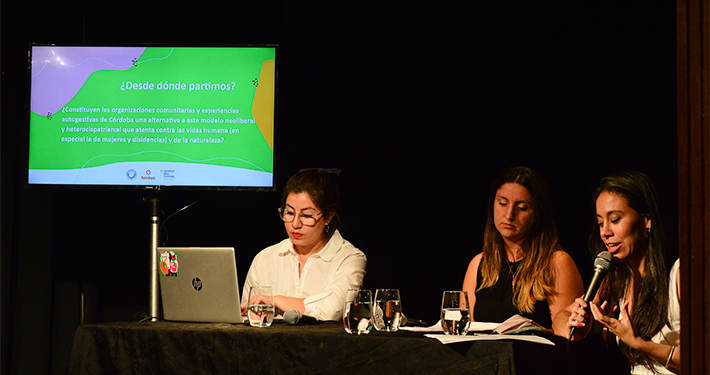
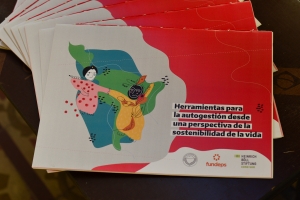
On December 1, we presented the report “Other economies: self-management from a perspective of Sustainability of Life” together with the Feminist Economy Space of Córdoba and with the support of the Heinrich Böll Southern Cone Foundation. It was a year-end meeting in which we reflected on feminist economics and self-management together with various organizations.
“Below, we offer a google translate version of the original article in Spanish. This translation may not be accurate but serves as a general presentation of the article. For more accurate information, please switch to the Spanish version of the website. In addition, feel free to directly contact in English the person mentioned at the bottom of this article with regards to this topic”.
In the world in which we live, unjust logics of production, work organization and distribution of wealth predominate. They are founded on a neoliberal, colonial and hetero-patriarchal capitalism that legitimizes and sustains inequalities that benefit a few: a male, white, adult, bourgeois, Western, hetorosexual, cisgender around which the entire economy has been organized.Faced with this model that prioritizes markets and the unlimited accumulation of wealth in a few hands, the Other Economies arise. These are constituted, in different measure and form, in real alternatives, and are visible in self-managed organizations of the Feminist, Popular, Ecological, Social and Solidarity Economy. They are characterized by having practices based on mutual support; solidarity and sisterhood; collective support and cooperation; the valuation not only of productive work but also of the work of social reproduction and of life, the recognition of its indivisibility and of its historical feminization and invisibility; the inclusion and care of the life of its members and of nature, avoiding individualistic, selfish and competitive logics that threaten life.
With this north, as of 2020 we have carried out different activities together with organizations and spaces that are committed to a socioeconomic transformation.
2020 was a year of hard work, together with the Córdoba Feminist Economy Space, focused on the production of knowledge based on self-managed experiences and content aimed at making them visible. As a result, we produced the report “Other economies: self-management from a perspective of Sustainability of Life”. We also carry out a cycle of virtual meetings on Feminist Economics in which we reflect, together with organizations and specialists, on the obstacles and possibilities of carrying out and strengthening other logics of production, distribution, consumption and organization of work that are more equitable and focused on persons.
In addition, we built a resource with legal, administrative and tax tools for self-management and four audiovisual shorts. This year, together with the Latin American Feminist Incubator, we carried out a process of internal strengthening of 7 self-managed organizations of the Other Economies of the province of Córdoba, in order to build tools that serve them to advance towards their economic sustainability from a perspective of the Feminist Economics. This implies thinking, building and planning strategies so that, with the available resources, the spaces can carry out sustainable economic processes in the medium and long term, considering and respecting the times of nature as well as the times and needs of its members and of the communities in which they are found.
The event
On December 1, we met to present the aforementioned report “Other economies: self-management from a perspective of the sustainability of life.” This report is the product of a year of research carried out in the middle of the pandemic. Its objective is to begin to know and make visible a small part of the diverse universe of self-managed and community experiences of Córdoba, from the critical perspective that the Feminist Economy offers us, in dialogue with the Popular Economy, Ecological Economy and the Social and Solidarity Economy. That is, from a perspective that aims to subvert the economy and build another that guarantees the provision of everything that is needed for the sustainability of human and non-human life, through economic processes that preserve the planet and are respectful of dignity. human. This approach is that of the Sustainability of Life and we adopt it because it is multidimensional, holistic since it integrates all sustainability: economic, social, ecological, human and the complex and dynamic interrelationships that occur between all of them over time and in specific territories and experiences.
We believe that this perspective has transformative power by allowing us to identify, on the one hand, unequal relations, such as gender, class, racialization processes, among others, which are sustained from biocidal and androcentric logics. But on the other hand, it also helps us to recognize other types of experiences that carry out practices different from those of the dominant economy and that respond to logics typical of Other Economies.
From this place, we understand that the Feminist Economy appears to us as a necessary perspective to think, develop and strengthen alternatives in favor of the sustainability of life since:
- It opens the debate around what are the limits of what we understand by economy, the role of gender in it and the consequent inequalities.
- It broadens the concept of work and recognizes the importance of the works that make up the social and life reproduction, In this way it makes visible and puts at the center of the scene the care that makes life possible, proposes its fair distribution, at the same time that conceives us as interdependent people with each other.
- It questions the foundations of the sexual division of labor.
The report that we present is a synthesis that includes our positioning and also the lines of action in relation to the Feminist Economy agenda that we are building. Agenda that we conceive as strategic and transversal to all of Fundeps since it touches and problematizes all aspects of our life; and from which we generate and strengthen alliances and joint work networks.
- See the presentation of the report: “Other Economies: self-management from a perspective of the Sustainability of Life“
The sustainability of life as a path of transformation
We believe that this type of self-managed experiences can provide us with tools and practices to resolve in a more equitable way the inequalities that are sustained at the cost of the invisibility and exploitation of bodies and lives, mainly of feminized identities and sex-generic dissidences, which are deepened in this context of crisis that we are experiencing: climate, health, social, economic, civilizational and care crisis.
Its existence, strategies and forms of organization, production and consumption, have acquired essential importance in local economies, and are presented to a greater or lesser extent and in different ways, as a real alternative to a system based on violence, oppression , impoverishment and in gender, class, ethnic-racial, age, etc. inequalities.
This does not happen without tensions or nuances since there are different positions and actions taken by these spaces in relation to the State and the predominant capitalist logic. The universe of self-management is extremely broad and heterogeneous. These spaces, like any other, are not exempt from the logic of structural inequality that can even be reproduced inside. However, they have favorable conditions to carry out various practices oriented to the Sustainability of Life, by subverting these situations of looting and inequality.
If we want a democratic and more equitable solution, a transformation, a paradigm shift and a system change that recognizes and strengthens self-managed spaces with the logic of Other Economies that undertake feminized identities and dissidents is urgent and necessary, so that their lives and of their communities are dignified and sustainable. This implies a commitment to profoundly transformative proposals that commit all social actors.
For this, the articulation of local and regional initiatives that aim to this end, and that allow the generation of data, information gathering, visibility, organization, articulation and enhancement of their activities is relevant. We know that what sustains us are networks, so let’s expand, enhance and strengthen them.
Contact
Cecilia Bustos Moreschi, cecilia.bustos.moreschi@fundeps.org