We received a response from the Public Defender’s Office regarding the claims of symbolic and media violence carried out on the Los Angeles de la Mañana program on Channel 13 and the journalist Fabiana Dal Prá on the central noon newscast on Channel 12 in Córdoba.
“Below, we offer a google translate version of the original article in Spanish. This translation may not be accurate but serves as a general presentation of the article. For more accurate information, please switch to the Spanish version of the website. In addition, feel free to directly contact in English the person mentioned at the bottom of this article with regards to this topic”.
Chimentos format and forced exposure
In the program Los Ángeles de la Mañana on Channel 13 on July 23, journalist Yanina Latorre told on the air that Karina Jelinek “does not whitewash her partner”, and that “she lives as a couple, with a very pretty girl” “They live together and are cuddly”, to which he added many other expressions referring to his private life. Later, a female worker claimed that Karina did not want to talk about her relationships and that she had declared that she was alone.
This type of “gossip” and content are very frequent on television, where the high exposure of famous women always leads to their private life and sexuality being exposed. However, an analysis of the case was requested by the Public Defender’s Office since it concerns the sexual orientation of a person who did not want to be exposed.
Faced with this claim, the Ombudsman’s Office responded by justifying and endorsing the dynamics that occurred in the program, through the argument that the reading and interpretation framework in which news related to the private life of public persons are presented responds to the magazine genre of shows. In the programs of this format, according to the Ombudsman’s Office, color “chimentos” are presented, firsts of the public and private life of entertainment figures, alluding, many times, to the fact that the media do not want data about them to be mediated . That is to say, the negative position of the figures works as the trigger for a chain of situations that transcend the broadcast, expanding on the rest of the television programs related to the genre: someone announces a scoop, the famous referrer gets angry in that or another program and interviews are carried out, among other variants provided by the format.
In this framework, the Directorate understands that the information offered by the panelist [Yanina Latorre] as a scoop, integrates the expected repertoire of possibilities that the program format enables ”.
Following this, the agency affirms that the program does not identify comments of a burlesque or discriminatory tone regarding Jelinek’s sexual orientation, but quite the opposite: “Likewise, it is observed that the comments and evaluations expressed are inserted in a framework of respectful communication of gender and sexual diversity and this approach is fostered throughout the development of the topic and by the host and all the panelists. Similarly, the dissemination of positive expressions and evaluations on the subject abounds, which contributes to questioning and de-constructing binary and stereotyped conceptions about affective relationships and a respectful visibility of diversity. “
Based on these arguments, the Ombudsman’s Office considers that the situation described does not enable an intervention in terms of violation of rights.
However, we understand that the institution must advance in deeper analyzes regarding the consent that is taken for granted about the exposure of the lives of public figures, as well as the objectification and fetishization of feminities and their sexual orientations.
The gossip format, like humor, seems to be a gray space where certain speeches are enabled that can be offensive and even violent, particularly towards the lives of LGTBIQA + people.
Without ignoring the importance of protecting the privacy of all people, it is necessary to recognize that it is not the same to speak and expose the sex-affective bonds between people who adhere to the heteronorm than those who do not, precisely because of the implications they have for their lives that pass in a heterocispatriarchal world.
In turn, the comments of the panelists involve the objectification of two women and their sexual orientation, which is evident in the comments of the panelist Yanina Latorre: “I love it”, “they tell me that it is a couple . It’s great. All good ”,“ well, we are glad ”,“ not bad. It gives me divine joy. They are both beautiful ”,“ you know I was looking at her to see what it would be like to be with her, I tell you she has divine tits ”.
Finally, why assume the supposed consent of public and media people to be exposed in all areas of their life? We are concerned about the interpretive framework used by the Ombudsman’s Office since it legitimizes the logic of these magazines, which imply a denial of the consent of public figures, which ignores what Jelinek said about not wanting to talk about his private life and which may have particularly violent implications when refer to your sexual orientation.
The Ombudsman’s Office in the media approach to cases of physical and sexual violence
Let us remember the interview conducted by the journalist Fabiana Dal Prá with a rape victim. “Do you blame yourself for something?” Dal Prá asks after Dahyana, the young woman from Cordoba who was sexually attacked in Barrio Ampliación Las Palmas, recounted her painful experience.
The claim presented to the Ombudsman’s Office was responded favorably by the agency: “This approach proposes a risky interpretative framework for the facts, since by insinuating the possible guilt of the victim (even under a discursive modality of interrogation and not of explicit affirmation) it promotes the legitimation and naturalization of the acts of violence suffered ”. At the same time, it highlights the need and responsibility of those who communicate, to dismantle and eradicate violent coverage that reproduces “the guilty and naturalizing senses that those who exercise violence often express as reasons for the causality of the facts. It is important that those who communicate emphasize that all the reasons and the responsibility lies with the person who carries out the violence ”.
At the same time, the analysis of the institution revealed inconveniences at the time of safeguarding the identity of the person in a situation of violence and the absence of a badge with the 144 telephone line for assistance to victims of gender violence.
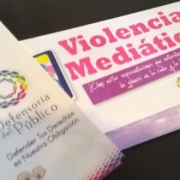
In this case, the Ombudsman’s Office recognizes that the situation presented corresponds to a case of symbolic and media violence, for which it proceeded to communicate the claim to Channel 12 and made itself available to dialogue with the channel in order to “enrich, from a rights perspective, future approaches of the station. “
The importance of the Public Defender’s Office for the eradication of gender violence
In May of this year, Miriam Lewin was appointed as Public Defender of Audiovisual Communication Services, after years of weakness and institutional weakness. This appointment has meant the strengthening not only of the Public Defender’s Office, but also an advance in the recognition of the rights of audiences as well as a renewed impetus in the fight against media and symbolic violence.
The responses received by the Ombudsman’s Office to the claims presented, in which the procedure for receiving, analyzing and returning them is clarified and made visible, indicates an important activation of the institution in pursuit of the defense of our rights.
Based on these claims, we celebrate the responses and actions of the Public Defender’s Office and, in turn, we require that progress be made in deeper and more enlightening interpretations of cases of symbolic and media violence.
More information
- Blame it on the media | Fundeps – July, 2020
- The show of violence | Fundeps – September, 2015
- Available?: Report to Arriba Córdoba on Channel 12 for media violence | Fundeps – September, 2018
- The Morning Show again incurred media violence | Fundeps – January, 2019
Contact
Cecilia Bustos Moreschi, cecilia.bustos.moreschi@fundeps.org