We participated in COP2 of the Escazú Agreement
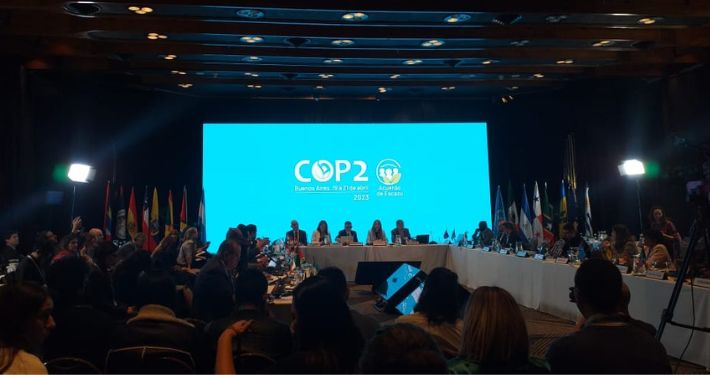
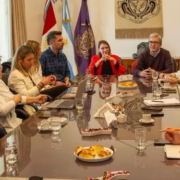
On April 19, 20 and 21, we participated in Buenos Aires in the Second Conference of the Parties to the Escazú Agreement (COP2), of an extraordinary nature. The main objective was to elect the first members of the Support Committee for the Application and Compliance of the treaty, a body that will accompany the countries in the implementation of the Agreement.
“Below, we offer a google translate version of the original article in Spanish. This translation may not be accurate but serves as a general presentation of the article. For more accurate information, please switch to the Spanish version of the website. In addition, feel free to directly contact in English the person mentioned at the bottom of this article with regards to this topic”.
During those days, continuity was given to the work that had begun a year ago at COP1 in Santiago de Chile, where it was agreed to hold the extraordinary meeting of 2023 in order to reach certain “agreements” between the member countries that allow the effective application from Escazú as soon as possible. In this sense, different discussions took place around the existing challenges to strengthen access to information, public participation and access to justice in environmental matters.
The official Conference was held in the rooms of the Hotel Libertador and in parallel there were also a series of talks, workshops and meetings organized by the Ministry of the Environment and Sustainable Development of the Nation in conjunction with civil society organizations. civil. The parallel events were enriching since there were exchanges of experiences, knowledge and knowledge regarding the implementation of the Agreement in the different countries.
On the second day of the COP, the Economic Commission for Latin America and the Caribbean (ECLAC) presented the Implementation Guide, which provides information, guidance and different options for States to carry out the Agreement. pointing out Secretary Carlos de Miguel pointed out that “Escazú must be interpreted in an integral way, with a holistic approach and in good faith.” Some States also presented their implementation plans, Argentina communicated the actions that are being developed within the framework of the Fifth National Action Plan for Open Government.
However, the most significant exchanges and interventions occurred when addressing the Action Plan for Environmental Defenders, an instrument that will allow progress towards the full and effective implementation of Article 9 of the Agreement, which establishes that each State party must guarantee a safe environment for people who defend rights in environmental matters. This is essential since Latin America and the Caribbean are more dangerous regions for environmental defenders. There, the original peoples were the protagonists by manifesting the entire path that remains to be traveled and the innumerable existing needs, among them, having effective participation in environmental protection and justice measures, according to their realities.
The defenders of the province of Córdoba were also able to express their claims through the voice of a neighbor who was a member of Vecinxs Unidxs del Barrio San Antonio, who expressed the serious situation of the defenders who were charged with the cause of the Punilla Highway and the conflict with the company Porta Hnos, among others.
In addition, the defenders put on the table the need for the Agreement to contain a gender perspective. In this sense, they stated that it is necessary to make visible the differentiated risks that women defenders have, to vindicate and make visible the role of women as defenders of life and the environment.
Regarding the election of the Support Committee for the Application and Compliance with the Treaty, the States Parties were in charge of electing the seven members of this new instance: Andrés María Napoli (Argentina), Guillermo Eduardo Acuña (Chile), Mariana Blengio Valdés (Uruguay), Rita Leonette Joseph-Olivetti (Granada), Patricia Madrigal Cordero (Costa Rica), Carole Denise Angela Stephens (Jamaica) and Félix Wing Solís (Panama). For the election, criteria of experience in the subject, geographical distribution, gender parity and legal trajectory were taken into account.
The preparation of an Action Plan that establishes protection standards for human rights defenders in Environmental Matters in Latin America and the Caribbean was also presented. This plan is made available and considered through a Public Consultation available until June 21 on the ECLAC website.
It is essential to note that citizen participation, one of the strengths of the Escazú Agreement, has been a matter of discussion since the beginning of the conference, since many people could not participate in the event due to the accreditation system for official activities. We must express our annoyance and concern in this regard, given that many defenders were unable to enter the sessions even when there was space in the room. On the other hand, we welcome Brazil’s commitment to be part of the Agreement in the short term, and we urge the other States of the region to ratify it.
We highlight, once again, that Escazú constitutes an essential tool for the protection of the environment in the region, strengthens the work that local communities are carrying out and provides concrete tools to achieve the human right to a healthy environment. For these reasons, we consider it essential that spaces for discussion continue to be generated and fostered so that the Agreement is implemented as soon as possible in all the countries of the region.
More Information
- The concrete results of COP 1 of the Escazú Agreement
- Rights in the Escazú Agreement
- Representatives of the public will be elected under the Escazú Agreement
Authors
Ananda Lavayén
Carrizo Maria Laura
Contact