• ES
  • EN
Fundeps
  • About Fundeps
  • Team
  • Working areas
    • Environment
    • Democracy
    • Gender
    • Global Gorvernance
    • Health
  • News
  • Publications
  • DONATE
  • Click to open the search input field Click to open the search input field Search
  • Menu Menu
Global Governance, News

Effective access to reparation measures at the center of the debate of the 6th United Nations Forum
“Below, we offer a google translate version of the original article in Spanish. This translation may not be accurate but serves as a general presentation of the article. For more accurate information, please switch to the Spanish version of the website. In addition, feel free to directly contact in English the person mentioned at the bottom of this article with regards to this topic”


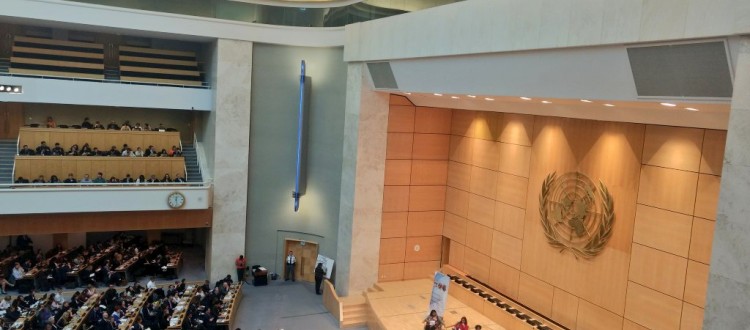
Like every year, during the month of November, the United Nations Forum on Human Rights and Business is held in Geneva. Whenever this event takes place, a particular theme is designated that will be the protagonist. This year, this theme has to do with: ‘access to repair mechanisms’.

The umbrella that protects this high-level meeting is subject to the United Nations Guiding Principles on Business and Human Rights. These Principles constitute the current tool to regulate the actions of national and transnational companies regarding human rights. They were born with the academic John Ruggie and were adopted by the United Nations in 2011, by the Human Rights Council, through resolution 17/4. The objectives of the Board at that time were: identify and clarify corporate responsibility standards; and clarify the role of states. To this end, the established guidelines were divided into three fundamental pillars: the duty of the State to protect human rights, the responsibility of companies to respect human rights and access to redress mechanisms.

The mandate of these guiding principles is to “reduce as much as possible the negative impacts of business on human rights in a short period of time“. They also have general characteristics: (a) they cover all States. (b) they cover all companies, of all sizes, in all sectors and in all countries. (c) identify different but complementary responsibilities between States and companies. (d) they do not create new legal obligations, they elaborate based on existing obligations and best practices for States and companies. (e) are based on the idea that it can not be compensated: positive impacts do not compensate for negative impacts on human rights elsewhere. (f) they are a mixture of regulatory and voluntary approaches.

The context that gave birth to these principles is not different from that of today. The actions of the companies (even after the adoption of the principles) and their consequences, continue to show that national and international regulatory frameworks have not met the objective of protecting human rights. During 2016 we have witnessed the largest massacre of human rights defenders. Around the world, vulnerable communities have been violated their rights (housing, health, life, a healthy environment, among others) because of the actions of companies and corporations.

This situation has shown that the guiding principles have not yet managed to become an effective preventive framework regarding human rights violations due to corporate actions. In this sense, it is understandable why in the session of the Forum this year 2017 has focused on access to reparation. This third pillar refers to the existence of effective remedies for victims of human rights violations. At the state level, it is expected that States take appropriate measures to investigate, punish and repair. On the part of the corporations, the principles encourage the existence of early warnings that identify negative impacts and allow resolving complaints before the situation escalates to more damaging scenarios.

Since DD.HH. are currently at the mercy of business activity, the role of the States becomes fundamental. Specifically in regard to the strengthening of regulatory frameworks at the domestic level. For this, an essential part of the obligations of the States has to do with: ensuring access to judicial and non-judicial mechanisms; and reduce the obstacles to access to justice. In this regard, it is necessary to emphasize that non-judicial mechanisms play a very important complementary role. Some of them include: State mechanisms, national human rights institutions, ombudsmen, complaints offices, National Contact Points (OECD), among others.

The application of the guiding principles by the States has been given through the form of National Plans of Action. It is expected that these plans will be constituted as instruments that:

– Promote greater coordination among government agencies with direct involvement in business issues and human rights.

– Promote the protection of human rights through due diligence in companies.

– Identify national priorities regarding this topic and translate them into concrete public policies

– Ensure monitoring and evaluation of the implementation of the plan, in a continuous manner.

– Are based on a platform of continuous dialogue with all the actors involved (government, companies and civil society)

– Possess a flexible format for cooperation, coordination and international exchange of good practices and lessons learned.

– Strengthen regulations at the domestic level.

The result of the development of these plans around the world leaves much to be desired. There are still many States that have not embarked on this process and those that have done so have not succeeded in having their plans promote a framework strong enough to respect, protect and / or remedy.

The situation of widespread vulnerability to this problem has raised doubts about the effectiveness of the guiding principles, and a process to create a legally binding instrument has been developed at the same time. During the Forum, it is expected to debate about the roles that the principles and the binding treaty would occupy. Although opinions are divided (between those who support one initiative or another) it is necessary to clarify that the principles and the treaty are complementary. A binding instrument is a step forward with respect to the guidelines. To achieve this progress it is necessary to protect the autonomy of the process of construction of the treaty since, in short, this initiative would give greater impetus to the guiding principles, and would give greater and better content to the action plans.

More information

– Advancing towards a binding treaty on transnational corporations and human rights

– Discussions in Argentina regarding a business treaty and human rights

– We participate in the second regional consultation of ECLAC on human rights and companies

Author

 Agustina Palencia, agustinapalencia@fundeps.org

Contact

Juan Carballo, juanmcarballo@fundeps.org
9 de December de 2017
Tags: Global Governance, Human Rights and Companies
Share this entry
  • Share on Facebook
  • Share on X
  • Share on WhatsApp
  • Share on LinkedIn
  • Share by Mail
https://fundeps.org/wp-content/uploads/2018/01/ds_1-1.jpg 330 750 Fundeps.org https://fundeps.org/wp-content/uploads/2026/04/logo-2026-300x120.png Fundeps.org2017-12-09 23:58:412024-06-30 16:03:11Effective access to reparation measures at the center of the debate of the 6th United Nations Forum
You might also like
Argentina en el AIIB Argentina in the AIIB
We make comments and observations on the IDB’s Environmental and Social Policy Framework from a gender perspective
Fundeps host the International Advocates Working Group (IAWG) Retreat
Trunk gas pipelines: we make requests for information from agencies in the province of Córdoba
A Key Year for the Transparency in BNDES
Latin American organizations urge the Asian Bank to fulfill its commitment to sustainable development.
Advances and challenges at the Villa Carlos Paz Environmental Center Project
More than 100 organizations are calling on EITI to publish environmental information

Tags

Access to Information Access to Justice BID Chinese Investments Citizen Participation Democracy ENTs Environment Environmental Democracy Gender Global Governance Health Healthy nutrition IFIs Infrastructure Financing Legal Interruption of Pregnancy Sexual and Reproductive Rights Social and Environmental Standards Tobacco Control Transparency
See all tags

Acuerdo de Escazú

Emergencia Agroquímica

MOCI - monitoreo ciudadano en proyectos de infraestructura

{el entramado} Contamos historias. Acercamos Realidades.

Instagram

fundepsargentina

Trabajamos para que se garanticen los derechos humanos 🌱⚖️🗣️🌈💜🚭🍎
Promovemos la equidad de #genero, el derecho a la #salud y un #ambiente sano.

La Legislatura de Córdoba otorgó a Fundeps un bene La Legislatura de Córdoba otorgó a Fundeps un beneplácito por el Tercer encuentro Redes de compromiso y cuidados: “Acceso a la salud sexual integral. Debates urgentes”. El encuentro se realizó el pasado 20 de junio y reunió a más de cien profesionales de toda la provincia.

La mención (aprobada por unanimidad) fue iniciativa de la Legisladora Karen Acuña, en coautoría con las legisladoras Silvina Jurich, Ariela Szpanin, Doris Mansilla y Julieta Rinaldi. La misma expresa: “iniciativas con estas características, impulsadas por organizaciones de la sociedad civil, resultan fundamentales para fortalecer la protección y el ejercicio efectivo de los derechos ciudadanos, al tiempo que contribuyen a la construcción de una sociedad más justa, inclusiva e igualitaria".

Recibir este reconocimiento nos llena de orgullo y fortalece sin dudas los vínculos y el camino conjunto en pos del acceso a derechos en nuestra provincia.
Este viernes 31 de julio realizamos un nuevo encue Este viernes 31 de julio realizamos un nuevo encuentro de formación en derechos sexuales y (no) reproductivos. 

En articulación con el Consultorio de Salud Integral y con el aval de la DAJA, compartimos la jornada de capacitación con profesionales del Hospital Vicente Agüero de Jesús María.

Más de 15 profesionales de diversas disciplinas se dieron cita, para conocer diferentes aspectos de la práctica de AMEU y fortalecer su trabajo diario, en pos del acceso al aborto legal, seguro y gratuito.

Como en cada instancia, celebramos el compromiso de cada participante y agradecemos especialmente a la Dra. Kenia Torres y al Director del Hospital, Dr. Javier Díaz, por la predisposición para recibirnos.
La información como herramienta ya está disponible La información como herramienta ya está disponible en Aprender con Fundeps.

Aprendé a ejercer el derecho de acceso a la información pública y a usarlo para defender derechos, monitorear decisiones e impulsar procesos de incidencia.

En este curso vas a aprender:

📌 Cómo hacer solicitudes de acceso a la información pública.
📌 Qué hacer cuando un organismo no responde.
📌 Cómo acceder a información sobre proyectos financiados por organismos internacionales.

💻 Curso virtual, gratuito y autoadministrado.
🔗 Inscribite en aprender.fundeps.org
🌎 Hace un año, la @corteidhoficial emitió su histó 🌎 Hace un año, la @corteidhoficial emitió su histórica Opinión Consultiva sobre la emergencia climática.

✊ Una victoria para quienes defienden el ambiente en América Latina y el Caribe: la Corte confirmó que proteger a las personas defensoras del ambiente no es opcional. Es una obligación legal.

⚖️ Para explicar qué exige esa protección, la Corte se apoyó en el Acuerdo de Escazú. Resultado: la gran mayoría de Estados de América Latina y el Caribe no pueden ignorar los estándares de Escazú, incluso si aún no han ratificado el tratado.

🔎 La implicación es clara: los países de la región deben fortalecer el acceso a la información, la participación pública, la justicia ambiental y la protección de quienes defienden el ambiente. 

📝 La Opinión abre nuevas rutas para frenar la criminalización de personas defensoras, responder a las restricciones al espacio cívico y defender la participación pública en países como Costa Rica, Guatemala y Perú. Compartimos el análisis de  @manizalmigrante del @ciel_org

📣 La discusión ya no es si los países de América Latina y el Caribe deben proteger a quienes defienden el ambiente. Eso ya está claro. Ahora hay que usar la Opinión: en tribunales, reformas, debates públicos y procesos de movilización para exigir mejores garantías y mayor protección.

🔗 Lee el análisis completo en el link en www.ciel.org/corte-idh-escazu-personas-defensoras/
Follow on Instagram

Twitter

Tweets por @fundeps

Newsletter Subscription

    Fundeps. Córdoba (CP X5000JZH), Argentina. info@fundeps.org
    • Link to X
    • Link to Facebook
    • Link to Instagram
    • Link to Mail
    • Link to Youtube
    • Link to LinkedIn
    • Link to TikTok
    Link to: Regional meeting of OGP Americas: the open government honeymoon has ended Link to: Regional meeting of OGP Americas: the open government honeymoon has ended Regional meeting of OGP Americas: the open government honeymoon has ended Link to: China-Argentina relations under the Macri administration: do we change? Link to: China-Argentina relations under the Macri administration: do we change? China-Argentina relations under the Macri administration: do we change?
    Scroll to top Scroll to top Scroll to top