Historic: The Inter-American Court recognizes the human right to a healthy climate

Advisory Opinion 32-25 of the Inter-American Court of Human Rights (IACtHR) established the scope of States’ obligations in protecting human rights in the face of the climate emergency. It was issued in response to the request made by Chile and Colombia and was the most participatory process in the history of the institution. Along with other civil society organizations, we contributed arguments that are now reflected in this historic ruling.
On July 3, 2025, the Inter-American Court of Human Rights (IACtHR) published Advisory Opinion 32-2025 on the climate emergency and human rights, recognizing the right to a healthy environment and climate, the rights of nature, the climate emergency, and States’ obligations in that regard.
This Advisory Opinion was issued in response to a request from Chile and Colombia for the Inter-American Court to clarify the obligations of States in the face of the climate emergency within the framework of international human rights law.
What is an advisory opinion?
An Advisory Opinion is the means by which the Inter-American Court of Human Rights responds to inquiries from member States of the Organization of American States (OAS) regarding the compatibility of domestic norms with the American Convention on Human Rights; and the interpretation of the Convention or other treaties related to the protection of human rights in the Americas.
Why is Advisory Opinion 32-25 important?
Advisory Opinion 32-25 explicitly recognizes the climate crisis and frames it within the context of a “triple planetary crisis” caused by the interconnected and reinforcing effects of three concurrent phenomena: climate change, pollution, and biodiversity loss. In the Court’s words, this triple crisis “threatens the well-being and survival of millions of people around the world.”
It notes that the magnitude of climate change impacts is undeniable, interconnected, and rapidly evolving. The Court places special emphasis on the disproportionate impact of the climate crisis on people in vulnerable situations: “The poorest and most unequal regions of the world are more vulnerable to experiencing the most severe consequences of climate change precisely because their livelihoods are more climate-sensitive, they have fewer resources and less capacity to cope with these consequences, have limited access to basic services and resources, often face greater governance challenges, and are more likely to experience violent conflict.”
Based on this, the Court concludes that this climate emergency can only be adequately addressed through urgent and effective mitigation and adaptation actions and a shift toward sustainable development, articulated with a human rights perspective and grounded in the paradigm of resilience.
In this regard, the Court sets out a series of obligations for both States and businesses, while also recognizing the rights of citizens. These obligations are organized around four main pillars:
-
Human rights obligations in response to the climate crisis
The Court states that States must take all necessary measures to reduce risks related to climate degradation and its consequences. To do so, they must act with reinforced due diligence, which includes: identifying and assessing risks; adopting proactive and ambitious preventive measures to avoid the worst climate scenarios; using the best available science in the design and implementation of climate actions; continuously and adequately monitoring the effects and impacts of the measures taken; ensuring transparency and accountability in climate matters; and appropriately regulating and supervising corporate due diligence. Additionally, States must cooperate with one another in good faith to advance the respect, protection, and progressive realization of human rights that are threatened or affected by the climate emergency.
-
Obligations arising from the recognition of fundamental rights
The Court expressly recognizes the right to a healthy environment, which is fundamental to humanity’s existence and, when violated, may directly or indirectly affect individuals due to its connection with other rights such as the right to health, personal integrity, and life, among others. Connected to this right, it also recognizes the right to a healthy climate, which means that every person should be able to develop within a climate system free from dangerous human interference. It especially highlights the rights of present and future generations of humans and other species to maintain a climate system suitable for ensuring their well-being and the balance among them.
In a novel development, it also recognizes nature and its components as rights-bearing subjects, stating that States have the positive obligation to ensure the protection, restoration, and regeneration of ecosystems.
Furthermore, the Court emphasizes that States must safeguard and guarantee the realization of other rights that are threatened or affected by climate impacts, such as the rights to life, personal integrity, health, private property, housing, freedom of residence and movement, water, food, work, social security, culture, and education. It also affirms the obligation to reduce greenhouse gas emissions and promote a transition toward sustainable development.
-
Obligations stemming from democracy and procedural rights
The Court stressed the need to ensure that, in the context of the climate emergency, decisions are made in a participatory, open, and inclusive manner. To that end, States must guarantee the rights of access to information, public participation, access to justice, and the protection of human rights defenders in environmental matters.
It also underscores the importance of the right to science and the recognition of traditional, ancestral, and local knowledge, as well as the role of Indigenous women in the preservation of ecosystems.
-
Obligations arising from the principle of equality and the prohibition of discrimination
The Court identifies the following groups as especially vulnerable to the climate crisis: children and adolescents; Indigenous, tribal, Afro-descendant, peasant, and fishing communities; women, persons with disabilities, and older adults. These populations are more dependent on ecosystems that are exposed to the effects of climate change and extreme weather events. Their vulnerability is particularly acute when they are also in situations of multidimensional poverty.
In this context, the Court held that States must gather all necessary information to design and implement policies and strategies that ensure these individuals have access to goods and services to lead a dignified life in the context of the climate crisis. The Court also emphasized that measures taken as part of a just climate transition should not worsen multidimensional poverty but instead be used as an opportunity to include these populations and enable them to fully enjoy their rights.


The Key Role of Civil Society Organizations
The outcome of this advisory opinion was reached following one of the most important consultative and participatory processes in the history of the Inter-American Court of Human Rights, during which 263 submissions were received from over 600 actors, including States, international organizations, state institutions, communities, civil society organizations, academic institutions, businesses, and individuals.
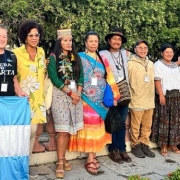
At Fundeps, we were part of this participatory process through an amicus curiae submitted together with more than 15 civil society organizations, elected Public Representatives from the Escazú Agreement, and communities in resistance, contributing various arguments that are now reflected in this ruling. We also supported the participation of Luisa Gómez from the CIEL Foundation, Silvia Cruz, and Maria Rosa Viñolo from Vecinas Unidas en Defensa de un Ambiente Seguro (VUDAS), who presented, on behalf of the amicus, during the hearing held on May 27, 2024, in the city of Manaus, Brazil, as part of this process.
Undoubtedly, this Advisory Opinion is an unprecedented step forward in the protection of human rights in the face of climate change. At Fundeps, we hope it inspires countries across the Americas to take urgent, just, and nature- and people-respecting actions.
Author:
Ananda Lavayen
Contact
Laura Carrizo, lauracarrizo@fundeps.org