• ES
  • EN
Fundeps
  • About Fundeps
  • Team
  • Working areas
    • Environment
    • Democracy
    • Gender
    • Global Gorvernance
    • Health
  • News
  • Publications
  • DONATE
  • Click to open the search input field Click to open the search input field Search
  • Menu Menu
Global Governance, News

Negotiations between Argentina and China continue for the construction of Atucha III
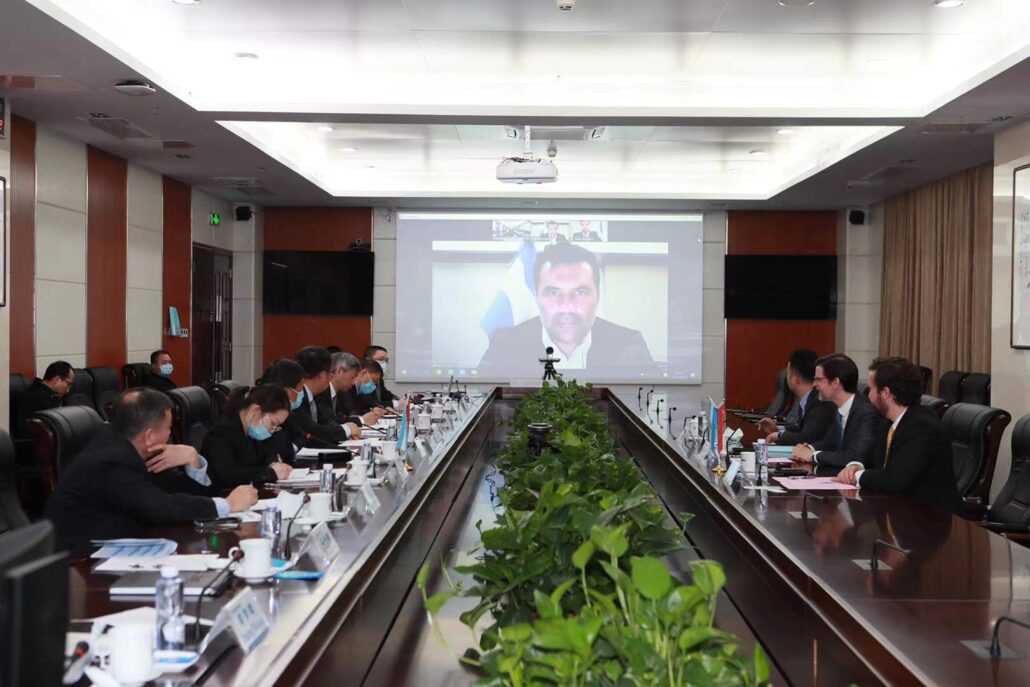
Argentina and China are advancing in the negotiations for the construction of Atucha III, the fourth nuclear power plant in our country, with Chinese technology and financing. US officials expressed their concern to the President of the Nation on a recent visit.

“Below, we offer a google translate version of the original article in Spanish. This translation may not be accurate but serves as a general presentation of the article. For more accurate information, please switch to the Spanish version of the website. In addition, feel free to directly contact in English the person mentioned at the bottom of this article with regards to this topic”.

The Ambassador of Argentina in China, Sabino Vaca Narvaja, the Secretary of Energy of the Nation, Darío Martinez, and the director of Nucleoeléctrica Argentina, Isidro Baschar, held, on April 6, a meeting with the directors of the National Agency for Energía de China (NEA) and the China Nuclear Corporation (CNNC), in which they agreed to boost negotiations for the construction of the fourth nuclear power plant in Argentina.

The representatives of Argentina and China reviewed the status of the negotiations for the construction of the nuclear power plant in our country with Chinese technology. In addition, they explored the possibility of expanding the bilateral link in other areas of cooperation, such as the Argentine export of services and components for Chinese nuclear projects and the life extension of nuclear power plants in China.

The Secretary of Energy, Darío Martinez, affirmed that “the project of the IV Nuclear Power Plant has the full support of the President of the Nation and is on the list of priority projects between both countries.” Likewise, Sabino Vaca Narvaja explained that “Argentina has a highly developed platform in the nuclear sector with its own developments and a unique scientific base in the region. Achieving our fourth nuclear power plant, in addition to expanding our energy sovereignty, will place us at the forefront of a sector with historical development in our country ”.

For his part, the Deputy Director of the Department of Nuclear Energy of NEA, Qin Zhijun, stressed the importance of nuclear energy in the Chinese development strategy, in particular, considering the need to have a diversified energy matrix, as well as the importance of nuclear energy in the fight against climate change.

Worry in Washington

On April 14, two high-ranking officials of the United States government arrived in Argentina. The Director for the Western Hemisphere of the National Security Council, Juan Gonzalez, and the Acting Undersecretary of the State Department for Western Hemisphere Affairs, Julie Chung, shared a lunch with the President of the Nation, Alberto Fernandez at Quinta de Olivos . Also, in the evening, they shared a dinner with the President of the National Chamber of Deputies, Sergio Massa.

Joe Biden’s government officials asked the Argentine government for “prudence” in relation to China. Likewise, they expressed their concern about the project for the construction of the Atucha III nuclear power plant, with financing and technology from China.

The concern on the part of the United States in the construction of the nuclear power plant with technology and financing from China reflects that Argentina is not exempt from the current political dynamics characterized by competition between the two giants.

Atucha III, the fourth nuclear power plant in the country

The construction of this project is scheduled to be located at the Atucha Nuclear Complex, located in Lima, Zárate district, about 100 km from the City of Buenos Aires. In this same complex are the Atucha I and II nuclear power plants.

According to Nucleoeléctrica Argentina S.A, the negotiations contemplate that the reactor to be built in the new plant is a Hualong HPR1000 Pressurized Water Reactor (PWR) of Chinese origin. How do these reactors work? Basically they use enriched uranium as a source of heat (thermal energy), which is transported by high pressure water to a steam generator, which in turn converts that water into steam that drives an electricity generating turbine. This is the type of reactor most used in the world for electricity generation.

With regard to risks, NASA assures that “the safety levels of the Hualong reactor are significantly high and the risks of delay during construction are reduced.”

This new plant would be capable of generating 1200 MWe of gross energy. To put this in perspective, the Atucha I, Atucha II and Embalse reactors generate 362 MWe, 745 MWe and 656 MWe respectively.

Given the characteristics of the project in question, the type of energy to be used, the controversy regarding the technology to be used and its impact on the external positioning of the Argentine Republic in a context of dispute between the United States and China, from Fundeps we propose the need to that the national State faces the negotiation process in a transparent way and provides a broad framework for debate within Argentine society regarding the project and the use of atomic energy.

More information
  • Argentina continues to bet on nuclear power plants with Chinese financing – Fundeps
  • Nuclear cooperation between Argentina and China advances – Fundeps
  • Negotiations for the construction of a fourth nuclear power plant advance
  • Steps move forward for the fourth nuclear power plant
  • Biden’s envoys expressed concern about the Chinese nuclear power plant and Huawei
  • Pressurized water nuclear reactor (PWR)
Authors
  • Mariano Camoletto
  • Andres Paratz
Contact

Gonzalo Roza, gon.roza@fundeps.org
4 de May de 2021
Tags: Chinese Investments, Global Governance, Infrastructure Financing, Social and Environmental Standards
Share this entry
  • Share on Facebook
  • Share on X
  • Share on WhatsApp
  • Share on LinkedIn
  • Share by Mail
https://fundeps.org/wp-content/uploads/2021/05/Gestiones-por-cuarta-central-nuclear-argentina-2-060421.jpeg 1080 1620 Comunicaciones Fundeps https://fundeps.org/wp-content/uploads/2026/04/logo-2026-300x120.png Comunicaciones Fundeps2021-05-04 15:23:382024-11-14 13:27:44Negotiations between Argentina and China continue for the construction of Atucha III
You might also like
Impact of COVID-19 on the Sustainable Development Goals
What is the Green Climate Fund and how does it work?
Asian Infrastructure Investment Bank: Key Insights from the First Financing in Argentina
We participated in a discussion with the new MICI director, Andrea Repetto
The ICIM External Consultative Group was formed
Internal IDB evaluation raises the need for reforms in the operation of the MICI
Regulation of Public-Private Partnerships in Argentina: risks and opportunities
Observations on the second draft of the IDB Environmental and Social Policy Framework from a gender perspective

Tags

Access to Information Access to Justice BID Chinese Investments Citizen Participation Democracy ENTs Environment Environmental Democracy Gender Global Governance Health Healthy nutrition IFIs Infrastructure Financing Legal Interruption of Pregnancy Sexual and Reproductive Rights Social and Environmental Standards Tobacco Control Transparency
See all tags

Acuerdo de Escazú

Emergencia Agroquímica

MOCI - monitoreo ciudadano en proyectos de infraestructura

{el entramado} Contamos historias. Acercamos Realidades.

Instagram

fundepsargentina

Trabajamos para que se garanticen los derechos humanos 🌱⚖️🗣️🌈💜🚭🍎
Promovemos la equidad de #genero, el derecho a la #salud y un #ambiente sano.

🌎 Hace un año, la @corteidhoficial emitió su histó 🌎 Hace un año, la @corteidhoficial emitió su histórica Opinión Consultiva sobre la emergencia climática.

✊ Una victoria para quienes defienden el ambiente en América Latina y el Caribe: la Corte confirmó que proteger a las personas defensoras del ambiente no es opcional. Es una obligación legal.

⚖️ Para explicar qué exige esa protección, la Corte se apoyó en el Acuerdo de Escazú. Resultado: la gran mayoría de Estados de América Latina y el Caribe no pueden ignorar los estándares de Escazú, incluso si aún no han ratificado el tratado.

🔎 La implicación es clara: los países de la región deben fortalecer el acceso a la información, la participación pública, la justicia ambiental y la protección de quienes defienden el ambiente. 

📝 La Opinión abre nuevas rutas para frenar la criminalización de personas defensoras, responder a las restricciones al espacio cívico y defender la participación pública en países como Costa Rica, Guatemala y Perú. Compartimos el análisis de  @manizalmigrante del @ciel_org

📣 La discusión ya no es si los países de América Latina y el Caribe deben proteger a quienes defienden el ambiente. Eso ya está claro. Ahora hay que usar la Opinión: en tribunales, reformas, debates públicos y procesos de movilización para exigir mejores garantías y mayor protección.

🔗 Lee el análisis completo en el link en www.ciel.org/corte-idh-escazu-personas-defensoras/
Seguimos compartiendo algunos momentos del 3° Encu Seguimos compartiendo algunos momentos del 3° Encuentro Provincial de Redes de Compromiso y Cuidados 🧡

Creemos que no hay mejor manera de cerrar una jornada de formación, intercambio y construcción colectiva que encontrándonos también desde el arte. Porque la música y la poesía también nos invitan a imaginar otros mundos posibles.

Así vivimos Revuelo Sur, Íntimas, el espectáculo de Susy Shock junto al Dúo Bazán-Bonillo, que acompañó el cierre de este encuentro.

Gracias a todas las personas que se acercaron y fueron parte de esta jornada.
Preguntas, experiencias y saberes compartidos 💭 A Preguntas, experiencias y saberes compartidos 💭

Así vivimos el 3° Encuentro Provincial de Redes de Compromiso y Cuidados, una jornada dedicada a reflexionar sobre salud integral con perspectiva de diversidad y a fortalecer redes para la promoción de derechos.

Les compartimos algunos momentos de este encuentro que reunió a más de 170 personas de distintos puntos de la provincia.
El litio está en el centro de la transición energé El litio está en el centro de la transición energética global. Y Argentina, con los salares, principalmente de Jujuy, Salta y Catamarca, es protagonista de esa historia.

Pero hay preguntas que no siempre se hacen: ¿quién se beneficia realmente? ¿qué pasa con el agua? ¿qué derechos están en juego en los territorios donde se extrae?

Acá respondemos las más importantes. Accedé al documento completo en nuestra bio.
Follow on Instagram

Twitter

Tweets por @fundeps

Newsletter Subscription

    Fundeps. Córdoba (CP X5000JZH), Argentina. info@fundeps.org
    • Link to X
    • Link to Facebook
    • Link to Instagram
    • Link to Mail
    • Link to Youtube
    • Link to LinkedIn
    • Link to TikTok
    Link to: The day of the animal in Argentina Link to: The day of the animal in Argentina The day of the animal in Argentina Link to: The Deliberative Council of Córdoba would prohibit the display of ultra-processed products in checkout lines Link to: The Deliberative Council of Córdoba would prohibit the display of ultra-processed products in checkout lines The Deliberative Council of Córdoba would prohibit the display of ultra-processed...
    Scroll to top Scroll to top Scroll to top