During the month of December 2016, the Foundation for the Development of Sustainable Policies decided to carry out a survey process in the neighborhood of Chacras de la Merced, in order to obtain accurate information about the state of situation of the community there.
“Below, we offer a google translate version of the original article in Spanish. This translation may not be accurate but serves as a general presentation of the article. For more accurate information, please switch to the Spanish version of the website. In addition, feel free to directly contact in English the person mentioned at the bottom of this article with regards to this topic”
Since 2015, FUNDEPS has been working with the recently mentioned neighborhood of the City of Cordoba, in relation to the problems of the sewage treatment plant (WWTP). The proven malfunction of the plant, located in the area since 1984, has caused numerous problems in the nearby population, as well as in the ecosystem there.
The purpose of this survey process was to be able to discover the perception of the neighbors of the neighborhood with respect to the plant, as well as of other problems that they could identify as an emergency. The instrument used was intended to compile the perception of the community of Chacras de la Merced about the operation of the sewage treatment plant, the environmental situation of the area, the performance of the government authorities towards the neighborhood and its interest Engage in control activities.
In this sense, within the results obtained, below are presented those of greater relevance.
An 83% (44 families) does not feel calm with the environmental situation of the district Chacras de la Merced.
Five issues were mentioned and respondents were asked to prioritize among themselves, establishing from 1 to 5 the urgency with which they believed they should be addressed by government authorities. Of the total families surveyed, 34 (64%) of them gave the number 1 priority and urgency to the pollution caused by the sewage treatment plant.
The respondents were then asked whether or not they knew the work that EDAR does, and 58.8% said they did not know with certainty the work and operation of the WWTP. 50.9% said he was very badly informed about the issues that relate to the operation of the plant. Consistent with this, 79.2% of neighbors said they do not trust the information provided by the municipality of Cordoba on the operation of the plant.
Notwithstanding the lack of knowledge, 86% consider that the plant is not functioning properly; And opined in reference to the factor considered to cause malfunction. 37.2% of the respondents said that the plant does not work properly due to lack of municipal controls that verify the correct functioning. Likewise, 46.5% consider that the malfunction of the plant causes the immediate contamination of the river.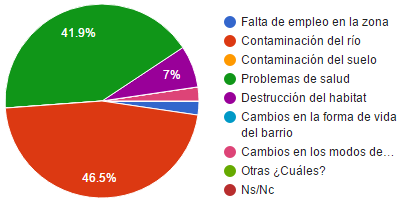
He wondered about the confidence that respondents had in certain institutions and organizations. Entrepreneurs, the provincial government, the municipal government, the police, the legislature, the judiciary, political parties, trade unions and the national government receive nothing from the neighbors of Chacras de la Merced. Private and public universities; Environmental organizations, social organizations, religious institutions, and the media are receptive to the trust of neighbors. The neighbors opined, undoubtedly with 77% (41 families), who do not trust EDAR.
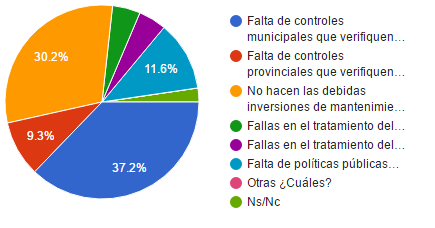
It is important to note that 76.9% of the neighbors do not have / had information about the bidding process carried out by the province for the expansion of the sewage treatment plant. Likewise, with regard to the opinion about the expansion of the plant, it is surprising that despite the declared distrust of the authorities and the information they provide; 58.5% of the residents are confident that the work will improve the quality of life of the community.
88.7% of the respondents believe that they should (people from the neighborhood with civil society organizations) participate in monitoring spaces to the actions of the state in the area of environmental control. It was also consulted about the inclination towards participation in monitoring spaces of the actions of the municipality and the province in the process of construction of the new plant. 56.6% expressed that they would be willing to participate in these spaces if they arose.
The survey also aimed to know about the health history of the neighbors, consulting about symptoms and diseases they have had, their frequency, the diagnosis provided and the treatment indicated. In this regard, 69% said they had suffered from one of the listed symptoms.
The results of the survey process show that the community of Chacras de la Merced is in a serious situation of vulnerability due to the confluence of numerous factors that lead to the violation of their most basic rights. Álida Weht, director of the Las Omas grassroots organization whose objective is to improve the quality of life of the neighbors, has stated that: “the results constitute the visibility of a pollution situation that dates back several decades and a community Which has been immersed in an immediacy of problems for the same time.
In the context of the recent events related to the overturning of the Suquía River, both from company waste and from raw sewage, it is necessary to highlight the emergency in which the Chacras de la Merced neighborhood is located.
Full survey report
More information
Contact
Agustina Palencia – agustinapalencia@fundeps.org

Presentation of a report to the UN Human Rights Council
The report focuses on health protection in the face of the tobacco epidemic and urges the UPR (Universal Periodic Review) Committee to recommend that the Argentine State adopt measures to achieve higher standards of protection.
“Below, we offer a google translate version of the original article in Spanish. This translation may not be accurate but serves as a general presentation of the article. For more accurate information, please switch to the Spanish version of the website. In addition, feel free to directly contact in English the person mentioned at the bottom of this article with regards to this topic”
ARGENTINA. This year, the second five-year evaluation carried out by the United Nations Human Rights Council will take place in our country. It provides States with the opportunity to state what measures they have taken to improve the human rights situation and to establish obligations in this regard.
One of the reports, presented by FUNDEPS, together with FIC Argentina, O ‘Neill Institute for National and Global Health Law and FEIM, analyzes the smoking in the world, the marketing of the industry and the legal situation in the country.
Tobacco advertising has a strong influence on smokers and non-smokers: a third of initial experimentation in young people occurs as a result of advertisements. 78% of 13- to 15-year-olds report regular exposure to cigarette commercials around the world.
The reality is that there is a lack of controls, non-compliance with laws and a refusal to ratify the Framework Convention on Tobacco Control (FCTC), an instrument that places obligations on States to adopt Control and establishes a series of effective measures against the consequences of direct and indirect consumption. The treaty was ratified by more than 180 participants and Argentina is the only South American country that is not yet a member of this convention.
The state spends 33 billion pesos every year to treat health problems due to smoking. The tax collection from the sale of cigarettes barely covers two-thirds of the direct costs that the cigarette causes in the health system.
The partial restrictions of the ads encourage the manipulation of the same and generates a legal vacuum. Only through regulations that ensure a complete ban on all direct and indirect forms of advertising can lead our country to reach its goals in terms of cigarette consumption. Current laws lack many of the most significant components of the FCTC and hamper the efforts of health institutions to reduce tobacco use in the territory.
From Fundeps we urge that the Argentine State take this opportunity to take the necessary measures to ensure compliance with fundamental rights.
Source
Institute of Clinical and Health Effectiveness
FIC Argentina
Author
Federico Piccioni
Contact
Agustina Mozzoni <agustinamozzoni@fundeps.org>
Towards Argentina’s ratification of the Framework Convention on Tobacco Control
In the Senate of the Nation took place today, a day of intersectoral dialogue that included the presentation of a bill for the ratification of the Framework Convention on Tobacco Control.
“Below, we offer a google translate version of the original article in Spanish. This translation may not be accurate but serves as a general presentation of the article. For more accurate information, please switch to the Spanish version of the website. In addition, feel free to directly contact in English the person mentioned at the bottom of this article with regards to this topic”
BUENOS AIRES. On Thursday, May 18, a day was held to promote the Argentine ratification of the WHO Framework Convention on Tobacco Control (FCTC), an international public health treaty with members from 180 countries that Argentina has yet to ratify.
The Convention provides for a series of measures aimed at improving the health of the population by seeking the elimination or reduction of the consumption of these products and exposure to second-hand smoke. These measures include banning all forms of advertising, promotion and sponsorship, increasing the price of cigarettes and tobacco taxes, enacting laws that monitor and evaluate policies aimed at preventing consumption, implementation Of 100% smoke-free environments, offering help to quit smoking and the inclusion of health warnings with images on cigarette labels, among other measures.
In Argentina, about 44 thousand people die each year from diseases related to smoking. The average age at which smoking begins is at 12 and until then people are bombarded by aggressive marketing strategies developed by the tobacco industry. One of the most advanced measures of the FCTC is to eliminate all forms of dissemination with the aim of “protecting present and future generations against the devastating health, social, environmental and economic consequences of smoking and exposure to smoke “.
In the event they spoke Juan Manuel Abal Medina, Senator of the Nation; Marta Santore, President of the Inter-American Heart Foundation of Argentina (FIC) Dr. César Di Giano, President of the Argentine Anti-tobacco Union (UATA); Armando Peruga, Former Manager of the WHO Tobacco Free Initiative; Patricia Sosa, Campaign for Tobacco Free Kids Latin American Programs Director, among other leading personalities.
We were present with the certainty that our country must ratify the Convention to guarantee the effective protection of the Right to Health; And also with the certainty that such ratification would constitute a key tool to address the interests of the tobacco industry.
Author
Federico Piccioni
Contact
We support the declaration of Principle 10 and the objectives of sustainable development
The Forum of Latin American and Caribbean Countries for Sustainable Development in Mexico City met for the first time in April. It presented the progress of the negotiation process of the Regional Agreement by Principle 10.
“Below, we offer a google translate version of the original article in Spanish. This translation may not be accurate but serves as a general presentation of the article. For more accurate information, please switch to the Spanish version of the website. In addition, feel free to directly contact in English the person mentioned at the bottom of this article with regards to this topic”
FUNDEPS together with several civil society organizations signed a declaration that supports the fundamental alliance between sustainable development objectives and principle 10, as we understand that:
“There will be no sustainable development without the implementation of the Sustainable Development Goals (ODS) nor without the rights of access to information, access to justice and participation on environmental issues, known as access rights.”
Within the framework of the first meeting of the Forum of Latin American and Caribbean Countries for Sustainable Development, it was claimed that there can be no real sustainable development if there is no real access to information and justice, as well as As an authentic participation of the citizens. In this regard, the Vice Minister of Environment of Costa Rica, Patricia Madrigal stressed that “Principle 10 redefines the traditional concept of development for its inclusive, transparent and participatory nature.”
Hence the importance of this Forum, which presents the ideal opportunity for the Agenda 2030 for Sustainable Development, which proposes 17 Sustainable Development Objectives, and the Regional agreement for Principle 10 to be implemented and can be addressed in an integral way to In order to strengthen each other.
FUNDEPS as an organization that promotes the construction of sustainable public policies participates actively in the negotiation process Regional Agreement on Principle 10, as well as publicly supports the Sustainable Development Objectives (ODS) of the United Nations Agenda 2030, recognizing the importance of access rights in the implementation of real sustainable development policies.
More information
Declaration that supports the P10 and the ODS-Signers
First Meeting Forum of the Latin American and Caribbean Countries for Sustainable Development
Author
María Perez Alsina
Contact
Male Martínez Espeche – malemartinez@fundeps.org
The High Court of Justice and its doctrine on femicides
The High Court of Justice of the province of Córdoba (TSJ), established the criteria on how cases of femicide should be treated, confirming Gonzalo Lizarralde’s life sentence for the crime of Paola Acosta, stating that he measured gender violence And it was a femicide.
“Below, we offer a google translate version of the original article in Spanish. This translation may not be accurate but serves as a general presentation of the article. For more accurate information, please switch to the Spanish version of the website. In addition, feel free to directly contact in English the person mentioned at the bottom of this article with regards to this topic”
The sentence of the 11th Chamber of the Crime, reviewed by the TSJ, had condemned Lizarralde to life imprisonment for homicide classified as treachery against Paola Acosta and for homicide qualified for the bond and for treachery in an attempt against his Daughter, MA Both the defense and the complaint married this sentence and the TSJ was issued last month confirming the conviction, but with the aggravating of femicide.
The Chamber had dismissed the application of this aggravating factor because it understood that there had been no gender violence, stating that “Acosta and Lizarralde had an informal and short-lived relationship of a few months.” The Chamber also pointed out that the personal characteristics of the victim prevented the application of the femicide figure, since it was a woman who “was not docile” and who “decided to empower herself in defense of her rights and those of her daughter” .
The TSJ ruling is the first of this court that addresses the figure of femicide, which is why they established their interpretive criteria.
In principle, it clarifies that in this case it was a case in which a man assaulted against a woman using gender violence, and considered that Lizarralde committed the homicide against Acosta based on gender bias
Consider, it is not essential that there is a stable, formal or cohabiting relationship. Homicide must occur in a context in which women are in conditions of inequality with respect to men. This context must be evaluated by the judge according to each specific case, but no personal characteristic can be demanded in the victim (that is submissive or of weak character, for example).
It is especially important to note that the TSJ took into account that the femicida understood that she would not resign her personal choices to the responsibility that takes care of a girl’s care, which led him to overcome the burden of pregnancy and the assistance of his Daughter, leaving everything in the hands of the victim for three years. This left Paola in a situation of vulnerability and inequality, which she herself sought to reverse through a family judicial process. The death of Paola meant to impose the plans of life of the femicide over those of the victim and his daughter.
We welcome this judicial pronouncement because we believe it is essential to raise awareness and raise awareness of this extreme form of violence, which is only the last step in violence against women. The aggravating factor of femicide acts when the damage is already done, which makes it necessary to accompany this type of actions with policies aimed at prevention.
In times of intense debate about the State’s punitive response to violence against women, which has proven to be insufficient, we insist on a comprehensive and preventive approach that includes violence in all its forms.
More information
Author
Mayca Balaguer
Contact
Virginia Pedraza – vir.pedraza@fundeps.org
Co-creating policies: Provincial Government Board Opened in Córdoba
During the past Wednesday, April 12 and 19, the Open Government Office of the Province of Cordoba summoned civil society organizations at a dialogue table. This, in the framework of the elaboration of the provincial goal that will be part of the National Plan of Action of Argentina before OGP during the years 2017 to 2019.
“Below, we offer a google translate version of the original article in Spanish. This translation may not be accurate but serves as a general presentation of the article. For more accurate information, please switch to the Spanish version of the website. In addition, feel free to directly contact in English the person mentioned at the bottom of this article with regards to this topic.”
Within the framework of the Open Government Alliance (OGP), Argentina will have to submit a new National Action Plan in July 2017, which will contemplate new commitments regarding transparency, accountability and citizen participation.
The Open Government Alliance was launched in 2011 to provide an international platform for domestic reformers committed to making their governments accountable, more open and improving their responsiveness to their citizens. Since then, OGP has moved from 8 participating countries to the 64 countries indicated on the map below. In all these countries, government and civil society work together to develop and implement ambitious reforms around open government.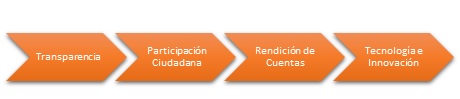
The concept of “open government” is based on 3 fundamental pillars: transparency, participation and collaboration. It implies a new paradigm, under which decision-makers put citizens at the center of public policy and include them in their design, understanding that greater citizen participation in the formulation of public policies contributes to a more open government and that Accountable to citizens.
The last plan of action presented by our country was in 2015, and included commitments assumed both by the administration of Cristina Fernandez and by the current management of Mauricio Macri. For this 2017, from the Ministry of Modernization of the Nation, it was decided to incorporate a section in the plan that is made up of subnational commitments.
In this regard, the provinces are invited to add a goal to this new plan. During the end of 2016, federal meetings were organized by the federal executive, explaining the methodology for the elaboration of commitments. In this sense and according to the process explained, the goals had to be co-created with civil society.
The relevance of the Open Government as a new cultural paradigm in the sphere of state management lies in the possibility of incorporating the citizenry in the decision-making processes of the government. A more transparent and accountable administration of society translates into stronger and more legitimate institutions.
The past Wednesday, April 12 and 19, from the Secretariat of the Governorate of the Province of Cordoba, civil society organizations were summoned to participate in two dialogue panels. During both meetings we worked on the creation of the commitment that the Province of Cordoba will assume in the National Action Plan of Argentina before OGP 2017-2019.
Among the organizations that participated in these tables are the AGA Association, the Nuestra Córdoba Citizen Network, the Córdoba Environmental Forum, FUNDEPS, the Federal Government Institute, Open Data Córdoba, among others. The debate was essentially about the need to achieve the institutionalization of the paradigm of Open Government within the government of the Province of Cordoba. Also discussed was the possibility of creating an Open Government Portal belonging to the province.
From FUNDEPS we consider this one, as an important step in the progress toward the establishment of Open Government policies in the province. The institutionalization of spaces with these characteristics would achieve, in the future, greater and better mechanisms of citizen participation. Consequently, the levels of accountability and transparency of government management in Córdoba would increase.
More information
We participated in the Open Government Partnership Summit in Paris
Climate Change and Open Government at the Global TAI Meeting
Participation in the Regional Meeting of Subnational Entities by the Open Government
Contact
Agustina Palencia – agustinapalencia@fundeps.org
Activity Report 2016
The past 2016 was a year of great growth for our foundation, not only for the development of our many agendas of work, but also for the consolidation of our team of volunteers.
We further diversified our work agendas, we were able to increase our social impact, we were able to position ourselves in networks and we increased the collaboration with new partners.
As we did year after year, we continue to conduct research, workshops and events; We participate in national and international meetings with multiple organizations; We carry out activities of monitoring, advocacy and judicial cases to advance in matters of public policies.
We thank all those who participated and trusted in FUNDEPS. We hope that in 2017 we will continue to find and work together in pursuit of our main objective: to continue to grow and influence public policies.
We invite you to read the result of a great year of work, by clicking on our 2016 report at the following link bit.ly/FUNDEPS2016; Or on our website in the “About Fundeps” section.
Studies show environmental degradation and government neglect in Chacras de la Merced
During the month of December 2016, the Foundation for the Development of Sustainable Policies decided to carry out a survey process in the neighborhood of Chacras de la Merced, in order to obtain accurate information about the state of situation of the community there.
“Below, we offer a google translate version of the original article in Spanish. This translation may not be accurate but serves as a general presentation of the article. For more accurate information, please switch to the Spanish version of the website. In addition, feel free to directly contact in English the person mentioned at the bottom of this article with regards to this topic”
Since 2015, FUNDEPS has been working with the recently mentioned neighborhood of the City of Cordoba, in relation to the problems of the sewage treatment plant (WWTP). The proven malfunction of the plant, located in the area since 1984, has caused numerous problems in the nearby population, as well as in the ecosystem there.
The purpose of this survey process was to be able to discover the perception of the neighbors of the neighborhood with respect to the plant, as well as of other problems that they could identify as an emergency. The instrument used was intended to compile the perception of the community of Chacras de la Merced about the operation of the sewage treatment plant, the environmental situation of the area, the performance of the government authorities towards the neighborhood and its interest Engage in control activities.
In this sense, within the results obtained, below are presented those of greater relevance.
An 83% (44 families) does not feel calm with the environmental situation of the district Chacras de la Merced.
Five issues were mentioned and respondents were asked to prioritize among themselves, establishing from 1 to 5 the urgency with which they believed they should be addressed by government authorities. Of the total families surveyed, 34 (64%) of them gave the number 1 priority and urgency to the pollution caused by the sewage treatment plant.
The respondents were then asked whether or not they knew the work that EDAR does, and 58.8% said they did not know with certainty the work and operation of the WWTP. 50.9% said he was very badly informed about the issues that relate to the operation of the plant. Consistent with this, 79.2% of neighbors said they do not trust the information provided by the municipality of Cordoba on the operation of the plant.
Notwithstanding the lack of knowledge, 86% consider that the plant is not functioning properly; And opined in reference to the factor considered to cause malfunction. 37.2% of the respondents said that the plant does not work properly due to lack of municipal controls that verify the correct functioning. Likewise, 46.5% consider that the malfunction of the plant causes the immediate contamination of the river.
He wondered about the confidence that respondents had in certain institutions and organizations. Entrepreneurs, the provincial government, the municipal government, the police, the legislature, the judiciary, political parties, trade unions and the national government receive nothing from the neighbors of Chacras de la Merced. Private and public universities; Environmental organizations, social organizations, religious institutions, and the media are receptive to the trust of neighbors. The neighbors opined, undoubtedly with 77% (41 families), who do not trust EDAR.
It is important to note that 76.9% of the neighbors do not have / had information about the bidding process carried out by the province for the expansion of the sewage treatment plant. Likewise, with regard to the opinion about the expansion of the plant, it is surprising that despite the declared distrust of the authorities and the information they provide; 58.5% of the residents are confident that the work will improve the quality of life of the community.
88.7% of the respondents believe that they should (people from the neighborhood with civil society organizations) participate in monitoring spaces to the actions of the state in the area of environmental control. It was also consulted about the inclination towards participation in monitoring spaces of the actions of the municipality and the province in the process of construction of the new plant. 56.6% expressed that they would be willing to participate in these spaces if they arose.
The survey also aimed to know about the health history of the neighbors, consulting about symptoms and diseases they have had, their frequency, the diagnosis provided and the treatment indicated. In this regard, 69% said they had suffered from one of the listed symptoms.
The results of the survey process show that the community of Chacras de la Merced is in a serious situation of vulnerability due to the confluence of numerous factors that lead to the violation of their most basic rights. Álida Weht, director of the Las Omas grassroots organization whose objective is to improve the quality of life of the neighbors, has stated that: “the results constitute the visibility of a pollution situation that dates back several decades and a community Which has been immersed in an immediacy of problems for the same time.
In the context of the recent events related to the overturning of the Suquía River, both from company waste and from raw sewage, it is necessary to highlight the emergency in which the Chacras de la Merced neighborhood is located.
Full survey report
More information
Contact
Agustina Palencia – agustinapalencia@fundeps.org
We participate in the Spring Meetings of the World Bank 2017
From April 18 to 22, the World Bank’s spring meetings were held in Washington. On April 20 we presented a panel on the legal framework of Public-Private Partnership Projects and Infrastructure Projects in Latin America with the NGOs that make up GREFI.
“Below, we offer a google translate version of the original article in Spanish. This translation may not be accurate but serves as a general presentation of the article. For more accurate information, please switch to the Spanish version of the website. In addition, feel free to directly contact in English the person mentioned at the bottom of this article with regards to this topic”
Spring meetings of the World Bank are being held in Washington, DC from April 18 to 22. On April 20 we presented a panel on the legal framework of Public-Private Partnership Projects and Infrastructure Projects in Latin America with the NGOs that make up GREFI.
From April 18 to 22, the Spring Meetings of the World Bank took place in Washington. These meetings of the International Monetary Fund (IMF) and the World Bank Group (GBM) meet annually with central bank authorities, finance and development ministers, private sector executives and representatives of academic circles.
The aim is to discuss issues of global concern, such as the global economic outlook, the end of poverty, economic development and aid effectiveness. In addition, seminars, regional briefings, press conferences and many other activities focusing on the world economy, international development and the global financial system are organized.
Within this framework and within the Civil Society Policy Forum, we will be presenting, together with the NGOs that make up the Regional Group on Financing and Infrastructure, a panel on the legal framework of Public-Private Partnership Projects and Infrastructure Projects in Latin America. Martha Torres Marcos-Ibanez of Law, Environment and Natural Resources will moderate the panel. The exhibitors will be Vanessa Torres from Environment and Society Association, María José Romero from Eurodad, Nancy Alexander from Heinrich Boell Foundation and Heike Mainhardt from Bank Information Center (BIC).
Public-private partnership (PPP) projects have gained a key role in the development of infrastructure projects in Latin America. In this context, the legal framework of PPPs has been deepened in several countries of the region in order to improve and promote the use of this form of investment in the implementation of mega projects in Latin America. It is becoming more common to see how the private sector is taking on the responsibilities and duties of the state alone, and the best example is the provision of public services and the development of infrastructure. In this regard, PPPs have been used by governments as a powerful tool to boost the economy through increased infrastructure development and as a mechanism to bridge the infrastructure gap. This panel intends to report on the legal framework of PPPs in Latin America, more precisely in Peru and Colombia. The legal instruments used by the private sector and the State will be developed to implement the PPPs and will focus on the gaps in the legal framework that generate environmental and social risks in the implementation of infrastructure projects under APP.
On 20 April, we also moderated a panel on accountability mechanisms in financial institutions. We also participated in meetings with the Independent Consultation and Investigation Mechanism of the Inter-American Development Bank and the Inter-American Investment Corporation.
More information
Calendar
Contact
Juan Carballo – juanmcarballo@fundeps.org
We participated in the public hearing for the installation of Cantera Colombo in Chacras de la Merced
Concerned about the situation of vulnerability in the community of Chacras de la Merced, we participated in the public hearing with a legal technical report that gives an account of the irregularities of the project to install a new quarry.
“Below, we offer a google translate version of the original article in Spanish. This translation may not be accurate but serves as a general presentation of the article. For more accurate information, please switch to the Spanish version of the website. In addition, feel free to directly contact in English the person mentioned at the bottom of this article with regards to this topic”
On Wednesday, April 12, the Secretary of Environment and Climate Change convened a public hearing to discuss the installation project “Cantera Colombo” in the vicinity of the neighborhood Chacra de la Merced. The Cantera Colombo project would be located to the east of the city of Cordova, outside the urban ejido of the city, in the place known as Heart of Maria, being the population center affected by the work the locality of Chacra de la Merced. This is an open pit dry quarry, where the extraction of aggregates without the use of explosives would be carried out, and then transferred the material to the classification plant owned by the owner named Canteras Ruiz, located at Camino Chacra de La Merced, Km.
Among the main considerations that we made in the Report on the environmental impact study “Cantera Colombo” it should be mentioned that it did not take into account the special situation of vulnerability in which the community of Chacra de la Merced is located due to the accumulated impact that affects Progressive and negative in the right to health, life and a healthy environment. Among the main causes that explain the transformation of what was the “Green Belt of the city of Cordoba” we find: the installation of real estate ventures, quarrying, installation and omission in the controls on tanneries, malfunctions and The supersaturation of the sewage treatment plant (EDAR Bajo Grande), lagoons generated by the old quarries. Also within the irregularities that emerged from the analysis of the environmental impact study we find that:
-The integrality of the project will have significant and mostly negative and irreversible impacts on the environment, especially on the quality of water, soil, air, health and quality of life.
– Does not comply with the minimum content detailed in art. 19 of the law 10,208 (baseline in health taking into account that it will be located 300 meters from a school and 150 meters from the river Suquía, public services affected as public transport).
-Takes outdated baselines (affected population, census 2008).
“He does not cite reliable sources.”
– Does not detail the measures of recomposition and mitigation of the impacts.
Therefore, from FUNDEPS we recommend an in-depth evaluation by the Ministry of Environment as the controlling body of this project, taking into account the considerations made, and having the necessary mechanisms in order to comply with the expected legal and environmental parameters In order to protect the fundamental rights of the residents of Chacra de la Merced.
More information
Report of FUNDEPS by installation Cantera Colombo
Video situation Chacras de la Merced
Authors
María Pérez Alsina, Virginia Corradi y Male Martínez Espeche.
Contact
Male Martínez Espeche / Environment Team Coordinator
malemartinez@fundeps.org
The Court of Colombia removed a censorship on a pro-health campaign
The decision null and void the prohibition on “Take it seriously”, an operation aimed to make people aware of the impacts of the sugar-sweetened drinks. It sets a precedent on the defense of the information, health and food rights.
“Below, we offer a google translate version of the original article in Spanish. This translation may not be accurate but serves as a general presentation of the article. For more accurate information, please switch to the Spanish version of the website. In addition, feel free to directly contact in English the person mentioned at the bottom of this article with regards to this topic.”
Bogotá.- “Don’t hurt yourself”, announces the commercial of “Educar Consumidores” that exposes the consequences of the excess of sugar on the human being. However, after a complaint from Postobon –one of the biggest companies in Latin America- the Industry and Trade Superintendence (SIC) ordered the immediate suspension of the whole campaign, for “misleading advertising”.
Last April 5th, the Constitutional Court of Colombia left with no effect the resolution and for the first time were recognized the rights to access to food and health-related information.
Educar Consumidores is a non-profit civil society organization that in September of last year launched the campaign ¨Cuida tu vida – Tómala en Serio¨. It is intended to show the health consequences of drinking. After the complaint, SIC prohibited the dissemination of commercials claiming to be “misleading advertising” because they did not have scientific or medical support, although the issuing organization forwarded the documents that supported their claims.
The ban constituted a violation of freedom of expression, the right to health and the right to information.In response to this situation, one of the judicial authorities, one of the agency issuing the campaign, focused on its right to freedom of expression, and another from Dejusticia along with a coalition of NGOs, focused on the right of access to information.
The second action was rejected in first and second instance until arriving at the Constitutional Court of Colombia, which ruled in favor of. The Court argued that the SIC should have allowed consumers to participate in a decision affecting them, and that it had not violated their right to the process.In addition, he referred to the right of users to make decisions based on informed consent, and the importance of accessing the information for it to be configured. Likewise, the Inter-American System and the United Nations Protection System, Colombia has an obligation to respect the rights enshrined, and in this case, the SIC failed to comply with this obligation.
From FUNDEPS we accompany actions such as Educate Consumers who seek to empower people to make informed decisions. We also welcome the provision made by the Colombian justice system. Chronic noncommunicable diseases are the leading cause of death in the world. It is the duty of the State to respect, guarantee and protect the rights of its citizens, especially when it comes to fundamental issues such as the protection of health.
More Information
Commercial Consumer Education
Authors
Maga Ailén Merlo Vijarra, Federico Piccioni y Agustina Mozzoni.
Contact
Agustina Mozzoni – agustinamozzoni@fundeps.org
Maga Ailén Merlo Vijarra – magamerlov@fundeps.org
Encuestas a la comunidad de Chacras de la Merced en relación a la planta cloacal Bajo Grande – April 2017
Durante el mes de diciembre de 2016, llevamos a cabo un proceso de encuestas en el barrio Chacras de la Merced, con la finalidad de fotografiar la realidad del barrio actualmente. El objeto del proceso ha sido poder descubrir la percepción de los vecinos y vecinas del barrio respecto de la planta de líquidos cloacales, al mismo tiempo que de otras problemáticas que se pudieran identificar con carácter de emergencia y su gestión gubernamental.
Regional thematic hearing of the IACHR in the fulfillment of the DESCA
We will be participating in one of the public hearings convened by the Inter-American Commission on Human Rights (IACHR) to be held on March 17, 18, 20, 21 and 22 in Washington.
In the context of public hearings, the one that summons us is about “Right of access to information relevant to the enforceability of economic, social, cultural and environmental rights”. This was requested from the IACHR in conjunction with organizations in the region, such as Fundación Construir (Bolivia); Institute of Legal and Social Studies of Uruguay (Ielsur, Uruguay); Regional Alliance for Free Expression and Information (Uruguay); ARTICLE 19 (Brazil); Center for Archives and Access to Public Information (CAinfo, Uruguay); Fundar – Analysis and Research Center (Mexico); And Civil Association for Equality and Justice (ACIJ, Argentina).
The hearing we will participate in will expose to the Inter-American System of Human Rights (IACHR) the need to consolidate standards regarding production and access to information that allow progress towards the effective implementation and enforceability of economic, social, cultural and environmental rights DESCA). There are international and regional commitments in this area that show clear obligations with respect to production and access to information, which are necessary in order to advance the enforceability and exercise of these rights. However, in the countries of the region there are serious failures to comply.
Several international agencies have not found necessary information to determine whether DESCAs are respected in the countries of the region. Specifically, they have noted deficiencies related to the collection and systematization of information on the exercise of the rights to education, employment, health and social security of women; Children and adolescents; People with disabilities; Indigenous peoples; Afro-descendants and migrant workers and their families. In this same line, they have stated that it is a state obligation to produce information from which it is possible to validate indicators and, in general, access to many of the guarantees covered by each social right.
Argentina and Cordoba are no exception in this regard. The case of contamination by the Bajo Grande WWTP plant, which affects the Chacras de la Merced community, is a clear example of human rights violations aggravated by the lack of access to information. The State does not provide data on levels of air and soil pollution, nor does it provide information on health effects to the people of the neighborhood, mainly women and children. In this way, the enforceability of the rights of the people affected is hampered.
That is why it is fundamental to strengthen the implementation of standards around the scope of state obligations of production, availability and timely access to information on DESCA. The latter, in addition to being essential for the design, implementation and evaluation of public policies, makes it possible to strengthen the demand strategies of civil society, generating the conditions for many violations of rights to be repaired.
We invite you to follow the live broadcast through the official website of the IACHR.
More information
Contact
Juan Carballo – juanmcarballo@fundeps.org
Débora Fernandez