We filed a complaint against the AFA and Vaporesso for illegal electronic cigarette advertising
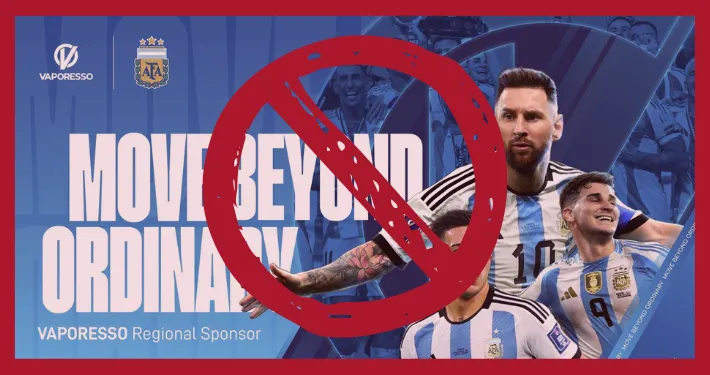
We filed an administrative complaint before Argentina’s Ministry of Health against the Argentine Football Association (AFA) and Vaporesso over the “Move Beyond Ordinary” campaign, launched in March 2026 during the FIFA World Cup. The campaign uses the images of Messi, Julián Álvarez, and Enzo Fernández to promote products that are harmful to health, particularly for adolescents and young people. Advertising and brand sponsorship of these products are prohibited in Argentina.
On March 18, 2026, Vaporesso, a global manufacturer of electronic nicotine delivery devices, and the AFA publicly announced a “strategic partnership” in connection with the 2026 FIFA World Cup. The campaign, titled “Move Beyond Ordinary,” included social media posts, a video featuring images of the Argentine National Team, giveaways of jerseys and World Cup tickets, and the inclusion of the Vaporesso logo on the AFA’s official website as a regional sponsor.
Following criticism from public health experts and civil society organizations, the AFA removed the logo from its website and deleted its social media posts. However, Vaporesso’s campaign remains active on its own digital channels, with unrestricted access from Argentina.
Why it is illegal
Argentina’s National Tobacco Control Law (Law No. 26,687) expressly prohibits the advertising, promotion, and sponsorship of tobacco and nicotine products — including electronic cigarettes — in any media outlet, digital platform, or public event. This prohibition remains fully in force under the new Ministry of Health regulation (Resolution 549/2026): authorizing commercialization does not lift restrictions on advertising and sponsorship.
The complaint is based on four arguments. First, the campaign violates Articles 5 and 8 of Law 26,687, which prohibit brand sponsorship and any form of direct or indirect advertising or promotion of tobacco and nicotine products through any medium accessible in Argentina. Second, the campaign began on March 18, 2026, when ANMAT Provision 3226/2011 was fully in force and categorically prohibited electronic cigarette advertising: the subsequent repeal does not extinguish liability for violations already committed. Third, using sports idols and the symbols of the World Cup-winning National Team to promote harmful products constitutes an abusive and misleading practice that violates the Consumer Protection Law (Law 24,240). Fourth, the campaign contravenes international treaties with constitutional hierarchy — including the Convention on the Rights of the Child — which require the State to protect the health and best interests of children and adolescents against strategies aimed at normalizing the consumption of addictive and harmful products.
“Having a vaping brand sponsor the Argentine National Team and use Messi’s image to sell products to adolescents is illegal. It is also a very clear example of what we have been denouncing for years: the industry systematically violates the law while the State fails to monitor or sanction it. Since Law 26,687 was enacted, the State has not imposed a single sanction for noncompliance. This leads us to the question the Ministry of Health has yet to answer: if they were unable to enforce a simple prohibition for fifteen years, how are they going to enforce the rules now that they have authorized the sale of electronic cigarettes and heated tobacco products?” said Laura Fons, attorney in Fundeps’ Health Area.
What we demand
With the support of different civil society organizations and professional associations, we are asking the Ministry of Health to order the immediate suspension of the campaign and the removal of all related content from social media, websites, and digital platforms; to terminate the commercial agreement between the AFA and Vaporesso on the grounds that it is manifestly illegal; to impose the corresponding sanctions on both entities for violations of Law 26,687 and related regulations; and to adopt preventive and non-repetition measures to prevent future sponsorship campaigns for tobacco and nicotine products.
The risk for children and adolescents
According to a 2025 study by SEDRONAR, 35.5% of high school students have already tried electronic cigarettes. A single liquid pod may contain nicotine equivalent to an entire pack of cigarettes. Nicotine exposure during developmental stages alters brain maturation, affects attention and impulse control, and creates persistent addiction.
Campaigns like “Move Beyond Ordinary” are not accidental: the tobacco industry studies how to maximize reward responses in the adolescent brain. Associating vapes with sports icons turns a harmful product into a symbol of success and belonging. That is exactly what the law prohibits.
Tobacco and nicotine advertising circulates widely on social media, often in subtle and covert ways. For this reason, Fundeps launched a collective monitoring campaign that encourages people to detect, document, and report illegal advertising on social media and digital platforms. The goal is to gather evidence that helps expose these practices and strengthen the enforceability of regulations protecting the right to health.
Contact
Maga Merlo Vijarra — magamerlov@fundeps.org