Porta Hnos.: IACHR to Investigate Human Rights Violations in Córdoba
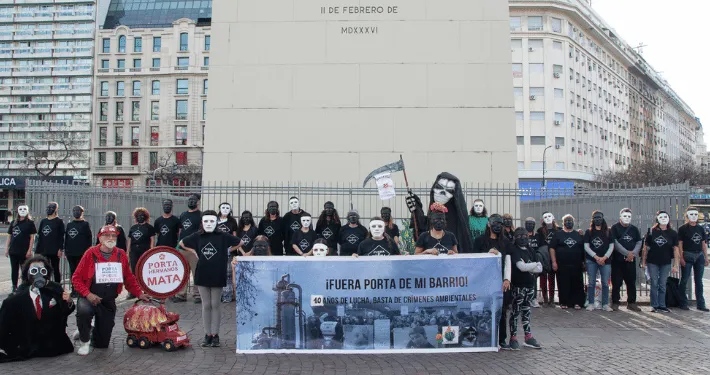
The Inter-American Commission on Human Rights (IACHR) has decided to open the case filed by Fundeps together with local residents and will investigate the international responsibility of the Argentine State for human rights violations resulting from the illegal operation of the Porta Hnos. S.A. plant in the San Antonio neighborhood of the city of Córdoba. After years of non-compliance by both the company and the provincial government, the sustained struggle of the Women United in Defense of a Healthy Environment (VUDAS) has thus reached one of its most significant milestones.
With this decision, the petition submitted to the Inter-American System has moved beyond its initial stage and has become Case No. 15,978. The Commission will now examine the merits of the case—that is, whether the Argentine State failed to fulfill its obligation to protect fundamental rights, including the right to a healthy environment, health, citizen participation, access to information, and effective judicial protection.
This development is the result of more than a decade of community organizing and strategic litigation led by the affected community, whose members continue to demand compliance with environmental legislation and with judicial decisions issued in Argentina.
The decision also reflects the Commission’s assessment that the complaint warrants international scrutiny of the Argentine State’s conduct in response to this socio-environmental conflict. This is the first industrial pollution case in Argentina to reach this stage within the Inter-American Human Rights System.
More Than Ten Years of Non-Compliance
The conflict began in 2012, when Porta Hnos. expanded its plant to produce bioethanol without first carrying out the Environmental Impact Assessment (EIA) required by law. Since then, local residents have reported serious impacts on health and the environment, pursuing a sustained strategy of administrative and judicial claims, as well as community organizing, to demand that the company comply with the applicable regulations.
In 2016, VUDAS filed a collective environmental protection action demanding that Porta Hnos. comply with the environmental regulations in force. In December 2019, Federal Court No. 3 of Córdoba ordered the company to carry out the Environmental Impact Assessment (EIA) required under Provincial Law No. 10,208, including the corresponding public participation process.
In December 2020, the Federal Court of Appeals upheld that ruling in full. Six years later, that obligation remains unfulfilled.
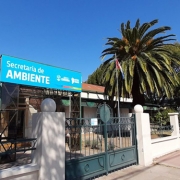
Between 2021 and 2026, both Porta Hnos. and the Secretariat of Environment of the Province of Córdoba argued that environmental audits, monitoring activities, and technical reports were sufficient to demonstrate compliance with the court ruling. The Federal Judiciary repeatedly rejected this position, reaffirming that none of these instruments can replace the Environmental Impact Assessment procedure required by law or guarantee citizens’ right to participate in environmental decision-making processes.
A New Ruling Confirms Porta’s Non-Compliance and Questions the Provincial Government’s Actions
On August 3, the Federal Court of Appeals of Córdoba ruled once again on the case and confirmed, yet again, that Porta Hnos. continues to fail to comply with the final judgment issued in 2019. This new ruling goes even further. The Court expressly questioned the actions of the Secretariat of Environment of the Province of Córdoba, stating that it was “striking” that the agency had adopted Porta Hnos.’s arguments as its own and considered an administrative authorization sufficient, despite the existence of a final judgment ordering the completion of an Environmental Impact Assessment under Law 10,208.
The Court recalled that public participation is an essential component of the environmental assessment process, rather than a mere formality. It also emphasized that the fact that the plant has been operating for years does not exempt the company from complying with the law or with judicial decisions. On the contrary, the Court held that the incorporation of bioethanol production reinforces the need to carry out the legally required procedure in order to assess the potential environmental impact of this new activity.
To date, Porta Hnos. continues to operate without having carried out the Environmental Impact Assessment ordered by the courts, while the provincial environmental authority continues to fail to enforce that obligation, disregarding both the applicable legislation and a final judicial ruling.
The IACHR Will Examine the Argentine State’s Responsibility
This prolonged situation of violations of fundamental rights and systematic non-compliance with environmental regulations is what led to the case being brought before the Inter-American Human Rights System. The Inter-American Commission’s (IACHR) decision to open the case represents a milestone in the community’s pursuit of justice, as it means that an independent international body will examine whether the Argentine State failed to fulfill its obligations to prevent, protect, and guarantee the human rights of affected individuals.
At this new stage, the Commission will have to determine whether the Argentine State acted with due diligence or whether, on the contrary, the actions and omissions of public authorities allowed the alleged violations to continue for more than a decade. Among other issues, it will examine the actions of public bodies responsible for environmental oversight and the effectiveness of the administrative and judicial responses provided in the face of a ruling that, more than six years after becoming final, has still not been fully enforced.
The opening of the case also constitutes recognition of the legal and institutional significance of the complaints submitted by VUDAS. From this point forward, the Argentine State will have to respond before the IACHR to the alleged violations, and the Commission will determine whether it is appropriate to declare the State internationally responsible and issue recommendations to remedy the rights violated and prevent similar events from occurring again.
In this context, the recent ruling by the Federal Court of Appeals of Córdoba constitutes particularly relevant evidence, as it confirms that the company continues to fail to carry out the Environmental Impact Assessment ordered by the courts and that the alleged violations persist to this day.
Beyond its significance for the people directly affected, this case could become one of the first cases before the Inter-American System to examine a State’s responsibility for failing to exercise environmental oversight over an industrial plant located within an urban area, as well as for the prolonged non-enforcement of an environmental judgment. It is a case with the potential to contribute to the development of Inter-American standards on environmental justice, citizen participation, and the enforcement of environmental judgments.
The Case Moves Forward Amid a Scandal Shaking the Federal Judiciary
The case’s progress before the IACHR also coincides with an event of serious institutional significance. In July 2026, the Office of the Federal Prosecutor initiated a criminal investigation into federal judges Abel Guillermo Sánchez Torres and Graciela Susana Montesi for the alleged commission of the offense of accepting improper benefits.
According to the prosecutor’s filing, both judges allegedly accepted a round-trip flight on a private aircraft between Córdoba and Punta del Este, a benefit that prosecutors consider prima facie incompatible with the Public Ethics Law. The investigation also alleges that the trip may have been connected to companies and business groups that had pending cases before those same judges, including the environmental dispute involving Porta Hnos.
Although the investigation is ongoing and there has been no judgment establishing criminal liability, the matter is of considerable institutional importance. The judges under investigation were involved at different stages of the litigation concerning Porta Hnos. The allegations raised by the federal prosecutor’s office therefore deepen concerns regarding the guarantees of judicial independence and impartiality in a case that has remained unresolved for more than ten years, with no effective solution for the affected community.
A New Stage in the Pursuit of Justice
After more than a decade of complaints, multiple favorable judicial rulings, and repeated failures by both the company and the provincial government to comply with their obligations, the Inter-American System will now begin examining the international responsibility of the Argentine State.
At this point, the conflict is no longer solely about a company’s failure to comply. It also calls into question the actions of the State, which for years allowed a final judicial ruling to remain unenforced while the rights of a community continued to be violated. This is precisely the core of the case that is now entering a new stage before the Inter-American Commission on Human Rights.
For VUDAS, this new step also represents recognition of years of community organizing, perseverance, and defense of everyone’s right to live in a healthy environment.
Authors:
Ananda Lavayén, Maria Laura Carrizo
Contact:
lauracarrizo@fundeps.org