Abortion Access in Córdoba: Progress and Ongoing Challenges in Implementing Law 27.610
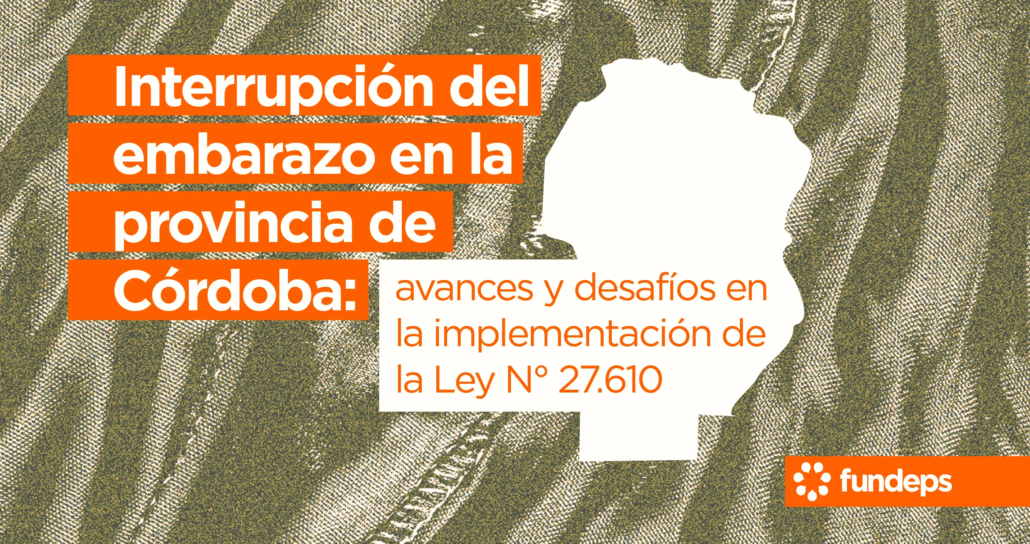
More than five years after the enactment of Law 27.610, Fundeps presents a provincial report that systematizes progress, barriers, and good practices in access to voluntary and legal abortion in Córdoba. The report provides evidence produced in collaboration with healthcare teams and feminist activists, within a challenging national context for the protection of sexual and reproductive rights.
More than five years after the enactment of Law No. 27,610, which guarantees the right to voluntary and legal termination of pregnancy (IVE/ILE), effective access to safe abortion continues to face implementation challenges that require ongoing monitoring, evidence generation, and sustained strategies to strengthen public policy.
Within this framework, the Fundación para el Desarrollo de Políticas Sustentables (Fundeps) presents the study “Termination of Pregnancy in the Province of Córdoba: Progress and Challenges in the Implementation of Law No. 27,610,” which systematizes persistent barriers and good practices within the province’s public healthcare system.
This report is the result of research conducted between May and October 2025, aimed at identifying the real conditions of access to sexual and (non-)reproductive health services in Córdoba. Based on a participatory survey of healthcare providers, the study—carried out by Consuelo González Clariá in coordination with Fundeps’ Gender and Diversity Area—provides relevant information to improve service implementation and consolidate rights-based practices, particularly in adverse contexts.
The research adopted a mixed qualitative and quantitative approach. It included 80 surveys of healthcare workers across different departments and jurisdictions of the province, analyzed through non-probabilistic descriptive statistics, as well as five semi-structured interviews selected through purposive sampling. The survey was answered primarily by family or general medicine professionals (51.2%) and social workers (22.5%), and to a lesser extent by professionals in gynecology and obstetrics (11%) and psychology (7.5%). This reflects the interdisciplinary nature that the guarantee of abortion rights currently assumes within the public health system.
A Contextualized Diagnosis of Abortion Access in the Province
The findings show a sustained process of expansion and normalization of abortion services in the province. Termination of pregnancy—whether through misoprostol alone, the combined misoprostol and mifepristone regimen, or Manual Vacuum Aspiration (MVA)—is guaranteed at all levels of care, with regional variations.
Nearly 80% of respondents stated that the procedure is resolved within one or two consultations, reflecting simplified care processes and strengthened institutional pathways.
Challenges persist in the implementation of the instrumental MVA procedure, which remains concentrated in certain health centers with established experience, alongside some more recent experiences at the primary and secondary levels of care. Only 22% of respondents reported that MVA is performed at their institutions. The main obstacles include lack of technical training, supervised practice, coordination with emergency services, and the availability of adequate recovery space and restroom facilities.
Regarding institutional support for healthcare teams providing abortion services, significant differences were observed between the capital city and the rest of the province. In the city of Córdoba, most professionals reported receiving “considerable” (55%) or “strong” (25%) support to provide IVE services. In contrast, the interior of the province presents a more uneven scenario: 90% of responses were distributed almost evenly among “strong,” “considerable,” and “limited” support, with lower levels of support particularly in the northern and western regions.
Institutional conflicts are concentrated mainly in pharmacy, emergency, and gynecology departments. A notable good practice identified is administrative diligence, which helps build internal alliances and foster trust by associating IVE teams with values such as transparency and responsibility.
Interviews confirm that institutional recognition of abortion services was neither automatic nor linear. The knowledge, commitment, and legitimacy of teams were built over time through sustained training, interdisciplinary work, consensus-building, and accumulated institutional experience.
Precarious hiring conditions undermine team stability and service sustainability. While permanent positions are concentrated in the capital, primary care centers in the interior rely mainly on independent contractor arrangements (monotributo), which also contribute to burnout among those who guarantee this right daily.
Persistent Barriers and Good Practices Sustaining Access
Although progress is evident, the mapping identifies structural barriers that continue to shape access, especially outside the capital. More than half of respondents indicated that users face transportation-related difficulties (52%), followed by staff shortages (41%), and obstacles in obtaining appointments and broader economic constraints (33.8%).
In terms of available resources, only 20% reported difficulties accessing medications, with mifepristone identified as the most problematic supply, followed by misoprostol. When supplies are lacking, 50% suspend the procedure and refer the patient elsewhere, while 43% file a formal complaint. This situation is mitigated by the institutional decision of both the provincial government and the municipal government of Córdoba to guarantee access to the procedure despite national-level cuts in medication distribution. The presence of feminist networks within healthcare spaces, administrative structures, and civil society organizations also plays a fundamental role in ensuring access.
Slightly more than half of respondents received specific training in IVE, with marked regional disparities.
The study also revealed instances of mistreatment toward service users: one-third of professionals identified such situations in their health centers, although underreporting is possible.
Conversely, good practices are widely extended in care for children and adolescents. However, challenges remain in providing care to LGBTIQ+ populations and people with disabilities, linked to difficulties in sustaining interdisciplinary approaches under current labor conditions.
A Collective Process in a Challenging Context
The presentation of this report takes place within a restrictive national scenario marked by the weakening of public policies and reduced funding for civil society organizations. In this context, reaffirming the validity of Law 27,610 and ensuring its institutionalization beyond changing administrations is crucial. The State, at all levels, is obligated to guarantee timely, dignified, and quality access to voluntary termination of pregnancy and to actively remove the barriers that hinder it.
Today, implementation is sustained by a historical network of feminist collectives, grassroots activism, social organizations, and the commitment of healthcare teams.
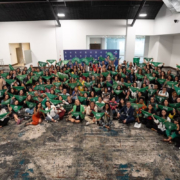
On December 9, at the Museum of Anthropology of the National University of Córdoba (UNC), Fundeps presented preliminary findings at the event “Access to Abortion in Córdoba: Perspectives and Resources for Strengthening It.” The gathering brought together feminist activists, healthcare teams, public officials, and civil society organizations. Key findings were shared, along with a digital resource guide for healthcare teams—featuring rights-based guidelines, publications, and audiovisual materials—and a communication campaign aimed at young users to strengthen access to clear, reliable, and timely information.
Sustained Commitments from Fundeps
Through its Gender and Diversity Area, Fundeps worked intensively throughout 2025 to strengthen sexual and (non-)reproductive rights, even amid a deep crisis for social organizations. Key initiatives included the Second Provincial Meeting of Health Professionals: “Networks of Commitment and Care: MVA Practice in Córdoba and Access to Abortion for Children, Youth, and Diverse Communities,” as well as MVA training sessions for healthcare teams in Santa Rosa de Calamuchita, Mina Clavero, and Del Campillo, in coordination with the Directorate of Adolescence, Youth, and Adulthood.
Additionally, the organization continued promoting Comprehensive Sexual Education (ESI) through workshops with secondary-level teachers and students, in collaboration with the ESI Diploma Program at the Faculty of Philosophy and Humanities and in coordination with the Unión de Educadores de la Provincia de Córdoba (UEPC).
A self-paced virtual course on access to legal abortion in Córdoba has also been developed and will be available starting in March 2026.
This work would not have been possible without collaboration with the Comprehensive Health Clinic Team, the Directorate of Adolescence, Youth, and Adulthood, the ESI Diploma Program of the Faculty of Philosophy and Humanities, La Casita Trans, UEPC, and the daily commitment of feminist activists and healthcare teams who often guarantee access anonymously.
The report we present is one more tool to continue strengthening networks and building joint strategies to defend a hard-won right.
We invite activists, healthcare teams, social organizations, public officials, and all those committed to strengthening abortion rights to read, share, and use this report as a resource for collective action.
Guaranteeing access to abortion is not only about complying with the law—it is about sustaining, every day, a public policy grounded in social justice and human rights.
Author:
Carola Bertona, carolabertona@fundeps.org
Contact:
Romina Pezzelato, romina.pezzelato@fundeps.org