Civil Society Organizations and Communities Call for Respect for Rights at the IDB Annual Meeting in Asunción
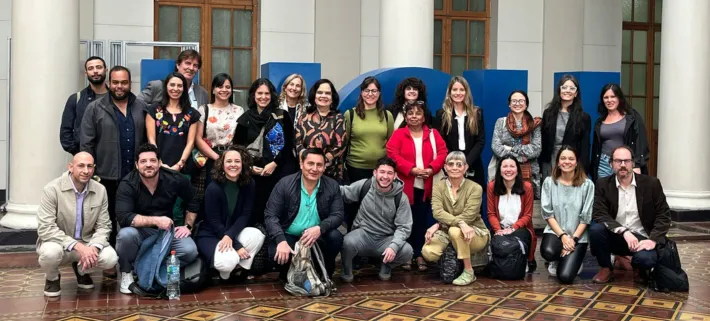
Civil society organizations from Latin America and the Caribbean will participate this week in the Annual Meeting of the Inter-American Development Bank (IDB) Group, which will take place in Asunción from March 11 to 14. The aim is to raise concerns about the direction of the Bank’s investments and to demand that its operations respect human rights, protect nature, and ensure that communities can decide whether projects are developed in their territories and participate effectively in decision-making from beginning to end.
Organizations that are part of the IDB Working Group will use the Assembly as an opportunity to hold meetings with Bank authorities, governments, and other stakeholders. Among the issues we seek to place on the agenda are the growing restrictions on civic space in the region, the risks associated with the commodification of nature, the role of the IDB in the Amazon, the development of regional infrastructure corridors, and the challenges of advancing a truly just energy transition.
Participation Agenda
During the week of the Assembly, we will participate in various dialogue and coordination activities.
On March 9, a workshop will be held with Paraguayan organizations, in collaboration with local groups such as Henoi, Sunu, Axial, and Climate Reality, to analyze the impacts of IDB-financed projects in the country and strengthen regional civil society coordination.
On March 10, a full-day working session with the Bank will take place to discuss its Civil Society Engagement Strategy and Action Plan.
On March 11, Suhayla Bazbaz, Director of Community Cohesion and Social Innovation (Mexico) and a member of the IDB Working Group, will participate in the IDB–Civil Society/Stakeholders Forum in the panel “The Importance of Multilateral Engagement with Civil Society Organizations: Challenges and Perspectives,” focused on the challenges of ensuring informed and meaningful participation of civil society in the Bank’s decision-making processes.
That same day, a meeting is scheduled with the Bank’s President, Ilan Goldfajn. These exchanges are part of an ongoing dialogue process that the working group has maintained with the IDB presidency in recent years. Dialogue sessions between the IDB and social organizations will also be held on the following topics: regional logistics corridors, the Amazonia Forever program, the new procurement policy, and restrictions on civic space.
Concerns Regarding the South Connection Program
Within the framework of the Assembly, we will present observations on the South Connection Regional Program for South American Connectivity (Conexión Sur in Spanish), an IDB initiative aimed at promoting regional corridors for transport, logistics, energy, and digital connectivity in South America.
While we recognize the importance of improving regional connectivity, the program’s current design poses social, environmental, and governance risks if substantial changes are not introduced.
The program prioritizes global competitiveness and integration into international value chains, with a strong emphasis on logistics corridors, ports, and energy transmission, while paying limited attention to territorial impacts, local economies, and the needs of the communities living in the areas where this infrastructure will be developed.
Without complementary local productive development strategies, the new corridors could reinforce economic patterns based on the export of raw materials and extractive activities, without generating substantial improvements in the quality of life of local populations.
In initiatives such as support for logistics corridors in the Amazon and large-scale energy transition projects, the IDB risks repeating past mistakes and promoting false solutions that may generate severe socio-environmental consequences, largely due to the lack of effective dialogue spaces with civil society organizations that place the needs and rights of local communities at the center of discussions.
Brent Millikan, GT Infraestrutura (Brazil)
IDB Project in Paraguay
The Bioceanic Road Corridor, financed by the IDB through a USD 200 million loan to the government of Paraguay, aims to connect the port of Santos in Brazil with ports in northern Chile, with the goal of facilitating international trade and improving access to markets in the country’s western region.
However, local organizations and communities have expressed concern about the lack of adequate consultation with Indigenous peoples such as the Ayoreo, as well as the project’s potential impacts. These could include displacement, loss of livelihoods, risks of gender-based violence, pressure on Indigenous territories, and damage to biodiversity in one of the most fragile areas of the Paraguayan Chaco.
Participation and Transparency
The working group has also expressed concern about the limited participation of civil society, Indigenous peoples, local communities, and Afro-descendant populations in the design of several of the Bank’s strategic initiatives, including Conexión Sur, the Amazonia Forever program, and the Biodiversity and Natural Capital Action Plan.
These processes have offered few opportunities for meaningful dialogue with the actors living in the territories where these initiatives will be implemented. In the case of the Biodiversity Plan, for example, organizations warn that despite references to inclusive approaches in the document, there were no substantive opportunities for exchange with these groups during its development.
Strengthening early participation, transparency, and accountability is key to improving the quality of the Bank’s policies and preventing socio-environmental conflicts.
In this context, part of the agenda will be dedicated to a dialogue with Bank teams to present an assessment of current trends in restrictions on civic space. We hope to share recommendations from civil society and learn about the concrete steps the Bank is taking to address these situations.
A Just Energy Transition
Finally, we will present our concerns regarding how the IDB is addressing the energy transition in the region. While we recognize the urgency of moving toward low-carbon energy systems, the Bank’s current approach continues to reproduce “business-as-usual” dynamics.
Among the main criticisms is the continued support for fossil fuel infrastructure, including the promotion of gas as a transition technology, as well as the expansion of mining and green hydrogen in the region without adequate processes for information sharing, consultation, and impact assessment. In response, we call on the IDB to prioritize social and environmental justice, strengthen the implementation of safeguards, guarantee the effective participation of affected communities, and develop an energy plan aligned with the Paris Agreement and human rights.
“Through instruments such as the IDB Initiative on Minerals in Latin America and the Caribbean—through which the Bank presents itself as a key multilateral partner for the extraction of critical minerals—the IDB seeks to position itself as a reference in financing the energy transition. However, this strategy places Latin America and the Caribbean at risk of becoming a sacrifice zone for ‘critical minerals’ for the global transition, with limited participation of communities and Indigenous peoples in decision-making and in defining policies and projects. We urge the IDB to prioritize social and environmental justice, ensuring the effective participation of affected communities and promoting a truly just transition.”
Gonzalo Roza, Fundeps (Argentina)
In a regional context marked by the climate crisis, socio-environmental conflicts, and shrinking civic space, transparency, public participation, and accountability are essential conditions to ensure that investments in infrastructure and energy truly contribute to sustainable development and the well-being of communities.
Contact
Gonzalo Roza, gon.roza@fundeps.org