Tag Archive for: Global Governance

In the framework of the process of reviewing the environmental and social policies of the Inter-American Development Bank, we participated in public consultations held in the cities of Buenos Aires and Washington DC. Together with a group of civil society organizations, we raised certain concerns and recommendations regarding the review and consultation process, as well as the content of the draft of the proposed Environmental and Social Policy Framework.

“Below, we offer a google translate version of the original article in Spanish. This translation may not be accurate but serves as a general presentation of the article. For more accurate information, please switch to the Spanish version of the website. In addition, feel free to directly contact in English the person mentioned at the bottom of this article with regards to this topic”.

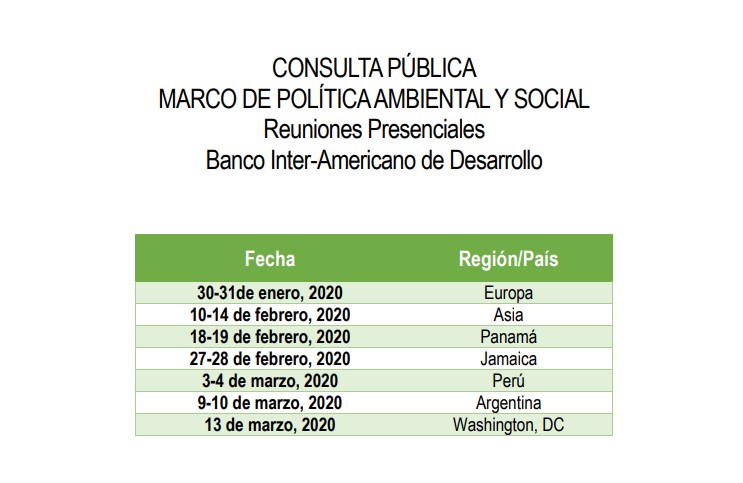
In January, the IDB began the public consultation process on a new Environmental and Social Policy Framework (MPAS), which has included, up to now, face-to-face and virtual consultations in the cities of Brussels (Belgium), City of Panama (Panama), Kingston (Jamaica), Lima (Peru), Buenos Aires (Argentina) and Washington DC (United States). In addition, the reception of a first round of virtual comments regarding the draft is contemplated until April 20.

From Fundeps, we participated both in the face-to-face public consultation carried out on March 10 in the City of Buenos Aires and in the consultation carried out on March 13 in the city of Washington DC. In turn, we plan to send written comments regarding the draft released by the Bank in the framework of a joint work we have been carrying out with a group of civil society organizations in the region.

In general terms, the draft MPAS proposes two different sections: a Policy Statement that basically establishes the roles and responsibilities that will correspond to the IDB in terms of compliance with the socio-environmental provisions and requirements of the new Framework; and a second section that includes the detail of the Environmental and Social Performance Standards with which the borrowers must comply. The draft proposes the inclusion of ten Standards: 1. Assessment and management of environmental and social risks and impacts; 2. Work and working conditions; 3. Efficiency in the use of resources and pollution prevention; 4. Community health and safety; 5. Land acquisition and resettlement; 6. Conservation of biodiversity and sustainable management of natural resources; 7. Indigenous peoples; 8. Cultural heritage; 9. Gender equality; and 10. Stakeholder participation and disclosure of information.

The IDB has argued that the proposed MPAS is based on five guiding principles: the non-dilution of current policies; results orientation (that is, effective implementation); the proportionality of the responsibilities and the established requirements regarding the level of risk of the project; transparency and the idea of ​​”doing good” beyond “doing no harm”.

However, the analysis that we have carried out together with the rest of the organizations involved in this process allows us to glimpse that, at least as proposed, the current draft is far from effectively complying with each of these guiding principles. In general terms, a dilution of policies and socio-environmental protection can be seen in many of the Performance Standards; it is not clear how effective the implementation of said MPAS will be; The idea of ​​proportionality is not reflected in many sections of the draft; and practically no sections can be identified in the draft that propose “doing good” in the sense that the Bank proposes: that of facilitating more sustainable social and environmental results.

In turn, the entire review process being carried out by the Bank is far from being transparent and “offering significant opportunities for participation by all interested parties” as established by the IDB. Precisely, as usually happens with the consultation processes carried out by the IDB, this process has had important shortcomings, especially in the objective of achieving effective participation by stakeholders.

We have duly expressed all these criticisms and problems to the Bank’s representatives in each of the consultations in which we participate and we accompany them with specific recommendations and suggestions that they should take into account when preparing the next draft of the Framework. In addition, these recommendations will be sent in writing in advance before the expiration of the term to send comments virtually.

Having completed the public consultations and once the period for receiving comments and suggestions virtually ends, the Bank must prepare a new draft of the Environmental and Social Policy Framework to be presented to the Board of Directors. Subsequently, the new Draft will be published for a new round of virtual comments for a period of 30 days, according to the Public Consultation Plan approved by the Bank’s Executive Board. Upon completion of this period, the IDB will develop the final version of the Framework that will be submitted to the Policy and Evaluation Committee of the IDB Board for final evaluation.

The IDB is a member of the IDB Group. It is a source of long-term financing for the economic, social, and institutional development of Latin America and the Caribbean and, unlike IDB Invest that invests in private sector projects, the IDB is responsible for investment in the public sector.

More information

This working document addresses one of the new multilateral development banks: the New Development Bank (NDB) of the BRICS. It develops its beginnings, structure, policies and strategies, the projects it has underway and the role that China has in the Bank.

With the law 27,328 approved in 2017 on the modality of Private Public Participation contract, the previous Argentine Government intended, among other objectives, to reduce the country’s infrastructure deficit, while leveraging private investment. After having confirmed only a handful of projects of those initially raised, and taking into account the criticisms existing in other countries and regions regarding this type of contracting, the question that arises is how effective this contracting modality has been so far , and what decision the new Government will make regarding the continuity or not of both the confirmed and pending projects; as of the decision to promote PPPs to boost infrastructure in the country.

“Below, we offer a google translate version of the original article in Spanish. This translation may not be accurate but serves as a general presentation of the article. For more accurate information, please switch to the Spanish version of the website. In addition, feel free to directly contact in English the person mentioned at the bottom of this article with regards to this topic”.

The contract modality of Public Private Partnerships (PPPs) or Public Private Participation (PPP) are medium or long term agreements between the State and a private sector company. PPPs apply to projects related to public infrastructure and the provision of social services that have a deficit in their financing. Therefore, together with private and governmental agents, it participates in the provision of services such as water, transportation, road infrastructure, energy, among others. (More information about APPs)

The need for capital, technology and resources has been and is necessary in our country due to the deficit that exists in infrastructure. Therefore, the PPP contract modality has been presented as an alternative to end or reduce this imbalance. Since 2000, Argentina has a legal framework that regulates PPPs, one is Decree No. 1299 of year 2000 and the other is Decree No. 967 of year 2005. However, due to changes in the international economy , these instruments were obsolete, so in 2017 a new law was approved that regulates the application of the PPP, Law No. 27,328 and its Decree 118/2017. The difference between this instrument and the previous ones is that the current one excludes or limits the prerogatives of public law of the Administration as the ability to unilaterally modify the contract, making it impossible for the private contractor to invoke the breach of the State to suspend its benefits, among others.

The Subsecretariat of PPP is the body responsible for regulating this type of contract modality. This unit, before the assumption of the current government, was in charge of 5 National Directorates: the Executive Coordination of PPP Projects, Energy and Mining Projects, Transport Projects, Communications and Technology, Water Projects, Sanitation and Housing, and Health, Justice and Education. Currently, on the occasion of the change of government, modifications are being made in this unit. So now, the PPP Subsecretariat is responsible for 3 national directorates: the National Directorate of Information and Monitoring of PPP Projects, the National Directorate of Technical Evaluation of PPP Projects and the National Directorate of Legal and Regulatory Project Analysis of PPP.

It is important to mention that the High Level Reporting Mechanism (MRAN) was also implemented in the PPP Tenders that collaborates with the Anti-Corruption Office. This mechanism is a tool for preventing corruption and / or committing ethical irregularities. It aims to provide private sector companies and other parties that are participating in the bidding process, a reliable, specific channel known to all to report alert situations such as unethical behavior and offer of bribes.

As for the projects, once the law entered into force, an Argentine Government Plan was presented that contemplated the completion of 60 PPP projects between 2018-2022 for USD 26 billion. In this framework, from Fundeps, requests for information have been made to the national State to consult for more information on this type of contract such as the organizational structure that guarantees it, the entities responsible for monitoring, and what are the projects that are in March and in what sectors.

One of the largest projects currently being developed is the ‘Highway Network and Safe Routes PPP- Stage 1’ which began in June 2018, being awarded to National and International Public Tenders for the contracting of the design, construction, expansion, improvement, repair, remodeling, operation, maintenance and commercial exploitation of different National Road Corridors. Just to mention, this process had the participation of 10 consortia composed of 19 national and 7 international companies that submitted 32 offers in total.

However, when asked about the participation in this type of projects of any of the international financial institutions such as the IDB, IDB Invest or World Bank, from Nation they could not provide us with such information, despite the fact that they exist on the websites of said projects institutions, information linked to the realization of works with this type of modality.

Undoubtedly, the short period of validity of the new regime, as well as its poor implementation in only a handful of projects to date, added to the context of the economic crisis that the country has experienced in recent years, make it impossible to do an accurate balance of how effective or not this contracting modality has been to achieve the objectives set.

With the new government, it will be necessary to follow up on the projects that are underway and observe what position it will take according to the projects that are still to begin, since the package of projects covers from the year 2018 to 2022. In turn, It is worth considering whether the new government will follow in the footsteps of its predecessor, seeking to promote this type of contracting modality to carry out infrastructure works and attract private investment or if, on the contrary, it will resort to either more traditional options that are based on strong participation and financing of the public sector; or rethinking the APP mode in some way.

Regardless of this, and already having legislation that allows this type of contracting modality, from Fundeps we consider it a priority that, when thinking and promoting this type of projects, the problems and deficits that have had in the past are taken into account and they currently have PPPs in other countries of the region and the world. Problems that are widely documented and that can serve as lessons learned to avoid damages and enhance the benefits of this contracting modality to strengthen national infrastructure.

* The information provided has been modified according to the website of the Head of Cabinet where the new government management has modified the number of national addresses. It is important to clarify that they are still updating the contents of the site according to Decree 7/2019.

Authors

Sofia Brocanelli

Gonzalo Roza

Contact

Gonzalo Roza, gon.roza@fundeps.org

The Inter-American Development Bank (IDB) began the process of public consultations on the new Framework for Environmental and Social Policy. It will have both face-to-face and virtual instances and will be extended throughout the year 2020.

“Below, we offer a google translate version of the original article in Spanish. This translation may not be accurate but serves as a general presentation of the article. For more accurate information, please switch to the Spanish version of the website. In addition, feel free to directly contact in English the person mentioned at the bottom of this article with regards to this topic”.

With a statement on its website, the IDB announced the start of virtual and face-to-face public consultations on the draft of the new framework for environmental and social policy. According to the bank, this new framework aims to strengthen the environmental and social sustainability of the bank’s operations and, in turn, be more effective in responding to the challenges faced by the countries of the region to achieve the long-awaited growth. sustainable.

The Environmental and Social Policy Framework contemplates safeguards policies, lessons learned and good practices accumulated over the years. In addition, the policy mentions the bank’s commitment to environmental and social sustainability, and the 10 performance standards that borrowing member countries must meet.

Also, the draft policy contemplates environmental and social risks and impacts and highlights advances in human rights, gender equality, non-discrimination and stakeholder participation.

According to the consultation plan approved by the IDB Executive Board, the public consultation process will be significant, inclusive and transparent. However, a large part of civil society that has been working on agendas linked to the IDB over the last few years doubt that this is really the case, being guided by the bad experiences of the most recent public consultations carried out by the institution, which They characterized by their shortcomings in terms of public participation and transparency.

In-person consultation processes will take place at the Bank Headquarters in Washington D.C. and in some countries of Latin America and the Caribbean, Europe and Asia. Those interested in participating in face-to-face consultations may do so by registering here.

On the other hand, those who want to participate in virtual consultations, can send comments on the draft of the new policy through the website www.iadb.org/es/mpas or by sending an email to bid-mpas@iadb.org. The first phase of comments can be made until April 17.

Why is it important to participate?

For several reasons, it is necessary that civil society, citizens and, above all, indigenous communities and communities affected or potentially affected by IDB or IDB Invest operations actively participate in this process, contributing their experience and its recommendations and suggestions regarding the environmental and social safeguards of the institutions.

First, because both the IDB and the IDB Invest are, today and despite the diversification of financial actors operating in the region, key actors in financing for development in Latin America and the Caribbean. According to the Bank itself: in 2018, with a historical amount of US $ 17,000 million approvals, the IDB and the IDB Invest were consolidated as the main source of multilateral financing for Latin America and the Caribbean. The IDB approved a total of 96 sovereign guaranteed loan projects for a total financing of more than US $ 13.4 billion, and disbursed more than US $ 9.9 billion. In turn, 2018 was a record year for IDB Invest, with approvals of US $ 4,000 million, 26% more in volume and 21% more in number of transactions than the previous year. The IDB Invest extended its support to sectors such as infrastructure and Fintech, adding to education, tourism, water and sanitation, transport and energy. In the case of Argentina, the IDB has historically been the main multilateral partner for the country’s development, with an average of recent annual approvals of US $ 1,360 million. The current active portfolio with the public sector is 54 operations for an approved amount of US $ 9,206.4 million and an unpaid balance of US $ 3,874.7 million, according to the information provided by the Bank itself.

Second, because a robust and effective system of environmental and social safeguards is key to avoiding the impacts at the socio-environmental level that, in many cases, bring infrastructure projects financed by institutions such as the IDB or the IDB Invest. When the design, application or implementation of environmental and social safeguards fails in these types of projects, the impacts and consequences especially in the communities involved are often complex, and unfortunately in many cases, irreversible. Cases such as Camisea in Peru or Hidroituango in Colombia reflect the bitter consequences of the bad, or even the lack of application of socio-environmental safeguards in projects financed by the IDB Group.

Third, because an active, informed, responsible and coordinated participation by the key actors of civil society and the indigenous and affected communities of the region would contribute to the objective of avoiding a possible (and latent) dilution of the system of environmental and social safeguards from both the IDB and the IDB Invest. Recent experiences of dilution of environmental and social regulatory frameworks after review and “modernization” processes not only in related institutions such as the World Bank or the International Finance Corporation (IFC), but also in the national regulatory systems of the countries of The region clearly reflects a trend that the IDB Group seems not to want to escape.

Sofia Brocanelli

Gonzalo Roza

Contact

Gonzalo Roza, gon.roza@fundeps.org

The ICIM, accountability mechanism of the IDB and IDB Invest, on the occasion of increased reprisals towards applicants, has worked to improve the capacity of its team in dealing with these situations. Consequently, it has developed a series of Guidelines to address the risk of reprisals in the management of applications that will take effect in 2020.

“Below, we offer a google translate version of the original article in Spanish. This translation may not be accurate but serves as a general presentation of the article. For more accurate information, please switch to the Spanish version of the website. In addition, feel free to directly contact in English the person mentioned at the bottom of this article with regards to this topic”.

The IDB and the IDB Invest have an accountability mechanism (IAMs), the Independent Consultation and Investigation Mechanism, better known as ICIM.

The accountability mechanisms have been created by the IFIs so that communities can file claims against possible damages that have been caused by the investments that banks make and, therefore, that are not complying with environmental, social standards and transparency according to which the institutions carry out their work. The characteristics of this type of mechanisms are adapted to the UN Guiding Principles on Business and Human Rights, specifically its pillar 3 of access to reparation mechanisms by victims.

However, it has been frequently observed that applicants who file complaints in the ICIM suffer from reprisals, manifested in various ways. This does not cease to endanger the life of the applicants, who in most cases are environmental and / or human rights defenders. In 2018, the mechanism observed an increase in cases where confidentiality is requested for fear of reprisals or acts of intimidation towards the communities in which the Bank-financed project is being developed.

For this reason, the ICIM developed the toolkit ‘Guide for IAMs on measures to address the risk of retaliation in claims management’. This guide aims to assess the level of risk that would involve the intervention of a mechanism and what are the ways to prevent, mitigate, reduce or address it. In both sections, the document provides tools to guide the mechanisms and their respective institutions on what steps should be taken to address these situations.

In Latin America, environmental and human rights defenders suffer constant violations of their rights. For this reason, and in order for financial institutions to become more aware of this problem, the mechanism met with the office of the UN High Commissioner for Human Rights. The central conclusion of this meeting was to ratify the centrality that human rights should occupy in financing for sustainable development. As a result, the ICIM, starting in 2020, will have the ‘Guidelines to address the risk of retaliation in the management of applications’.

The Guidelines have been created so that applicants, given the risk of reprisals before or after making a complaint before the mechanism, can effectively apply the MICI-IDB and MICI-IIC Policies. They constitute a tool to implement in regions or areas where there is simply the risk of retaliation.

The Guidelines will be used according to factors that create, increase or aggravate the risk of retaliation by applicants before the Mechanism; It is also intended to work with applicants to reduce and address the risk factors that are identified.

The guidelines document addresses the principles for case management where retaliation risk is detected. Some of these principles are:

  • Zero tolerance for retaliation,
  • Participatory and continuous risk assessment;
  • Action without damage;
    Honesty and transparency about the ICIM mandate on reprisals.

The guidelines should serve as a guide to train the entire work team in Retaliation Risk Management, disseminate the guidelines and provide training to other IDB Group units. In addition, it makes the document available for any institution to use, provided they do not alter its content.

Finally, the guidelines will have to be shared with applicants at the registration stage to analyze the existence of retaliation risk. If so, an ICIM team must prepare a Retaliation Risk Analysis (ARR). According to the level of risk identified in the analysis, the Mechanism team will develop a Joint Plan to reduce retaliation risk (PCRR) that may establish prevention or mitigation measures.

If these guidelines are applied correctly, it would mean an advance in the protection of environmental and human rights defenders, as well as communities, who make claims due to the negative social and environmental impacts of projects financed by international financial institutions.

More information

Author

Sofia Brocanelli

Contact

Gonzalo Roza, gon.roza@fundeps.org

On the occasion of the public consultation on the draft of the Profile of the Access to Information Policy of the Inter-American Development Bank (IDB), civil society organizations, including Fundeps, have made comments and recommendations to the Bank in order to generate one more policy effective and efficient.

On a public consultation on the draft of the Profile of the Access to Information Policy of the Inter-American Development Bank (IDB), civil society organizations, including Fundeps, have made comments and recommendations to the Bank in order to generate one more policy effective and efficient.

The Executive Board of the IDB approved on November 4 the beginning of the process for the revision of its policy of access to information, whose last update was in 2011. This process will be open to virtual and face-to-face public consultation, and will be extended until May 2020.

“Below, we offer a google translate version of the original article in Spanish. This translation may not be accurate but serves as a general presentation of the article. For more accurate information, please switch to the Spanish version of the website. In addition, feel free to directly contact in English the person mentioned at the bottom of this article with regards to this topic”.

In 2018, the private sector investment arm of the Inter-American Development Bank, the IDB Invest, carried out an update of its access to information policy; in 2020, it will be the IDB’s turn, in charge of financing the public sector. According to the Bank, this update will be carried out in two phases of public consultations: the first one, started last November 13, will last 45 days and at the end a document called “Profile of Access to Information Policy” will be prepared. The second phase will have 120 days for review where comments on the consultations will be incorporated and a “Policy Draft” will be prepared. After the deadline, said document will be submitted for the consideration and approval of the Board of Directors scheduled for July 2020.

The consultations are open and free for anyone who wants to participate virtually by answering the questions presented by the IDB here or for an open participation by sending an email to consultapai@iadb.org

On the other hand, face-to-face participations will only be by invitation at the Bank Headquarters in Washington DC and for the second phase it is expected to hold meetings in borrowing member countries during the months of February and March 2020, but they have not yet been confirmed.

With respect to the Bank’s performance in terms of its policy of access to information and transparency, according to the index published annually by the Publish What You Fund called “Aid Transparency Index”, the IDB is in the highest category. However, it is evident that he has been in the same position since 2015, so there have been no improvements since that year. This is disturbing considering that in the period 2011-2015 the IDB climbed from the 14th position in the ranking to the 9th position, stalling in the 7th position from 2015 to the present.

It is considered that the last revision of the policy carried out by the Bank in 2011 resulted in the approval of a policy with high standards of access to information and transparency, although subsequently the implementation of said policy has not been effective. This new update in 2020 opens a door for the IDB not only to strengthen and improve the 2011 policy, but also to make progress in its better implementation. However, there is also a risk that the update will result in a weakening and / or dilution of current policy standards, something that the IDB should seek to avoid.

Taking into account the role played by International Financial Institutions such as the IDB in society and the impact generated by the projects they finance, it is essential that they have an updated, effective and accessible access to information policy according to the highest standards international in the matter; in a way that strengthens its transparency and institutional governance.

Thus, it is expected that this process of updating the IDB’s access to information policy will culminate successfully by actually incorporating the requests expressed in the public consultations so that such revision can increase the problems and good practices of the right to access information. , which not only constitutes a human right in itself; It is also essential to implement other rights.

From Fundeps, we invite you to participate in the process and we look forward to more information regarding face-to-face public consultations in Washington and the rest of the countries of Latin America and the Caribbean; and we will actively participate in this update process seeking not only to avoid a dilution of the policy but, on the contrary, to promote its strengthening and improve its implementation.

The eighth annual United Nations Forum on Business and Human Rights in Geneva was held from November 25 to 27. The Forum was attended by representatives of the Member States, Civil Society Organizations and other interested actors.

“Below, we offer a google translate version of the original article in Spanish. This translation may not be accurate but serves as a general presentation of the article. For more accurate information, please switch to the Spanish version of the website. In addition, feel free to directly contact in English the person mentioned at the bottom of this article with regards to this topic”.

The United Nations Annual Forum on Business and Human Rights is the global platform for evaluating and exchanging lessons learned about efforts to ensure that the UN Guiding Principles on business and human rights are not only theoretical, but applied in practice. More than 2000 people participate, including government, companies, community groups and civil society, law firms, UN agencies, academia, investors, media, among others.

The objective of the annual meetings of the Forum is to serve as an international platform where the actors involved evaluate and analyze the application of the UN Guiding Principles. In addition, it will seek to promote cooperation and dialogue regarding the issue of business and human rights. The meeting chairs the Working Group on Business and Human Rights.

This year, the forum focused on governments demonstrating progress, commitments and plans for the implementation of the State’s duty to protect and strengthen accountability. The agenda focused on what governments have to do in order to promote respect for human rights by companies and encourage them to develop responsible business behavior.

From Fundeps, the business and Human Rights agenda is transversal to all areas. Therefore, we monitor the results of the sessions and the annual Forums in the framework we work on the Guiding Principles and the binding treaty.

The purpose of this document is to bring observations and comments made by civil society organizations to the rules of implementation of the IDB Access to Information Policy Invest.

This document aims to bring observations and comments to the draft of the new Environmental and Social Sustainability Policy of the IDB Invest. These observations are made with the objective of making visible conflicts and problematic problems in the IDB Invest.

This document aims to present the observations and comments to the draft of IDB Invest’s new Environmental and Social Sustainability Policy from a gender perspective, which is practically absent in the current draft. These observations are made with the aim of making conflicts and existing problems in the actions of IDB Invest more visible, related to the violation of rights, inequality, violence and the sexual division of labour, first and foremost.