
The right to Public Education in the crosshairs
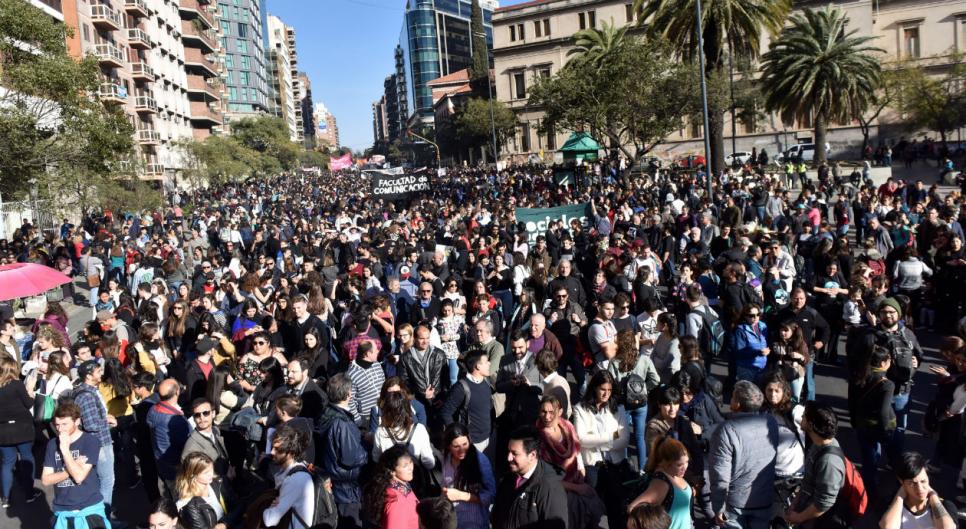
Faculties taken, others closed, others suspending their activities, mass marches, assemblies and students organizing. What is happening in the National Universities? What happens at the National University of Córdoba?
“Below, we offer a google translate version of the original article in Spanish. This translation may not be accurate but serves as a general presentation of the article. For more accurate information, please switch to the Spanish version of the website. In addition, feel free to directly contact in English the person mentioned at the bottom of this article with regards to this topic”.
Since 2016, the teaching conflict continues to escalate. At that time the budget and salaries did not go hand in hand with inflation and the entire academic community rose up against this situation. Also students, being affected by these measures, joined the fight and took the Argentine Pavilion through a decision that was debated and with the approval of the majority of the Interfaculty Assembly. He was denied admission to the Rector Hugo Juri, who sits down to debate the budget of public education at the negotiating table, and many times his political decisions have repercussions throughout the UNC.
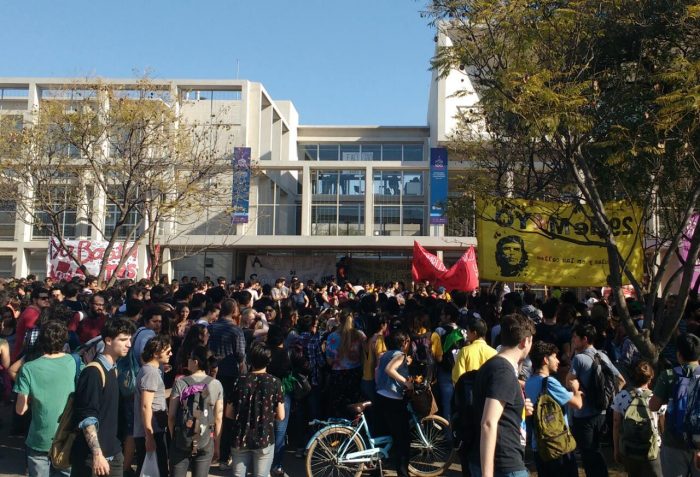
Today the situation is much more critical. They are taken: the Faculty of Psychology, the Faculty of Philosophy and Humanities (Casa Verde), the Fac. Of Arts (CePIA Pavilion), the Faculty of Communication, the Faculty of Social Sciences and a few days ago the decision was taken. Faculty of Architecture, Urbanism and Design after an Assembly attended by more than 1500 students (results: for raising the vote 905 votes, for keeping the vote 849 votes).
In all faculties, assemblies are being held in which not only a strategy is sought in conjunction with the teaching struggle, but also to claim the positioning of the student body, demanding the guarantee of their rights such as effective compliance with the systems of scholarships, payment for ad honorem posts (assistantships and paid assignments), among others. The common denominator of the claims: the right to Public Education.
Why this conflict
What is happening: the generalized economic crisis is reflected in education policies, and it feels even stronger in Public Universities. It is that, “in short, today we are more in front of a delay in the fulfillment of the budget than in the face of a genuine cut. But the magnitude of this delay is such that Universities are forced to function with about half of their resources, in a particularly difficult year due to the devaluation and the substantial increase in rates. ”
According to data from CONADU (National Federation of University Teachers), at the end of the first semester of 2018, only 25% of the annual budget had been executed. In an inflationary context and with a strong growth in the costs of services, this delay has a direct impact on the sustainability of university activities.
Why is education a right that must be fulfilled?
Education is a human right recognized by the international human rights law, particularly and expressly by the International Covenant on Economic, Social and Cultural Rights, approved by our country by law No. 23,313.
This is of vital importance since it is an essential precondition for the exercise of the other human rights. It is a right of a “transversal” nature in relation to other human rights and its dissatisfaction puts at stake the ability to complain about the latter. Its content has been greatly expanded, since it is the budget for the full exercise of individual liberties, the strengthening and development of the human person and the dissemination, respect, and enjoyment of human rights. It is a fundamental tool given that it enables progress to the detriment of economic inequality and collaborates in the processes of emancipation and struggle of those disadvantaged and oppressed sectors.
The Argentine Constitution, since the reform of 1994, has strengthened the protection of the right to education.
The art. 75, inc. 19 orders Congress “to provide research and scientific and technological development, its dissemination and use.” In addition, the article imposes the sanction of laws that “consolidate the national unity respecting the provincial particularities; to ensure the non-delegable responsibility of the state, the participation of the family and society, the promotion of democratic values, equality of opportunities and possibilities without any discrimination; and that guarantee the principles of free and fair public state education; and the autonomy and autarky of national universities. ” Likewise, it must dictate laws that “protect the identity and cultural plurality, the free creation and circulation of the author’s works; the artistic heritage and the cultural and audiovisual spaces “.
It should again be stressed that the educational issue is a non-delegable responsibility of the State, understood in its entirety, that is to say that it covers not only the enactment of laws by the legislative branch in order to guarantee the right to education, but also the implementation of measures taken by the administration (read executive power) to that end, including those measures or positive actions aimed at achieving real equality of opportunities in access.
Now, with regard to public education, this right has as its guidelines gratuity and equity, tending to reinforce equality in a material sense of those marginal, disadvantaged and vulnerable sectors, through contributions, scholarships, subsidies and material aid of the most varied nature. The State is obliged to guarantee and not prevent every person from being educated; to facilitate and promote free access and equal opportunities and possibilities for all to receive and impart education, without any discrimination; to create their official educational establishments, guaranteeing the principles of equality, equity and gratuity; and to encourage and respect pluralistic teaching.
Intimately linked to the right to education, is the right to culture. This right implies an expansive area in which literacy is not enough either through secondary or higher levels. Thus, for the purposes of access to the benefits of culture and participation in cultural life, the State must give impetus to scientific, technological, artistic, literary, etc. progress; of research in all fields, the dissemination of its results and the use of its progress. The State can not exercise regressive policies and retreat as regards its obligation to promote cultural development.
Our Constitution establishes the incorporation of international human rights treaties to our legal system, granting them constitutional hierarchy. The International Covenant on Economic, Social and Cultural Rights, which contains the rights to education and culture, is one of them, so it must be applied with the same force as the constitution itself.
Regarding this treaty, it is important to highlight some observations of the Committee on Economic, Social and Cultural Rights (CESCR) as its official interpreter. These citations highlight the key importance of the right to education, the State’s obligation to provide funds to guarantee it and ensure its availability and accessibility. Likewise, they highlight the obligation to progressively progress towards greater effectiveness of this right and the impossibility of taking retrogressive measures regarding the level of protection of this right.
The mobilization to demand rights
Thousands of students, teachers, scientific graduates and non-teaching workers were present at a massive mobilization in Plaza de Mayo that was echoed throughout the country last Thursday. In Córdoba, the day included a sit-down, a march and a festival for the UNC. “The university is in danger. Defend the salary and the budget” were the slogans taken to the streets to demand that no further progress be made against higher education. This week it was decided to continue with work stoppage until Friday, September 7.
From FUNDEPS, we accompany the claim for measures that guarantee the effective use of economic, social and cultural rights such as the right to education.
Contact
Juan Carballo – juanmcarballo@fundeps.org