• ES
  • EN
Fundeps
  • About Fundeps
  • Team
  • Working areas
    • Environment
    • Democracy
    • Gender
    • Global Gorvernance
    • Health
  • News
  • Publications
  • DONATE
  • Click to open the search input field Click to open the search input field Search
  • Menu Menu
News

UN Rapporteurs Urge the World Bank to Recognize Human Rights in its Policies
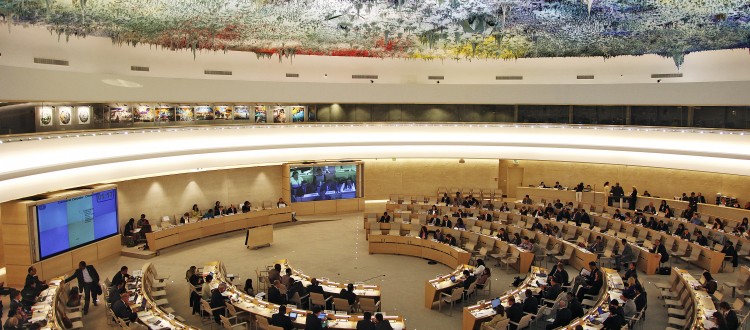
In response to the proposed modifications to the World Bank’s social and environmental safeguards, a large group of UN human rights rapporteurs launched tough critiques of the proposed changes, requesting via a letter addressed to the President of the World Bank that human rights be properly considered in the guarantees that the financial institution demands.

On December 16th of last year, 28 special rapporteurs for the United Nations Human Rights Council sent a collective letter to World Bank President Jim Yong Kim, severely criticizing the proposed modifications to the Bank. These modifications have been in full discussion and have been an ongoing project for FUNDEPS. According to the human rights rapporteurs, the proposed modifications “appear to move in opposition to progress” considering that they would reduce the amount of social and environmental guarantees that the Bank requires when approving loans, especially in regards to human rights. According to the special rapporteurs,“the document seems to go out of its way to avoid any meaningful references to human rights.”

Philip G. Alston, Special Rapporteur on extreme poverty and human rights, maintains that the principal reason for these modifications appears to be the Bank’s intention to compete with alternative financing initiatives (mainly backed by China, Russia, and India) which do not apply these minimum safeguards. Nevertheless, Alston explained that this is not sufficient reason to reduce the existing safeguards, considering that the World Bank, in their Articles of Agreement, are formally committed to the elimination of extreme poverty and to improving the quality of life for people in developing countries. The pursuit of these goals does not line up logically with the proposed modifications.

The authors of the letter hold that “the international community has already accepted that development and human rights are interdependent and mutually reinforcing.” That is why, in keeping with international law, they maintain that the World Bank should consider the relevance of human rights in its programs’ objectives, as well as incorporate human rights into its policies.

Ultimately, after appending a list of well-founded criticisms to the original letter sent to the President of the institution, the rapporteurs recommend that the Bank only finance projects that satisfy the established requirements. Further, they should withhold support from projects that do not comply with human rights obligations. In the screening process for each project, the Bank should rely not only on the information provided by the loan applicant, but should itself carry out the pertinent investigations, keeping in mind the affected or potentially-affected groups, as well as human rights defense groups and civil organizations. In this context, the rapporteurs pointed out that many vulnerable groups remain unprotected under projects funded by the World Bank, an issue that inspired protests at the Bank’s most recent annual meetings . In the same vein, they maintain that the proposed modifications should utilize stricter language that through clarity and precision would minimize discretionality when approving loans.

Here at FUNDEPS, we will continue participating in these global discussions, and in this way attempt to ensure that the World Bank establishes respectable human rights standards in its operational processes.

More information:

Letter to the President of the World Bank by the human rights rapporteurs-Safeguards-ENGLISH

Contact:

Gonzalo Roza, Area Coordinator of Global Governance
gon.roza@fundeps.org

Translated by: Elizabeth Laudenslager and Julian Novales Flamarique
 

27 de December de 2014
Tags: Global Governance, Social and Environmental Standards, World Bank
Share this entry
  • Share on Facebook
  • Share on X
  • Share on WhatsApp
  • Share on LinkedIn
  • Share by Mail
https://fundeps.org/wp-content/uploads/2014/12/ONU-1.jpg 330 750 Fundeps.org https://fundeps.org/wp-content/uploads/2026/04/logo-2026-300x120.png Fundeps.org2014-12-27 03:51:492024-06-30 16:04:14UN Rapporteurs Urge the World Bank to Recognize Human Rights in its Policies
You might also like
Negotiations between Argentina and China continue for the construction of Atucha III
China-driven financial initiatives: access to information and accountability
Lithium and Energy Transition: 10 Key Questions
Analysis of the IDB Invest Gender Risk Assessment Tool
Asian Infrastructure Investment Bank: Key Insights from the First Financing in Argentina
We were present at the Conference: ‘Rethinking the role of foreign investment and the New Silk Road in Latin America’
Approaches in the Sino-Argentina relationship: the incorporation to the AIIB and the Belt and Road Initiative
BID Invest will review in 2018 its policy of access to information

Tags

Access to Information Access to Justice BID Chinese Investments Citizen Participation Democracy ENTs Environment Environmental Democracy Gender Global Governance Health Healthy nutrition IFIs Infrastructure Financing Legal Interruption of Pregnancy Sexual and Reproductive Rights Social and Environmental Standards Tobacco Control Transparency
See all tags

Acuerdo de Escazú

Emergencia Agroquímica

MOCI - monitoreo ciudadano en proyectos de infraestructura

{el entramado} Contamos historias. Acercamos Realidades.

Instagram

fundepsargentina

Trabajamos para que se garanticen los derechos humanos 🌱⚖️🗣️🌈💜🚭🍎
Promovemos la equidad de #genero, el derecho a la #salud y un #ambiente sano.

TE NECESITAMOS 🧡 Para seguir de cerca el Plan de TE NECESITAMOS 🧡

Para seguir de cerca  el Plan de Saneamiento del Lago San Roque, hay que mirar de cerca todo el proceso. Revisamos información técnica, hacemos seguimiento de la causa y elaboramos informes públicos sobre el cumplimiento del Plan.

Sostener este trabajo en el tiempo requiere recursos. Tu aporte hace posible que continúe.

Doná hoy! (link en bio)
Y todo esto quedó en un papel? No. Ya hay avances. Y todo esto quedó en un papel? No. Ya hay avances. Pero tampoco está resuelto.

Hay plantas de tratamiento que comenzaron a funcionar, obras de cloacas terminadas y establecimientos que fueron auditados por posible contaminación.

➡️ También quedan medidas por cumplir y avances que necesitan seguimiento. Porque mostrar lo que se hizo también sirve para saber qué falta.

Para seguir acompañando este proceso y sosteniendo el trabajo que todavía queda, necesitamos tu apoyo.

Doná hoy.
La Justicia no solo dijo que el lago está contamin La Justicia no solo dijo que el lago está contaminado. También ordenó qué tiene que hacer el Estado para empezar a sanearlo.

La sentencia establece medidas concretas, con plazos y obligaciones que involucran a la Provincia y a los municipios de la cuenca.

Entre ellas: avanzar con las obras cloacales, controlar los vertidos contaminantes, fortalecer la fiscalización y garantizar espacios de participación y transparencia.

Deslizá para conocer qué tiene que pasar para que el saneamiento avance.

Ayudanos a seguir trabajando para que estas medidas se cumplan. Doná hoy.
Hoy, 4 de septiembre, es el Día Mundial de la Salu Hoy, 4 de septiembre, es el Día Mundial de la Salud Sexual. Una fecha que nos invita a volver sobre las discusiones que atraviesan el acceso a la salud sexual y (no) reproductiva: condiciones de acceso para que sea integral y de calidad, desde un enfoque de derechos y con perspectiva de diversidad.

En el mes de junio nos encontramos en el 3° Encuentro Provincial de Redes de Compromiso y Cuidados: Salud sexual Integral con Perspectiva de Diversidad para poner en común experiencias y preguntas sobre estos desafíos.

Hoy recuperamos algunas de las voces que fueron parte de las exposiciones de ese encuentro para volver sobre dos preguntas que siguen abiertas:
¿Cuál es hoy el debate más urgente cuando hablamos de salud integral y diversidad?
¿Por qué es importante encontrarnos en este contexto?

Porque garantizar el derecho a la salud también implica seguir encontrándonos para pensar, discutir y construir respuestas colectivas.
Follow on Instagram

Twitter

Tweets por @fundeps

Newsletter Subscription

    Fundeps. Córdoba (CP X5000JZH), Argentina. info@fundeps.org
    • Link to X
    • Link to Facebook
    • Link to Instagram
    • Link to Mail
    • Link to Youtube
    • Link to LinkedIn
    • Link to TikTok
    Link to: Foundation for the Development of Sustainable Policy (FUNDEPS) submits Amicus Curiae in tobacco-related cases in Argentina and Colombia Link to: Foundation for the Development of Sustainable Policy (FUNDEPS) submits Amicus Curiae in tobacco-related cases in Argentina and Colombia Foundation for the Development of Sustainable Policy (FUNDEPS) submits Amicus... Link to: Documento de Trabajo 02/2015: El Programa de Naciones Unidas para el Desarrollo: Nuevas vías de Acceso a la Justicia – September 2015 Link to: Documento de Trabajo 02/2015: El Programa de Naciones Unidas para el Desarrollo: Nuevas vías de Acceso a la Justicia – September 2015 Documento de Trabajo 02/2015: El Programa de Naciones Unidas para el Desarrollo:...
    Scroll to top Scroll to top Scroll to top