• ES
  • EN
Fundeps
  • About Fundeps
  • Team
  • Working areas
    • Environment
    • Democracy
    • Gender
    • Global Gorvernance
    • Health
  • News
  • Publications
  • DONATE
  • Click to open the search input field Click to open the search input field Search
  • Menu Menu
Environment, News

We reject the modification of the mining law in Mendoza

The Governor of Mendoza, Rodolfo Suárez, endorsed the reform of the law that protects the water of his province, to end the ban on the use of cyanide and other toxic substances and to remove the need for the Environmental Impact Statement (DIA) For metal mining projects, it must be ratified by the provincial legislative body. This modification implies a setback in the levels of environmental protection.

“Below, we offer a google translate version of the original article in Spanish. This translation may not be accurate but serves as a general presentation of the article. For more accurate information, please switch to the Spanish version of the website. In addition, feel free to directly contact in English the person mentioned at the bottom of this article with regards to this topic”.

Law 7722 in force in the province of Mendoza began to take shape in 2005 when, in the face of the interest of mining companies to settle in the Uco Valley, residents began to inform themselves and mobilize in defense of water. The law was approved by the Mendoza legislature in 2007 and ratified by the Mendoza Supreme Court in 2015 before about ten requests for unconstitutionality filed by mining companies. This law does not prohibit mining, but prohibits in the territory of the province of Mendoza, the use of chemical substances such as cyanide, mercury, sulfuric acid, and other similar toxic substances in mining processes, in pursuit of water protection and of agriculture

The draft modification of the law of Governor Rodolfo Suárez, seeks to introduce changes in the essential articles of the law, proposes to eliminate the prohibition of the use of chemical substances –except for mercury- and toxic substances “in metal mining mining processes, prospecting, exploration, exploitation and / or industrialization of metal ores ”; on the other hand, it seeks to remove the need for the Declaration of Environmental Impact (DIA) for metal mining projects to have to be ratified by the provincial legislative body. It aims to promote large-scale metal mining activity in the province of Mendoza.

This modification not only violates the environment as an integral legal good, but also implies the violation of the principles that order the environmental microsystem, in particular the principles of irretroactivity and progressivity established in the General Environment Law (Law 25.675), meaning a setback in the levels of protection already existing in the province. To this must be added the lack of water suffered by the Mendoza area, attentive to the fact that it has a water emergency declaration for more than ten years. The right to water constitutes a basic human right, a fundamental public good for life and health insofar as it is a necessary condition for the enjoyment of other human rights. Thus, in protection of this human right, it is that law 7722 was enacted that today the Mendoza government intends to modify.

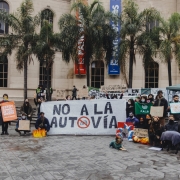
It is a primary duty of legislators to listen to citizens who have been mobilizing for years and expressing their rejection of this project during these days. As the Superior Court of Justice of Mendoza will express, the Mendoza decided by law 7722 the productive model they want to develop, it is the right of each society to decide, define and manage the way it adopts to progress. Given these circumstances, we express our concern and rejection of the attempt of the Government of the province to modify the current law.

Author

Maria Laura Carrizo

Contact

Juan Bautista Lopez, juanbautistalopez@fundeps.org
20 de December de 2019
Tags: Environment, Mining, Water and Sanitation
Share this entry
  • Share on Facebook
  • Share on X
  • Share on WhatsApp
  • Share on LinkedIn
  • Share by Mail
0 0 Comunicaciones Fundeps https://fundeps.org/wp-content/uploads/2026/04/logo-2026-300x120.png Comunicaciones Fundeps2019-12-20 11:41:292024-07-30 02:37:39We reject the modification of the mining law in Mendoza
You might also like
Activity Report 2016
The Supreme Court rejected the action initiated by the mining company Barrick Gold against the Law of Glaciers
We participate in the preparation of the general guidelines of the Yolanda law
Bajo Grande and Jerónimo de la Gente: A prize that seeks to cover a problem of years?
We asked the Senate to incorporate new principles into the General Environmental Law
International Day of Peasant Struggle
Public hearing: “Alternative to National Route N ° 38: Costa Azul Bridge – La Cumbre – Costa Azul Section – Cosquín”.
Report on the human rights situation in Argentina before the IACHR

Tags

Access to Information Access to Justice BID Chinese Investments Citizen Participation Democracy ENTs Environment Environmental Democracy Gender Global Governance Health Healthy nutrition IFIs Infrastructure Financing Legal Interruption of Pregnancy Sexual and Reproductive Rights Social and Environmental Standards Tobacco Control Transparency
See all tags

Acuerdo de Escazú

Emergencia Agroquímica

MOCI - monitoreo ciudadano en proyectos de infraestructura

{el entramado} Contamos historias. Acercamos Realidades.

Instagram

fundepsargentina

Trabajamos para que se garanticen los derechos humanos 🌱⚖️🗣️🌈💜🚭🍎
Promovemos la equidad de #genero, el derecho a la #salud y un #ambiente sano.

La Legislatura de Córdoba otorgó a Fundeps un bene La Legislatura de Córdoba otorgó a Fundeps un beneplácito por el Tercer encuentro Redes de compromiso y cuidados: “Acceso a la salud sexual integral. Debates urgentes”. El encuentro se realizó el pasado 20 de junio y reunió a más de cien profesionales de toda la provincia.

La mención (aprobada por unanimidad) fue iniciativa de la Legisladora Karen Acuña, en coautoría con las legisladoras Silvina Jurich, Ariela Szpanin, Doris Mansilla y Julieta Rinaldi. La misma expresa: “iniciativas con estas características, impulsadas por organizaciones de la sociedad civil, resultan fundamentales para fortalecer la protección y el ejercicio efectivo de los derechos ciudadanos, al tiempo que contribuyen a la construcción de una sociedad más justa, inclusiva e igualitaria".

Recibir este reconocimiento nos llena de orgullo y fortalece sin dudas los vínculos y el camino conjunto en pos del acceso a derechos en nuestra provincia.
Este viernes 31 de julio realizamos un nuevo encue Este viernes 31 de julio realizamos un nuevo encuentro de formación en derechos sexuales y (no) reproductivos. 

En articulación con el Consultorio de Salud Integral y con el aval de la DAJA, compartimos la jornada de capacitación con profesionales del Hospital Vicente Agüero de Jesús María.

Más de 15 profesionales de diversas disciplinas se dieron cita, para conocer diferentes aspectos de la práctica de AMEU y fortalecer su trabajo diario, en pos del acceso al aborto legal, seguro y gratuito.

Como en cada instancia, celebramos el compromiso de cada participante y agradecemos especialmente a la Dra. Kenia Torres y al Director del Hospital, Dr. Javier Díaz, por la predisposición para recibirnos.
La información como herramienta ya está disponible La información como herramienta ya está disponible en Aprender con Fundeps.

Aprendé a ejercer el derecho de acceso a la información pública y a usarlo para defender derechos, monitorear decisiones e impulsar procesos de incidencia.

En este curso vas a aprender:

📌 Cómo hacer solicitudes de acceso a la información pública.
📌 Qué hacer cuando un organismo no responde.
📌 Cómo acceder a información sobre proyectos financiados por organismos internacionales.

💻 Curso virtual, gratuito y autoadministrado.
🔗 Inscribite en aprender.fundeps.org
🌎 Hace un año, la @corteidhoficial emitió su histó 🌎 Hace un año, la @corteidhoficial emitió su histórica Opinión Consultiva sobre la emergencia climática.

✊ Una victoria para quienes defienden el ambiente en América Latina y el Caribe: la Corte confirmó que proteger a las personas defensoras del ambiente no es opcional. Es una obligación legal.

⚖️ Para explicar qué exige esa protección, la Corte se apoyó en el Acuerdo de Escazú. Resultado: la gran mayoría de Estados de América Latina y el Caribe no pueden ignorar los estándares de Escazú, incluso si aún no han ratificado el tratado.

🔎 La implicación es clara: los países de la región deben fortalecer el acceso a la información, la participación pública, la justicia ambiental y la protección de quienes defienden el ambiente. 

📝 La Opinión abre nuevas rutas para frenar la criminalización de personas defensoras, responder a las restricciones al espacio cívico y defender la participación pública en países como Costa Rica, Guatemala y Perú. Compartimos el análisis de  @manizalmigrante del @ciel_org

📣 La discusión ya no es si los países de América Latina y el Caribe deben proteger a quienes defienden el ambiente. Eso ya está claro. Ahora hay que usar la Opinión: en tribunales, reformas, debates públicos y procesos de movilización para exigir mejores garantías y mayor protección.

🔗 Lee el análisis completo en el link en www.ciel.org/corte-idh-escazu-personas-defensoras/
Follow on Instagram

Twitter

Tweets por @fundeps

Newsletter Subscription

    Fundeps. Córdoba (CP X5000JZH), Argentina. info@fundeps.org
    • Link to X
    • Link to Facebook
    • Link to Instagram
    • Link to Mail
    • Link to Youtube
    • Link to LinkedIn
    • Link to TikTok
    Link to: Joint Submission on IDB Access to Information Policy Profile Link to: Joint Submission on IDB Access to Information Policy Profile Joint Submission on IDB Access to Information Policy Profile Link to: The responsibility of accountability mechanisms to protect human rights: ICIM Case Link to: The responsibility of accountability mechanisms to protect human rights: ICIM Case The responsibility of accountability mechanisms to protect human rights: ICIM...
    Scroll to top Scroll to top Scroll to top