• ES
  • EN
Fundeps
  • About Fundeps
  • Team
  • Working areas
    • Environment
    • Democracy
    • Gender
    • Global Gorvernance
    • Health
  • News
  • Publications
  • DONATE
  • Click to open the search input field Click to open the search input field Search
  • Menu Menu
Gender, News

Let’s be empowered! Let’s make breastfeeding possible

Throughout the world, from August 1 to 7, dissemination, promotion and support activities for breastfeeding are carried out. What is the role and commitment of the actors involved?

“Below, we offer a google translate version of the original article in Spanish. This translation may not be accurate but serves as a general presentation of the article. For more accurate information, please switch to the Spanish version of the website. In addition, feel free to directly contact in English the person mentioned at the bottom of this article with regards to this topic”.

In August 1990, the World Health Organization (WHO), UNICEF, several States and civil society organizations signed the Innocenti Declaration with the objective of protecting, promoting and supporting breastfeeding.

This year’s motto is: “Let’s empower ourselves. Let’s make breastfeeding possible!” And was launched by the World Alliance for Breastfeeding (WABA). This slogan attempts to challenge states, unions, employers and civil society organizations to develop solutions that lead to gender equality and improve breastfeeding rates.

The World Health Organization emphasizes the need for paid maternity leave of at least eighteen weeks and paid paternity leave in order to achieve equality in the care of daughters and sons. It also expresses that breastfeeding policies should be promoted in work environments (breastfeeding breaks, safe, private and hygienic spaces and childcare services).
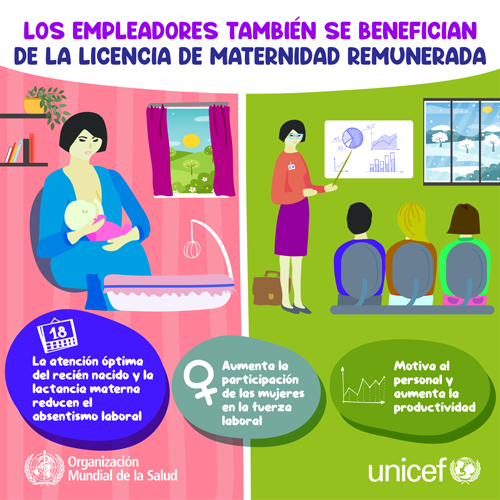
Along the same lines, we argue that breastfeeding promotion and support cannot be achievable without thinking about public policies in the face of the care crisis. The sexual division of labor remains rigid and mainly affects women. Against this, actions that understand care as public responsibilities are necessary.

Thus, public education, child care services, older adults and any person who requires special care from another and equal maternity and paternity leave must be part of public agendas. Also, the private sector is not out of these actions. Private companies are responsible for complying with labor regulations and collective bargaining agreements that promote and ensure equal and inclusive care and breastfeeding policies without gender stereotypes (ensuring the presence of lactaries in the workplace or respecting licenses).
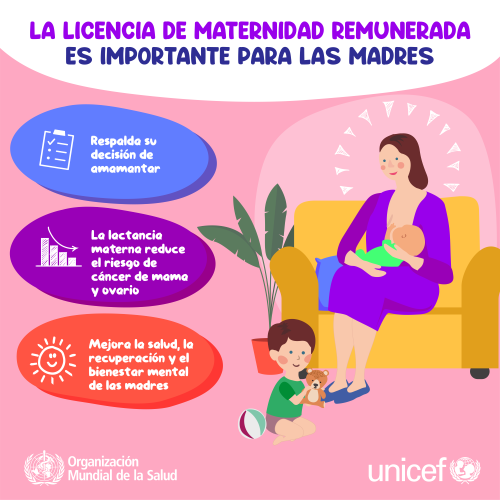
The body of women, historically, has been a field of regulations. Here they play speeches disputing hegemonic knowledge. We understand that it is the responsibility of the States to promote public policies that allow social scenarios where women and people who care for girls and boys freely decide on breastfeeding, with useful and clear information, without stereotypes and patriarchal cultural mandates.

Author

Ivana Sanchez

Contact

Cecilia Bustos Moreschi, cecilia.bustos.moreschi@fundeps.org
2 de August de 2019
Tags: Gender
Share this entry
  • Share on Facebook
  • Share on X
  • Share on WhatsApp
  • Share on LinkedIn
  • Share by Mail
0 0 Admi2024FunDEPS https://fundeps.org/wp-content/uploads/2026/04/logo-2026-300x120.png Admi2024FunDEPS2019-08-02 15:32:542024-06-30 16:03:03Let’s be empowered! Let’s make breastfeeding possible
You might also like
Litigation and research in response to rollbacks in gender policies
Statement for the appointment of the Attorney General of Córdoba
Civil society organizations and academics reject before the Senate the candidacy of Lijo and García-Mansilla to the CSJN
Observations on the second draft of the IDB Environmental and Social Policy Framework from a gender perspective
Comments and observations on the draft IDB Environmental and Social Policy Framework from a gender perspective
Not one less. We move in (the) networks.
The intervention of INADI before said homophobes against Flor de la V
Request an ANMAT to update your National Drug Vademecum

Tags

Access to Information Access to Justice BID Chinese Investments Citizen Participation Democracy ENTs Environment Environmental Democracy Gender Global Governance Health Healthy nutrition IFIs Infrastructure Financing Legal Interruption of Pregnancy Sexual and Reproductive Rights Social and Environmental Standards Tobacco Control Transparency
See all tags

Acuerdo de Escazú

Emergencia Agroquímica

MOCI - monitoreo ciudadano en proyectos de infraestructura

{el entramado} Contamos historias. Acercamos Realidades.

Instagram

fundepsargentina

Trabajamos para que se garanticen los derechos humanos 🌱⚖️🗣️🌈💜🚭🍎
Promovemos la equidad de #genero, el derecho a la #salud y un #ambiente sano.

TE NECESITAMOS 🧡 Para seguir de cerca el Plan de TE NECESITAMOS 🧡

Para seguir de cerca  el Plan de Saneamiento del Lago San Roque, hay que mirar de cerca todo el proceso. Revisamos información técnica, hacemos seguimiento de la causa y elaboramos informes públicos sobre el cumplimiento del Plan.

Sostener este trabajo en el tiempo requiere recursos. Tu aporte hace posible que continúe.

Doná hoy! (link en bio)
Y todo esto quedó en un papel? No. Ya hay avances. Y todo esto quedó en un papel? No. Ya hay avances. Pero tampoco está resuelto.

Hay plantas de tratamiento que comenzaron a funcionar, obras de cloacas terminadas y establecimientos que fueron auditados por posible contaminación.

➡️ También quedan medidas por cumplir y avances que necesitan seguimiento. Porque mostrar lo que se hizo también sirve para saber qué falta.

Para seguir acompañando este proceso y sosteniendo el trabajo que todavía queda, necesitamos tu apoyo.

Doná hoy.
La Justicia no solo dijo que el lago está contamin La Justicia no solo dijo que el lago está contaminado. También ordenó qué tiene que hacer el Estado para empezar a sanearlo.

La sentencia establece medidas concretas, con plazos y obligaciones que involucran a la Provincia y a los municipios de la cuenca.

Entre ellas: avanzar con las obras cloacales, controlar los vertidos contaminantes, fortalecer la fiscalización y garantizar espacios de participación y transparencia.

Deslizá para conocer qué tiene que pasar para que el saneamiento avance.

Ayudanos a seguir trabajando para que estas medidas se cumplan. Doná hoy.
Hoy, 4 de septiembre, es el Día Mundial de la Salu Hoy, 4 de septiembre, es el Día Mundial de la Salud Sexual. Una fecha que nos invita a volver sobre las discusiones que atraviesan el acceso a la salud sexual y (no) reproductiva: condiciones de acceso para que sea integral y de calidad, desde un enfoque de derechos y con perspectiva de diversidad.

En el mes de junio nos encontramos en el 3° Encuentro Provincial de Redes de Compromiso y Cuidados: Salud sexual Integral con Perspectiva de Diversidad para poner en común experiencias y preguntas sobre estos desafíos.

Hoy recuperamos algunas de las voces que fueron parte de las exposiciones de ese encuentro para volver sobre dos preguntas que siguen abiertas:
¿Cuál es hoy el debate más urgente cuando hablamos de salud integral y diversidad?
¿Por qué es importante encontrarnos en este contexto?

Porque garantizar el derecho a la salud también implica seguir encontrándonos para pensar, discutir y construir respuestas colectivas.
Follow on Instagram

Twitter

Tweets por @fundeps

Newsletter Subscription

    Fundeps. Córdoba (CP X5000JZH), Argentina. info@fundeps.org
    • Link to X
    • Link to Facebook
    • Link to Instagram
    • Link to Mail
    • Link to Youtube
    • Link to LinkedIn
    • Link to TikTok
    Link to: Binding Treaty on Business and Human Rights: Comments from Fundeps and the new revised Draf Link to: Binding Treaty on Business and Human Rights: Comments from Fundeps and the new revised Draf Binding Treaty on Business and Human Rights: Comments from Fundeps and the new... Link to: Complaints for school practices contrary to ESI Link to: Complaints for school practices contrary to ESI Complaints for school practices contrary to ESI
    Scroll to top Scroll to top Scroll to top