Irresponsible Mining: One Month After the Glacier Law Reform
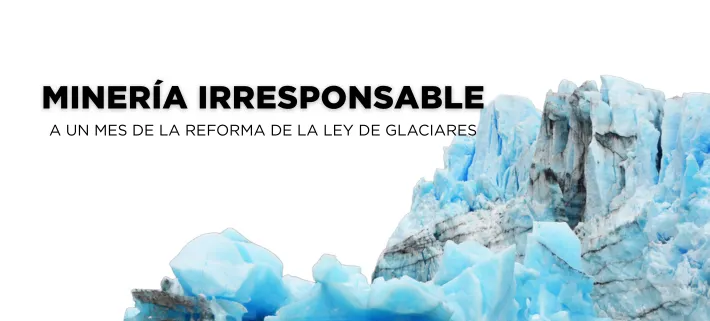
The reform to the Glacier Law approved on April 7 did more than weaken a law. It set a troubling precedent: environmental protection standards can be rolled back when they come into conflict with large-scale economic interests. This not only compromises the present, but also undermines the State’s ability to guarantee rights in the future, putting new generations at risk.
From a regulatory perspective, mining activities operate within a framework that combines outdated historical legislation —such as the Mining Code of 1885— with investment promotion regimes —such as Law 24,196— and new economic incentive mechanisms like the Large Investment Incentive Regime (RIGI).
Combined with the weakening of political, regulatory, and institutional environmental protection tools, this creates a scenario that prioritizes attracting investment over protecting common goods and fundamental rights.
The Last Straw
This reform represents a substantial alteration to Argentina’s current environmental protection system, particularly regarding the protection of water as a strategic legal asset.
The existing framework, based on scientific and technical standards and the precautionary principle, had made it possible to establish reasonable common limits on extractive activities in highly fragile ecosystems.
To better understand what is at stake, it is important to recognize that large-scale metal mining, as it currently operates in the country, has a structural dependence on water resources. Large-scale mining depends on water in order to exist and expand. The communities living in these areas do as well. And water is far from an infinite resource.
According to information disclosed in environmental assessment instruments, projects such as Alumbrera in the province of Catamarca —now entering a new reopening phase with estimated extraction levels lower than during its peak years— project water consumption between 3 and 5 million liters per day in their upcoming stages.
If we calculate an —already excessive— consumption of 150 liters of drinking water per person per day, then even in the best-case scenario this project would consume, every single day, the amount of water needed by the entire population of towns such as Agua de Oro in Córdoba, Lago Puelo in Chubut, or Tafí Viejo in Tucumán.
Meanwhile, ongoing operations such as Veladero report water consumption levels close to 9 million liters per day — three times that amount.
Moreover, these levels of use must be analyzed in light of their location: arid or semi-arid regions where water is scarce and strategically critical.
This, and nothing else, explains why disputes over water have existed for decades. Examples include Famatina, Esquel, Andalgalá, Chubut, and Mendoza. Local communities, aware of the importance of this resource for both present survival and future development, organize, educate themselves, and sustain resistance strategies over many years. Because water is essential not only for the survival of communities, but also for sustaining regional microeconomies.
These environmental defenders protect not only water, but also a way of life and a development model that successive governments continue to ignore. Anyone reading this would do the same in their place, because this is about defending their own survival and that of the place where they live.
As resistance grows stronger, the social license required for mining development becomes an increasingly difficult aspiration for companies to achieve.
Irresponsible Mining
Water, essential for the lives of communities, is being made available to the mining agenda promoted by the national government and several provincial governments, which present it as the only development alternative for especially arid regions of the country.
Those defending the reform promise responsible mining and legal certainty for corporations. But what kind of “responsible mining” are we talking about? Which companies are behind this reform?
As is already well known, this reform is the result of mining lobbying by multinational corporations that dominate the sector, including Glencore, Barrick, BHP, and First Quantum Minerals.
Glencore, linked to projects such as MARA in Catamarca and El Pachón in the province of San Juan —and backed by the hedge fund BlackRock— has been criminally convicted for corruption in jurisdictions such as the United States and the United Kingdom. The company also faces multiple proceedings over socio-environmental impacts not only in Argentina but in different parts of the world, including the Democratic Republic of the Congo, the Philippines, and Peru. These allegations range from water contamination to the killing of environmental defenders.
Barrick Gold, for its part, has faced allegations related to human rights and environmental violations, including reports of sexual violence in Papua New Guinea and deaths and violent repression in Tanzania. In 2018, the company received a ruling that included the permanent closure of the Pascua Lama project in Chile after serious breaches involving water resource protection and glacier environments were confirmed.
Likewise, BHP, involved in the development of the Vicuña project, has faced allegations of violations of Indigenous rights and labor rights abuses. The company was responsible for the collapse of the Samarco tailings dam in Brazil in 2015, considered one of the most significant environmental disasters in the region and currently the subject of major international litigation.
Similarly, First Quantum Minerals, promoter of the Taca Taca project in Salta, was involved in a judicial process in Panama that culminated in 2023 when that country’s Supreme Court declared the mining contract unconstitutional for violating multiple constitutional provisions, including environmental protection principles and fundamental rights.
These records cannot be treated as isolated incidents. They are part of a global pattern in which extractive expansion often occurs at the expense of fragile ecosystems, strategic water sources, and community rights.
Faced with companies that dominate the global industry, exert enormous pressure, and relentlessly pursue natural resources, it is impossible to believe that provinces already overwhelmed by economic crisis can effectively protect glaciers, water resources, or build truly sustainable development.
Legal Uncertainty
For these reasons, the debate surrounding the Glacier Law reform was never merely a technical or sector-specific discussion.
This became evident in the massive social mobilization preceding the legislative debate and in the more than 100,000 people registered for the Public Hearing — a hearing that failed to comply with existing regulations and minimum democratic standards.
Furthermore, the reform violated both the principle of progressivity and the precautionary principle, constituting a clearly unconstitutional regression that is likely to trigger dozens of legal actions, ultimately undermining the promised “legal certainty.”
In light of these precedents, claiming that weakening the Glacier Law will pave the way for “responsible” mining is highly questionable. Without strict environmental standards, effective oversight, and genuine community participation, risks do not decrease — they increase.
Continuing to defend the Glacier Law is not opposing development. It is affirming that development cannot be built at the expense of water, territories, and communities.
Author: María Laura Carrizo, Fundeps
Contact: lauracarrizo@fundeps.org