“Below, we offer a google translate version of the original article in Spanish. This translation may not be accurate but serves as a general presentation of the article. For more accurate information, please switch to the Spanish version of the website. In addition, feel free to directly contact in English the person mentioned at the bottom of this article with regards to this topic”
The idea of moving forward in an international instrument that responds to the regulatory challenges generated by the actions of international companies is taking on a new impetus in 2013, based on the initiative of a group of countries from Latin America, Asia and Africa. From the identification of numerous cases of human rights violations by transnational corporations, it was decided to create a space that would allow the debate on the creation of a legally binding instrument. The statement made at that time highlighted that:
The growing number of cases of human rights abuses and violations committed by transnational corporations remind us of the need to move towards a legally binding framework to regulate the work of transnational corporations and to provide adequate protection, justice and reparations to victims of transnational corporations. abuses against human rights, related to the activities of certain transnational corporations and other enterprises.
So far, the legal framework regulating the activities of international companies has been summarized in non-binding instruments and mechanisms: among them the
UN Guiding Principles on Business and Human Rights, the
OECD Guidelines and the
UN Working Group on companies and human rights. Such instruments have limited powers to monitor companies’ compliance with the Principles and only provide a partial response to urgent issues related to human rights abuses by transnational corporations. These principles and mechanisms do not adequately respond to the regulatory challenges of actors such as international companies. In addition, they fail to secure access to justice in the face of actions by transnational corporations that have an impact on human rights or to ensure adequate reparations for victims.
Resolution 26/9, established by the United Nations Human Rights Council on 26 June 2014, created the Working Group mandated “
to develop a legally binding instrument to regulate the activities of transnational corporations and other enterprises in international human rights law“.
An international legally binding instrument, adopted within the United Nations system, would make clear the obligations of transnational corporations, both in the field of human rights and in the face of States. It would also allow for fair reparations for victims in cases where it is clearly impossible to effectively prosecute companies with domestic legislation.
Meetings were held in the years following the formation of the intergovernmental group (2015 and 2016) to further advance the treaty negotiations. In 2017, the third session of the group was held, seeking to outline a possible textof the legally binding instrument.
During the course of the first two sessions both civil society organizations and participating States stressed that:
– The Guiding Principles on Business and Human Rights did not address the core of the debate on maximum protection of human rights and access to justice and redress.
– Any binding instrument should clearly establish the obligation of transnational corporations to respect environmental, health and labor standards and international humanitarian law.
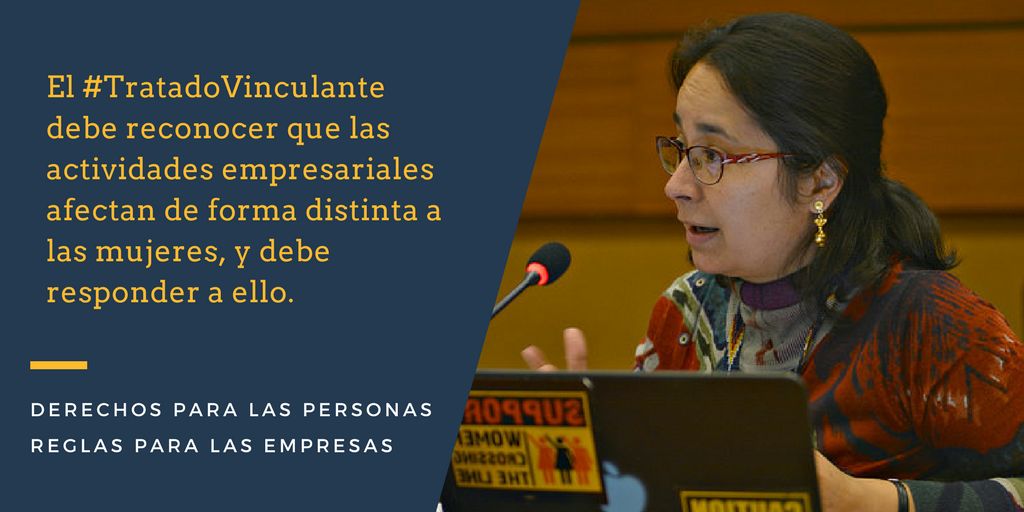
– The gender perspective was requested to be incorporated into the instrument, as human rights violations committed by transnational corporations could accentuate previous inequalities and have negative gender consequences.
– It was noted that the working group process was related to the implementation of Agenda 2030 for Sustainable Development.
– International financial institutions could also be included in the scope of the instrument, which would be consistent with international law.
– The size of the companies to which the treaty should apply was discussed, taking into account the activities of all companies, but focusing on transnational corporations.
– NGOs agreed to recognize the principle of human rights hierarchy in other areas of international law, in particular the rules on trade and investment protection.
For the 2017 session civil society has sought to achieve greater commitment on the road to the creation of the treaty. Numerous organizations and social movements are driving the generation of this instrument to finally achieve better levels of accountability on the part of transnational corporations. Groups such as Stop Corporate Impunity and Treaty Movement have been involved in trying to incorporate the vision of civil society organizations into the text of the treaty. In addition, the G77 + China Group, in its Ministerial Declaration of 2017, emphasized the importance and acceptance of a binding treaty; and urged Member States to participate in the third session to be held in Geneva.
In contrast, the International Business Community has emphasized that the elements to be included in the treaty proposed by the Intergovernmental Group represent a ‘setback on the commitments assumed from the Guiding Principles’. In this regard, it was emphasized that the almost exclusive approach in transnational corporations does not take into account the serious human rights violations caused by the actions of national companies. Likewise, it stresses that the creation of a legally binding instrument removes the power of States, and even underestimates them, when enforcing the current regulations. In addition, the need to strengthen state institutions is emphasized rather than embarking on the creation of such an instrument.

Since the creation of the Intergovernmental Working Group, the debate has focused on the need to define the approach of the treaty. Civil society has stressed the urgent need to involve transnational corporations, while the corporate community and the states of the European Union plus the United States have rejected this perspective.
The role of Argentina in the face of the discussion
Argentina’s position on this issue has not been entirely clear. During the management of Cristina Fernandez, the decision was to abstain in the vote to try to create the binding instrument. However, under the management of Mauricio Macri, there was no formalisation of a position. However, following a request for access to information to the Ministry of RREE and Worship, a response was received which showed that the Argentine Republic shares the growing interest of the international community in linking corporate responsibility with respect to human rights. In the same way, it maintains an active commitment with the initiatives aimed at raising the standards in this matter.
In this sense, it should be mentioned that it seems that Argentina is positively inclined towards this initiative. It is also worth noting that in the middle of this year a first version of a National Action Plan for the application of the Guiding Principles on Human Rights and Business was presented.
During the remaining days of the third session, the debate will continue on the generation of a binding instrument and we hope that the result will be a substantive advance regarding the obligations of companies to respect and guarantee human rights. Likewise, we hope that Argentina will assume a position of support for this initiative and that in that process it will allow the participation of civil society organizations and in particular of communities that have been impacted by the actions of transnational corporations.
Author
Agustina Palencia, agustinapalencia@fundeps.org
Contact
Juan Carballo, juanmcarballo@fundeps.org

The UN urges banks to address attacks on human rights defenders
“Below, we offer a google translate version of the original article in Spanish. This translation may not be accurate but serves as a general presentation of the article. For more accurate information, please switch to the Spanish version of the website. In addition, feel free to directly contact in English the person mentioned at the bottom of this article with regards to this topic”
“Through its financing and technical support, a complex range of public and private institutions continue to be involved in attacks against defenders,” cites the report of the UN Special Rapporteur on the situation of human rights defenders, Michel Forst.
According to Forst, “there is a deep crisis linked to the imposition of development models that seem to favor short-term benefits and commodification on the needs and aspirations of local populations.” The report found that in many cases, violations of rights and conflict stem from the exclusion of potentially affected communities from decisions about their lands and natural resources. “Only by guaranteeing the right of those communities to grant or deny their Free, prior and informed consent, as foreseen in international agreements, can avoid these origins of the conflict.”
The Special Rapporteur’s analysis echoes some of the critical trends and challenges highlighted in a brief submittedby the Coalition for Human Rights in Development in response to the Special Rapporteur’s call for the report. These include the growing role of the private sector in development, the lack of due diligence on human rights by development banks, the increasing use of financial intermediaries and the poor execution of consultation and consent processes.
The report of the Special Rapporteur highlights the “urgency” for development banks and other investors to use due diligence on human rights issues to identify potential risks for defenders and identify mitigation measures before making investment decisions. Taking into account the commitments of the States in matters of sustainable development, the Rapporteur stressed that “now is the time to ‘lead by example’ and ensure that no one can be killed or threatened for the mere fact of defending human rights.”
The report recommends several concrete policies and practices that development banks and other investors should adopt to safeguard defenders:
– Conduct ex ante impact assessments on the enabling environment for human rights and fundamental freedoms in host countries, as well as on the risks of projects for human rights defenders.
– Conduct on-site monitoring with human rights experience for all projects;
Use contractual provisions to require clients to ensure that defenders can publicly and securely disclose their claims;
– Demand accessible and independent complaints mechanisms with experience in human rights;
– Monitor projects closely for reprisals and, if they do occur, respond promptly and publicly, including exercising influence over governments to investigate and hold accountable those who use force against protesters or threaten critics of projects;
– Disclose all final users of loans from financial intermediaries and ensure compliance with safeguards and human rights;
– Retain investments where impact evaluations reveal serious threats to civil liberties and to defenders.
The Special Rapporteur’s findings echo many of the priorities and recommendations of the Defenders in Development campaign led by the Coalition along with civil society groups from around the world. The campaign is working to ensure that development activities respect human rights, that development funders promote an environment conducive to public participation, and that defenders can defend their rights and hold development actors accountable. fear.
Source: Coalición para los Derechos Humanos en el Desarrollo
source of the image: Accountability Counsel
Claim for the designation of the Ombudsman: citizen participation is very important
“Below, we offer a google translate version of the original article in Spanish. This translation may not be accurate but serves as a general presentation of the article. For more accurate information, please switch to the Spanish version of the website. In addition, feel free to directly contact in English the person mentioned at the bottom of this article with regards to this topic”
In the absence of answers, the claim was brought to the Inter-American Commission on Human Rights and to the Human Rights Committee of the United Nations, and both agencies urged the Argentine State to appoint the Ombudsman promptly. It should be noted that it is a key institution for the defense of human rights.
In accordance with the principles of the inter-American human rights system, States undertake to adopt legislative or other measures that are necessary to give effect to the rights and freedoms recognized in the American Convention on Human Rights. Among the measures mentioned, there are those tending to effect the establishment and regular operation of the Ombudsman’s Office.
The Ombudsman has basically two functions: 1) Defense and protection of the rights of the people before acts or omissions of the public administration; and 2) Control of the exercise of public administrative functions. However, this definition of the Defender may become limited since it does not contemplate its more procedural and human dimension: the idea and aspiration to create an entity capable of being receptive to the needs of the population. The Ombudsman’s Office plays a fundamental role not only in the protection of human rights and control of the exercise of public functions, but also as a key institution in direct communication between the State and individuals.
During the month of August 2017, 55 civil society organizations again called for the end of this situation and the designation of the Ombudsman. The complaint also included a proposal for the appointment that included both legal and constitutional requirements, as well as suggestions for the selection process. It was requested that the necessary measures be adopted so that the Bicameral Ombudsman’s Commission immediately begins the appointment procedure, which ensures 1) transparency and citizen participation in the process and 2) the suitability of the candidates.
The selection process of the Defender must follow rigorous criteria that guarantee the moral suitability and technical suitability. The moral suitability in this case not only refers to the absence of disciplinary offenses or conduct contrary to public ethics; but it refers to the need to prove a true commitment to human rights. The technical suitability, on the other hand, has to do essentially with the knowledge about the problems of Human Rights and the means to remedy them.
Another point to highlight in how the designation of the Ombudsman should be carried out, has to do with the independence of criteria. The CN in its article 86 emphasizes the autonomous character of the figure of the Defender and the independence of criteria. This refers to the non-partisanship of the figure and the absence of economic ties or interest that may interfere with the activities of the Ombudsman.
These selection criteria must be accompanied by a transparent and participatory procedure governed by publicity and openness in all stages of the process. The presentation made by the civil society detailed the proposal for the implementation of a selection process that should include: 1) Proposal of the candidates, 2) Publication of background, 3) Observations, challenges and questions, 4) Written responses from the candidates , 5) Public hearing before the bicameral commission, 6) Observations, 7) Decision of the bicameral commission.
This organ since 2009 lacks real leadership and since then it is operating under interim mandates because Congress has not yet agreed on the appointment of a director. Since 2015, undersecretary-general Juan José Böckel has been in charge of this unit, a man who answers the former intervener of that entity, the deputy governor of Jujuy, Carlos Haquim. Currently, the Ombudsman’s Office has been immersed in corruption cases after anonymous reports of irregularities in the organization.
According to reports, on Wednesday, November 8, the Bicameral Commission of the Ombudsman would sign the proposal of three candidates to the Ombudsman, with a view to having the Chambers designate it before the end of the year. This has been done without convoking the civil society and if this agreement were reached without the participation of the citizens in the formation of the shortlist, it will affect the proper institutional functioning of the Ombudsman, once their new holder is designated. .
The importance of the prompt designation of the Ombudsman is that it is one of the agencies in charge of the horizontal control of the State (called Horizontal Accountability). It is about the control exercised by the same institutions over the acts and / or omissions emanating from the State. In this sense, it is essential that the mechanisms that guarantee horizontal accountability work correctly. We join the claim of civil society for the prompt appointment of the Ombudsman.
More information
– Without citizen participation, the Ombudsman will not be for the People
– 55 organizations ask Congress for the designation of the Ombudsman
– Contributions for the regulation of the nomination process of the nation’s Ombudsman
Contact
agustinapalencia@fundeps.org
Labeling of food, claims and marketing strategies in food packaging – January 2018
FUNDEPS participated in an investigation together with the Federación Interamericana del Corazón (FIC) and the Universidad Católica de Santa Fe in which the labeling of food, claims and marketing strategies in various products of our country was analyzed.
Complaint for illegal environmental activities in Alta Gracia
“Below, we offer a google translate version of the original article in Spanish. This translation may not be accurate but serves as a general presentation of the article. For more accurate information, please switch to the Spanish version of the website. In addition, feel free to directly contact in English the person mentioned at the bottom of this article with regards to this topic”
Last Thursday, October 19, we made a presentation to the Environmental Police Department denouncing alleged illegal activities developed in the Potrerillo de Larreta Country Club located in the city of Alta Gracia. Apparently, during the last weeks of September and the first weeks of October, large-scale geomorphological injury actions were carried out in the country inn sector in the “Los Paredones” stream; consisting of dredging, deepening and expansion of the reservoir in order to increase the exploitation of the water of the stream by the Country.
They signify a clear violation of the provincial environmental policy law, since in order to carry out this type of works it is necessary to previously complete the Environmental Impact Assessment (EIA) process, foreseen in Annex I, subsection 31 of Law 10.208 , which includes the holding of public hearings prior to the granting of the corresponding environmental license, a procedure that has not been completed in this case.
It is worth remembering that since 2012 the Potrerillo de Larreta Country Club has been involved in a judicial process against the province of Córdoba, for the enclosure of almost 4 km of the same stream restricting free transit to third parties and the use of it by the entire community, mainly alleging security reasons. In this instance, together with the collective “Todos por Nuestros Arroyos” we present an Amicus Curiae invoking the character of public good of the stream and the illegitimacy of the fences, finding the next cause to issue a sentence.
Without prejudice to this, the illicit actions continue and are part of a long-standing problem in Alta Gracia that involves particular interests to the detriment of the fundamental rights of all inhabitants. The enclosure of rivers, streams and lakes of provincial dominion by the owners of the estates adjacent to them, constitutes a clear illegitimate act that violates, among others, the right to free transit, the use, enjoyment and use of public domain waters and the constitutionally recognized human right of access to water.
From FUNDEPS we made this presentation hoping to contribute to an adequate protection of the environment as a collective good and to guarantee the respect of rights of collective incidence over individual rights.
More information
Presentation to protect the environment against individual interests in Alta Gracia | FUNDEPS
Author
Noelia Salvia
Contact
María Pérez Alsina – mariaperezalsina@fundeps.org
Cutting resources to combat gender violence
“Below, we offer a google translate version of the original article in Spanish. This translation may not be accurate but serves as a general presentation of the article. For more accurate information, please switch to the Spanish version of the website. In addition, feel free to directly contact in English the person mentioned at the bottom of this article with regards to this topic”
At the beginning of this year, the cut for the budget aimed at eradicating gender violence in our country was evident, which was later clarified by the authorities of the National Women’s Council (current National Institute of Women) , recomposing such “error”. This movement aroused an alert to the organizations for the serious lack of transparency and clarity on the management of the public funds that would go to the Council.
In this context, it is worth noting that our country has signed and ratified a series of international agreements and treaties relating to human rights for gender equality (the International Convention on the Elimination of All Forms of Discrimination against Women and the Inter-American Convention on the Prevention of All Forms of Discrimination against Women , Sanctions and Eradication of Violence against Women), which oblige the State to develop public policies with the maximum resources required, mainly technical and economic, to guarantee the exercise of rights by women on equal terms with men.
Ignoring these commitments, in September of this year the budget for 2018 was presented, from which a number of civil society organizations (ELA, ACIJ, CAREF, FEIM, MEI and the Siglo 21 Foundation) once again alerted a reduction in the budget allocated to INAM, the main body of application of Law No. 26,485 on Comprehensive Protection for Women, and the lack of clarity and disaggregation of the budget directed at other programs to eradicate violence against women. The difference is 17% less than the current year, taking into account only the official inflation forecasts for the coming year.
The budget gap is more significant if one takes into account that the creation of INAM was established in order to give greater economic autonomy and institutional hierarchy to the body that regulates gender equality policies.
The budget forecast for next year is alarming, especially if we consider that in our country women receive a lower wage of up to 27% less than their male counterparts for the same work performed and are the most likely to work in precarious conditions, the figures of femicides amount to one every 18 hours, that the symbolic and media violence is reproduced through the media by the crisis of the institutions created for its monitoring and eradication.
We note that the budget cut and the absence of a clear picture of the resources that will be allocated to public policies aimed at promoting gender equality in various areas, jeopardize all the positive measures and actions that are being developed in this area. sense and backtrack with the national and international commitments made.
We add that the lack of disaggregation and budget specification towards gender policies shows serious difficulties in addressing the need to incorporate the gender perspective in matters related to the resources allocated, and also prevent their monitoring and monitoring in order to guarantee their fulfillment. In this sense, the State’s action is questionable, since, if it has committed itself to fight against gender-based violence, the measures and the budget approach for this purpose should not reproduce inequalities and violence against women.
The invisibilization and lack of clarity on the budget lines destined to most of the most important programs to guarantee the equality of opportunities and to combat the macho violence (except for some exceptions like the Program of Integral Sexual Education and the Victims against the Violence among others) , create a gray space that would allow the state to shape and alter public funds in favor of interests and contingent needs that could affect the survival and effectiveness of public policies to ensure gender equality.
That is why, once again, we adhere to the demand of civil society organizations against the budget reduction and in favor of transparency and specification regarding State funds allocated to public policies aimed at eradicating the violence that relapses in an insistent and relentless about so many women.
Contact
Cecilia Bustos Moreschi – cecilia.bustos.moreschi@fundeps.org
32nd National Meeting of Women: a movement that resists
“Below, we offer a google translate version of the original article in Spanish. This translation may not be accurate but serves as a general presentation of the article. For more accurate information, please switch to the Spanish version of the website. In addition, feel free to directly contact in English the person mentioned at the bottom of this article with regards to this topic”
More than 50,000 women gathered for another year to share experiences, update debates, express feelings and define policies that meet their needs, betting on collective work to advance the fight. Women approached from different parts of the country, but it is worth noting the presence of women from El Impenetrable Chaqueño, who made the difference in their first participation in an ENM.
The meeting was marked by a variety of workshops, including women and feminisms, sexual and reproductive rights, femicides, indigenous peoples, among others. Two new themes were added this year: “Women and Culture of Rape”, which developed the role of the media in the construction of the victim and the victimizer, institutional violence, sexual, affective and relational consent, among other axes . Also added “Activism Gordx”, workshop that dealt with the hegemonic medical model, cultural stigmatization of fat bodies and new forms of politicization. At the same time, women were able to enjoy numerous cultural activities, with 25 de Mayo Square being the epicenter of talks, handicrafts, music and mates “encounters”.
On Sunday, at 6:00 p.m., a multitudinous march was conducted that covered more than 35 blocks on the way to the Democracy Park, with the presence of women belonging to different social, political, trade union, civic organizations, indigenous communities, and so on. The march culminated with a great rock to the rhythm of good music, dance and several meals.
We can not fail to mention the lamentable assaults that were suffered by several women who attended the ENM on Monday by a group of people who, shouting “let them all go”, threw stones at them, chased them on motorcycles, hit with sticks, and threatened, corralated and intimidated violently. Once again, intolerance and violence played a part in the NME. We repudiate this episode of this anti-rights sector, which, far from respecting freedom of expression and democracy, once again tarnished an MNA. It is also worth noting that, unlike the previous ENM, the security forces did not repress and acted with respect for the rights of the attendees, safeguarding the security of the meeting.
We celebrate these 32 years of struggle that will not stop and we will meet again next year in Puerto Madryn, Chubut, headquarters of the 33rd ENM.
Sources
Incidents in the march of repudiation to the meeting of women | TN24
Violent demonstration of Resistance against the women of the Meeting | El Diario de la Región
Author
Mariana Cabanillas
Contact
Virginia Pedraza, vir.pedraza@fundeps.org
Moving towards a binding treaty on transnational corporations and human rights
“Below, we offer a google translate version of the original article in Spanish. This translation may not be accurate but serves as a general presentation of the article. For more accurate information, please switch to the Spanish version of the website. In addition, feel free to directly contact in English the person mentioned at the bottom of this article with regards to this topic”
The idea of moving forward in an international instrument that responds to the regulatory challenges generated by the actions of international companies is taking on a new impetus in 2013, based on the initiative of a group of countries from Latin America, Asia and Africa. From the identification of numerous cases of human rights violations by transnational corporations, it was decided to create a space that would allow the debate on the creation of a legally binding instrument. The statement made at that time highlighted that:
The growing number of cases of human rights abuses and violations committed by transnational corporations remind us of the need to move towards a legally binding framework to regulate the work of transnational corporations and to provide adequate protection, justice and reparations to victims of transnational corporations. abuses against human rights, related to the activities of certain transnational corporations and other enterprises.
Meetings were held in the years following the formation of the intergovernmental group (2015 and 2016) to further advance the treaty negotiations. In 2017, the third session of the group was held, seeking to outline a possible textof the legally binding instrument.
During the course of the first two sessions both civil society organizations and participating States stressed that:
– The Guiding Principles on Business and Human Rights did not address the core of the debate on maximum protection of human rights and access to justice and redress.
– Any binding instrument should clearly establish the obligation of transnational corporations to respect environmental, health and labor standards and international humanitarian law.
– The gender perspective was requested to be incorporated into the instrument, as human rights violations committed by transnational corporations could accentuate previous inequalities and have negative gender consequences.
– It was noted that the working group process was related to the implementation of Agenda 2030 for Sustainable Development.
– International financial institutions could also be included in the scope of the instrument, which would be consistent with international law.
– The size of the companies to which the treaty should apply was discussed, taking into account the activities of all companies, but focusing on transnational corporations.
– NGOs agreed to recognize the principle of human rights hierarchy in other areas of international law, in particular the rules on trade and investment protection.
For the 2017 session civil society has sought to achieve greater commitment on the road to the creation of the treaty. Numerous organizations and social movements are driving the generation of this instrument to finally achieve better levels of accountability on the part of transnational corporations. Groups such as Stop Corporate Impunity and Treaty Movement have been involved in trying to incorporate the vision of civil society organizations into the text of the treaty. In addition, the G77 + China Group, in its Ministerial Declaration of 2017, emphasized the importance and acceptance of a binding treaty; and urged Member States to participate in the third session to be held in Geneva.
In contrast, the International Business Community has emphasized that the elements to be included in the treaty proposed by the Intergovernmental Group represent a ‘setback on the commitments assumed from the Guiding Principles’. In this regard, it was emphasized that the almost exclusive approach in transnational corporations does not take into account the serious human rights violations caused by the actions of national companies. Likewise, it stresses that the creation of a legally binding instrument removes the power of States, and even underestimates them, when enforcing the current regulations. In addition, the need to strengthen state institutions is emphasized rather than embarking on the creation of such an instrument.
Since the creation of the Intergovernmental Working Group, the debate has focused on the need to define the approach of the treaty. Civil society has stressed the urgent need to involve transnational corporations, while the corporate community and the states of the European Union plus the United States have rejected this perspective.
The role of Argentina in the face of the discussion
Argentina’s position on this issue has not been entirely clear. During the management of Cristina Fernandez, the decision was to abstain in the vote to try to create the binding instrument. However, under the management of Mauricio Macri, there was no formalisation of a position. However, following a request for access to information to the Ministry of RREE and Worship, a response was received which showed that the Argentine Republic shares the growing interest of the international community in linking corporate responsibility with respect to human rights. In the same way, it maintains an active commitment with the initiatives aimed at raising the standards in this matter.
In this sense, it should be mentioned that it seems that Argentina is positively inclined towards this initiative. It is also worth noting that in the middle of this year a first version of a National Action Plan for the application of the Guiding Principles on Human Rights and Business was presented.
During the remaining days of the third session, the debate will continue on the generation of a binding instrument and we hope that the result will be a substantive advance regarding the obligations of companies to respect and guarantee human rights. Likewise, we hope that Argentina will assume a position of support for this initiative and that in that process it will allow the participation of civil society organizations and in particular of communities that have been impacted by the actions of transnational corporations.
Author
Agustina Palencia, agustinapalencia@fundeps.org
Contact
Juan Carballo, juanmcarballo@fundeps.org
Global Meeting of the Coalition for Human Rights in Development
“Below, we offer a google translate version of the original article in Spanish. This translation may not be accurate but serves as a general presentation of the article. For more accurate information, please switch to the Spanish version of the website. In addition, feel free to directly contact in English the person mentioned at the bottom of this article with regards to this topic”
From October 7 to 9, 2017, the 2017 Meeting of the Coalition for Human Rights in Development was held, a global coalition of social movements, civil society organizations and community groups of which we are part, and which works to ensure that all institutions that finance development respect, protect and fulfill human rights.
The agenda of the meeting focused on strengthening the relations of Coalition members and allies, closely examining the current development model, identifying strategies and modes of collaboration to successfully address it, and setting priorities and key initiatives for the next two years. This, after a 2016 where the work of the Coalition and its members was very active (see Coalition’s Impact Report 2016).
Over the course of three days, more than 60 participants from various regions of the world participated in discussions, activities and strategic discussions around a number of key issues. Among them, we sought to share experiences, challenges, lessons learned, and future needs around community participation partnerships; efforts were made to establish priorities for collective action and to strengthen the Coalition’s connections, collaborations and campaigns, and progress was made in the elaboration of a Collective Action Plan.
Within this framework, some global advocacy goals were selected, such as strengthening gender work and development finance or monitoring Chinese funding for development projects. Specific institutional focuses were also established, such as the New BRICS Development Bank or the Inter-American Development Bank.
More information
– Coalition’s Impact Report 2016
– Web page of the Coalition for Human Rights in Development
Contact
Juan Carballo / Executive Director of FUNDEPS
juanmcarballo@fundeps.org
Health and law: internship at the O’Neill Institute, Georgetown University
“Below, we offer a google translate version of the original article in Spanish. This translation may not be accurate but serves as a general presentation of the article. For more accurate information, please switch to the Spanish version of the website. In addition, feel free to directly contact in English the person mentioned at the bottom of this article with regards to this topic”
FUNDEPS, in collaboration with the O’Neill Institute for National and Global Health Law at Georgetown University and the Faculty of Law of the National University of Cordoba, announces renewal of the internship program.
Convening institutions
– O’Neill Institute for National and Global Health Law at Georgetown University Law Center
– Faculty of Law of the National University of Córdoba
– FUNDEPS – Foundation for the Development of Sustainable Policies
Requirements for presentation
– To be registered as a regular student of the career of Advocacy in the Faculty of Law and Social Sciences of the National University of Cordoba.
– Have passed or are studying Public International Law.
– Have a general average, with deferrals, of 7 or more points.
– Have excellent written and oral English language skills.
Selection Mechanism
– Deadline for submission of applications: 28 October 2017.
– A Selection Committee of the UNC will select a list of five to seven pre-selected persons, who will be invited to an interview to be held in English on October 31, 2017 at the UNC Law School, instead of confirm.
– On November 1, 2017 the UNC Selection Committee will send a list of three to five people to the O’Neill Institute for National whose team will decide the person selected to complete the internship.
– The selected person must participate, during November and December, in training activities on the human right to health, in the human rights area of FUNDEPS.
Documentation to be submitted
– Letter of motivation in English justifying the application to the internship program of the O’Neill Institute
– Detailed curriculum vitae in English, no more than 3 pages
– Scanned copy of the analytical certificate (not electronic version)
* The materials must be sent in digital format in a single file in Acrobat Reader (.pdf format) to the address: info@fundeps.org, indicating in the subject: O’Neill Call – “Name of the candidate”.
Selection criteria
– Average.
– Interest in the area of the right to health or human rights.
– Academic research experience.
– Experience working in civil society organizations.
– English level.
Financing
– The consideration given by the O’Neill Institute during the months of the rented internship (January, February and March) allows lodging and living expenses during those months as well as the tickets from Cordoba to Washington, DC.
– FUNDEPS makes available an honor credit for those who need support to cover the anticipated payment of the air ticket, under conditions to be determined.
For application send an email to info@fundeps.org
Informative talk: Wednesday, October 18, 2017 at the Faculty of Law of the UNC (time to confirm via social networks)
Phone number: 03572-15666871 (Agustina Mozzoni)
More information about the O’Neill Institute.
Joint submission of reports to the Committee on Economic, Social and Cultural Rights Social
“Below, we offer a google translate version of the original article in Spanish. This translation may not be accurate but serves as a general presentation of the article. For more accurate information, please switch to the Spanish version of the website. In addition, feel free to directly contact in English the person mentioned at the bottom of this article with regards to this topic”
When a country ratifies an international human rights treaty, it undertakes to comply with the obligations set out therein. Many of these treaties establish mechanisms for accountability on the level of compliance with these obligations to be open to the participation of civil society. In this case, the obligations of Argentina under the International Covenant on Economic, Social and Cultural Rights (ICESCR) are reviewed before the CESCR. In collaboration with other civil society organizations in Argentina, we have approached critical observations, recommendations and questions through two reports: one more general about various aspects related to obligations in ESCR and another focused on the protection of the health of chronic noncommunicable diseases .
Structural report developed jointly with ACIJ
Together with the Civil Association for Equality and Justice (ACIJ), we produced a report during the month of August with comments on Argentina’s compliance with the rights enshrined in the ICESCR. This report is based on the report that Argentina presented to the Committee in late 2016 to report on the progress it has made in terms of these rights, so it is called “shadow report”.
In this instance, the CDESC opens the opportunity for civil society organizations to comment on the topics covered in the official reports and to suggest questions for members of the Committee to delve into sessions with representatives of the State. To these ends, from FUNDEPS and ACIJ we have presented data alternative to those provided by the government, in some points such as: production and quality of data on ESCR; access to justice in ESCR; education rights; right to inclusive education; right to health; right to gender equality; rights of environmental defenders; among other.
Report on the protection of the health of chronic noncommunicable diseases
Together with FIC Argentina, the O’Neill Institute and the Chair of Food Sovereignty of the School of Nutrition of the University of Buenos Aires, we present a report in which we warn about the situation of chronic diseases in Argentina; at the same time as we suggest to the State the adoption of some measures to reduce the consumption of tobacco products and unhealthy foods.
Measures such as limiting advertising aimed at children, adoption of simpler and more understandable nutrition labeling, tax increases, ratification by the Argentine State of the Framework Convention on Tobacco Control and adoption of measures particularly vulnerable groups.
The information presented and the questions asked to the State are that next year the final evaluation will be done, after giving Argentina a right of reply and civil society organizations to submit shadow reports again. The concluding observations that the Committee issues are tools to require the Argentine State to comply with human rights standards on ESCR.
More information
– Shadow report of FUNDEPS and ACIJ
– Official reports and other shadow reports
Contact
Carolina Tamagnini – carotamagnini@fundeps.org
Discussions on Independent Accountability Mechanisms in Greece
“Below, we offer a google translate version of the original article in Spanish. This translation may not be accurate but serves as a general presentation of the article. For more accurate information, please switch to the Spanish version of the website. In addition, feel free to directly contact in English the person mentioned at the bottom of this article with regards to this topic”
Last Wednesday, August 30, at the annual meeting of the Network of Independent Accountability Mechanisms(IAMNet) held this year in the city of Thessaloniki, Greece, a roundtable discussion between representatives of the mechanisms and Civil Society Organizations (CSOs) working on accountability agendas, including FUNDEPS. At the same time, a public outreach event was held to present the work of the IAMNet Network and the characteristics and mandates of the main accountability mechanisms of the International Financial Institutions (IFIs), Inspection of the World Bank, the MICI of the Inter-American Development Bank (IDB Group) or the CAO of the International Finance Corporation (IFC), among others.
For their part, the CSOs that participated in the event addressed opportunities and challenges in accountability in the IFIs and the work that has been done from civil society in accountability.
At the round table, a technical discussion was held around a key question regarding the function of this type of mechanism: “Can Dispute Resolution be compatible with Rights?”. Recall that most of the IFIs’ independent accountability mechanisms have a dispute resolution function for complaints from communities affected by projects funded by these financial institutions. In that regard, the current problems of the dispute resolution process were discussed in the way it is currently being developed; and sought to address what an effective rights-based dispute resolution process should be, and what their outcomes should be.
On the other hand, in the days leading up to and after the aforementioned event, strategic meetings of two working groups were held that address issues and agendas related to our work at Fundeps. On 28 and 29 August the annual meeting of the EuroIFI network was held and on 31 August a strategic meeting of the IAWG (International Advocates Working Group) working group, of which we are part. The EuroIFI Network is an informal network of non-governmental organizations (NGOs) that focus their work on IFIs such as the World Bank, the European Investment Bank and the Monetary Fund, among others. The IAWG is a network of NGOs around the world that share information, lessons learned, best practices and strategies around accountability mechanisms; and supports communities that complain to these mechanisms.
Our participation in these three events has been very useful, not only because we were able to share information and experiences in terms of accountability with key players in this agenda, but also because it has enabled us to know and acquire more information regarding specific cases of presentation of complaints to this kind of mechanisms. Moreover, in view of our work on accountability mechanisms, and in particular in relation to the ICIM and the advice we are giving to communities in Córdoba and Bolivia regarding the possible submission of complaints to the ICIM.
More information
– Network of Independent Accountability Mechanisms
– Video on the IAMnet network
– MICI website
– Inspection Panel website
– CAO website
– Glass Half Full. The state of accountability in development finance – Enero de 2016
Contact
Gonzalo Roza / Coordinador del Área de Gobernabilidad Global
gon.roza@fundeps.org
We continue to build equality from the right
“Below, we offer a google translate version of the original article in Spanish. This translation may not be accurate but serves as a general presentation of the article. For more accurate information, please switch to the Spanish version of the website. In addition, feel free to directly contact in English the person mentioned at the bottom of this article with regards to this topic”
The reality of women in Argentina, urges that organizations take action, organize and strengthen their links. It is essential to generate collective strategies that can generate impacts that make visible the faults that women suffer in our country, such as access to justice, participation, the rights to a life free from violence, health, freedom, equality of opportunity, among many others.
The organizations and individuals that form part of the Abogadxs Alliance for Women’s Human Rights are meeting to discuss the achievements in recent years, the achievements and advances in the recognition of rights and their implementation. But we also put on the table the risks in the implementation of regressive policies, of strategies that continue reproducing the logics of gender inequality, and everything for which we have always struggled and have not yet reached.
That is why we focus our exchanges on two central themes: sexual and reproductive rights, and violence against women. In both areas of discussion we reach starting points for collective strategies, and we generate dynamics of mutual strengthening for those measures and actions that necessarily have to be diagrammed locally.
The human rights of women must be guaranteed by the State, and when this is not manifested in reality, the organizations will continue to carry out collective advocacy to demand that all people, regardless of gender, enjoy all rights and can live their lives without fear and in full freedom.
Contact
Virginia Pedraza, vir.pedraza@fundeps.org