• ES
  • EN
Fundeps
  • About Fundeps
  • Team
  • Working areas
    • Environment
    • Democracy
    • Gender
    • Global Gorvernance
    • Health
  • News
  • Publications
  • DONATE
  • Click to open the search input field Click to open the search input field Search
  • Menu Menu
Gender, News

We participated in the XVI Regional Conference on Women in Latin America and the Caribbean
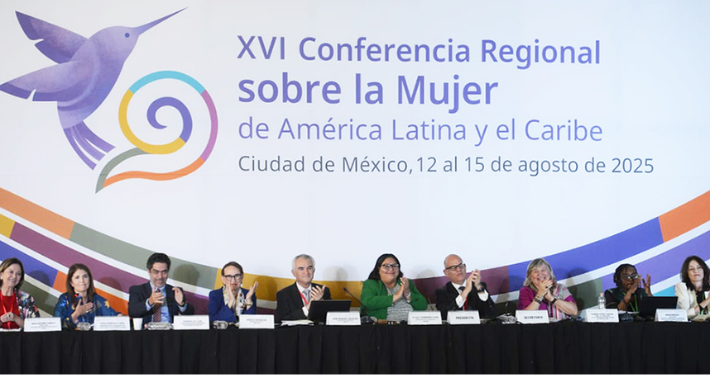
Fundeps took part in the XVI Regional Conference on Women in Latin America and the Caribbean, held from August 11 to 15 in Mexico City.

The Regional Conference on Women takes place every three years and is a key event to drive progress in gender equality across the region. It is a subsidiary body of the Economic Commission for Latin America and the Caribbean (ECLAC) and the main United Nations intergovernmental forum on women’s rights and gender equality in the region. Since 1977, it has convened regularly to analyze regional and subregional situations regarding women’s autonomy and rights, and to present recommendations on gender equality public policies, in compliance with regional and international agreements.

Romina Pezzelato, coordinator of the Gender and Diversity Area, represented Fundeps in the extensive agenda of “side events” officially supported by CEPAL. These gatherings brought together civil society representatives from across the region to deepen dialogue and debates around the human right to care, the central theme of this year’s Conference.

Throughout the week, one of the most significant highlights was the response of the Inter-American Court of Human Rights to Argentina’s request for an advisory opinion, recognizing the right to care as an autonomous right—that is, not only as an aspect linked to other rights but as a right in itself—across three dimensions: the right to provide care, the right to receive care, and the right to self-care. Based on this position, the IACHR recommended that states in the region implement public policies that guarantee dignity, equality, and shared responsibility in the provision of care throughout the life cycle.

Care as a concept of struggle and community resistance
In a regressive regional context, where the rise of right-wing forces compels us to uphold networks and actions that protect hard-won rights, many of the debates centered on sustaining agendas that push for public policies guaranteeing the right to care. Defending care as an act of sovereignty for women situates us not within our homes ensuring the reproduction of life, but as protagonists in struggles such as the defense of land, the environment, food sovereignty, and sexual and reproductive rights, among others.

On Monday, August 11, the Feminist Forum took place as a precursor to the XVI Regional Conference on Women. Feminists from more than 150 civil society organizations across Latin America and the Caribbean came together to make their voices heard by governments. As a result of an intense day of debate, a document was drafted and read at the official Conference by a representative of the Otrans organization, addressing authorities present:
“Neither silence, nor setbacks, nor nostalgia, nor consolation. Thirty years after Beijing, we demand justice. We call on States to return to the basics: to place life, social, racial and ecological justice, as well as gender equality and the protection of human rights, at the center. We also invite you to be bold and creative in your responses. Feminists have been building collective, sustainable and radical strategies for decades, which must be recognized and incorporated into State debates.”

In another strong document outlining the many dimensions of the right to care in the current regional context, the Feminist Forum also stated:
“We demand clear commitments to the most humanizing agenda of all: one that promotes an economic, political, social, and cultural model that generates well-being, is sustainable, and places care at the center. An agenda that has defended the recognition of the right to decide over our own bodies and life projects. One that guarantees social justice with a restorative and reparative approach. The agenda of substantive equality supported by feminisms. From Palestine to Haiti, we demand peace, justice, and equality!”

The Commitment of Tlatelolco is the name of the official document resulting from the XVI Regional Conference on Women, in which regional governments pledged to develop public policies aimed at reducing inequality gaps that continue to weigh on the bodies of women and LGBTQI+ people.

At Fundeps, we reaffirm our ongoing commitment to advocacy actions that engage with each of these demands in defense of human rights.

Contact:

Romina Pezzelato, romina.pezzelato@fundeps.org
9 de September de 2025
Tags: Gender, Sexual and Reproductive Rights
Share this entry
  • Share on Facebook
  • Share on X
  • Share on WhatsApp
  • Share on LinkedIn
  • Share by Mail
https://fundeps.org/wp-content/uploads/2025/09/Diseno-sin-titulo-22.png 375 710 Sofia Rubiano Eckert https://fundeps.org/wp-content/uploads/2026/04/logo-2026-300x120.png Sofia Rubiano Eckert2025-09-09 19:21:402025-09-09 19:21:40We participated in the XVI Regional Conference on Women in Latin America and the Caribbean
You might also like
Discrimination: the failures of virtual “denunciations” before the INADI
Presentation of report on media violence against women before CSW
We present amicus curiae in defense of reproductive freedom in Córdoba
Presentation of the Declaration by Academia within the framework of Cartagena +30
32nd National Meeting of Women: a movement that resists
Not one less. We move in (the) networks.
La ley 27.610 sigue vigente. Supreme Court must reject litigation against abortion law
Breaking the mold: advocacy from a feminist perspective

Tags

Access to Information Access to Justice BID Chinese Investments Citizen Participation Democracy ENTs Environment Environmental Democracy Gender Global Governance Health Healthy nutrition IFIs Infrastructure Financing Legal Interruption of Pregnancy Sexual and Reproductive Rights Social and Environmental Standards Tobacco Control Transparency
See all tags

Acuerdo de Escazú

Emergencia Agroquímica

MOCI - monitoreo ciudadano en proyectos de infraestructura

{el entramado} Contamos historias. Acercamos Realidades.

Instagram

fundepsargentina

Trabajamos para que se garanticen los derechos humanos 🌱⚖️🗣️🌈💜🚭🍎
Promovemos la equidad de #genero, el derecho a la #salud y un #ambiente sano.

Este viernes 31 de julio realizamos un nuevo encue Este viernes 31 de julio realizamos un nuevo encuentro de formación en derechos sexuales y (no) reproductivos. 

En articulación con el Consultorio de Salud Integral y con el aval de la DAJA, compartimos la jornada de capacitación con profesionales del Hospital Vicente Agüero de Jesús María.

Más de 15 profesionales de diversas disciplinas se dieron cita, para conocer diferentes aspectos de la práctica de AMEU y fortalecer su trabajo diario, en pos del acceso al aborto legal, seguro y gratuito.

Como en cada instancia, celebramos el compromiso de cada participante y agradecemos especialmente a la Dra. Kenia Torres y al Director del Hospital, Dr. Javier Díaz, por la predisposición para recibirnos.
La información como herramienta ya está disponible La información como herramienta ya está disponible en Aprender con Fundeps.

Aprendé a ejercer el derecho de acceso a la información pública y a usarlo para defender derechos, monitorear decisiones e impulsar procesos de incidencia.

En este curso vas a aprender:

📌 Cómo hacer solicitudes de acceso a la información pública.
📌 Qué hacer cuando un organismo no responde.
📌 Cómo acceder a información sobre proyectos financiados por organismos internacionales.

💻 Curso virtual, gratuito y autoadministrado.
🔗 Inscribite en aprender.fundeps.org
🌎 Hace un año, la @corteidhoficial emitió su histó 🌎 Hace un año, la @corteidhoficial emitió su histórica Opinión Consultiva sobre la emergencia climática.

✊ Una victoria para quienes defienden el ambiente en América Latina y el Caribe: la Corte confirmó que proteger a las personas defensoras del ambiente no es opcional. Es una obligación legal.

⚖️ Para explicar qué exige esa protección, la Corte se apoyó en el Acuerdo de Escazú. Resultado: la gran mayoría de Estados de América Latina y el Caribe no pueden ignorar los estándares de Escazú, incluso si aún no han ratificado el tratado.

🔎 La implicación es clara: los países de la región deben fortalecer el acceso a la información, la participación pública, la justicia ambiental y la protección de quienes defienden el ambiente. 

📝 La Opinión abre nuevas rutas para frenar la criminalización de personas defensoras, responder a las restricciones al espacio cívico y defender la participación pública en países como Costa Rica, Guatemala y Perú. Compartimos el análisis de  @manizalmigrante del @ciel_org

📣 La discusión ya no es si los países de América Latina y el Caribe deben proteger a quienes defienden el ambiente. Eso ya está claro. Ahora hay que usar la Opinión: en tribunales, reformas, debates públicos y procesos de movilización para exigir mejores garantías y mayor protección.

🔗 Lee el análisis completo en el link en www.ciel.org/corte-idh-escazu-personas-defensoras/
Seguimos compartiendo algunos momentos del 3° Encu Seguimos compartiendo algunos momentos del 3° Encuentro Provincial de Redes de Compromiso y Cuidados 🧡

Creemos que no hay mejor manera de cerrar una jornada de formación, intercambio y construcción colectiva que encontrándonos también desde el arte. Porque la música y la poesía también nos invitan a imaginar otros mundos posibles.

Así vivimos Revuelo Sur, Íntimas, el espectáculo de Susy Shock junto al Dúo Bazán-Bonillo, que acompañó el cierre de este encuentro.

Gracias a todas las personas que se acercaron y fueron parte de esta jornada.
Follow on Instagram

Twitter

Tweets por @fundeps

Newsletter Subscription

    Fundeps. Córdoba (CP X5000JZH), Argentina. info@fundeps.org
    • Link to X
    • Link to Facebook
    • Link to Instagram
    • Link to Mail
    • Link to Youtube
    • Link to LinkedIn
    • Link to TikTok
    Link to: From Fundeps, Fundación Sanar and Anfibia Podcast, we launch the second season of “Exceso de Todo.” Link to: From Fundeps, Fundación Sanar and Anfibia Podcast, we launch the second season of “Exceso de Todo.” From Fundeps, Fundación Sanar and Anfibia Podcast, we launch the second season... Link to: Territorial Feminisms for a Popular Ecology Link to: Territorial Feminisms for a Popular Ecology Territorial Feminisms for a Popular Ecology
    Scroll to top Scroll to top Scroll to top