• ES
  • EN
Fundeps
  • About Fundeps
  • Team
  • Working areas
    • Environment
    • Democracy
    • Gender
    • Global Gorvernance
    • Health
  • News
  • Publications
  • DONATE
  • Click to open the search input field Click to open the search input field Search
  • Menu Menu
Gender, News

For the 8th time the IVE project to the Congress is presented

Today, May 28, on the International Day of Action for Women’s Health, Campaña Nacional por el Aborto Legal, Seguro y Gratuito, which brings together more than 500 feminist, social and political organizations, presents for the eighth time, the bill of legal interruption of pregnancy

“Below, we offer a google translate version of the original article in Spanish. This translation may not be accurate but serves as a general presentation of the article. For more accurate information, please switch to the Spanish version of the website. In addition, feel free to directly contact in English the person mentioned at the bottom of this article with regards to this topic”.

May 28 is the International Day of Action for Women’s Health. It was proclaimed 32 years ago in Costa Rica, during the meeting of members of the World Network of Women for Reproductive Sexual Rights held at the end of the V International Meeting on Women’s Health. The purpose of this date is to reaffirm the right to health as a human right of women that they must access without restrictions or delays or exclusions of any kind, and throughout their lives.
In this context, the Campaña Nacional por el Aborto Legal, Seguro y Gratuito, Safe and Free, will present for the eighth consecutive time before the National Congress, the Law of Voluntary Interruption of Pregnancy (IVE). Already in 2018, the bill achieved the average sanction in the Chamber of Deputies being rejected in the Senate. Since 1921, the Penal Code establishes in article 86 inc 1 and 2, that abortion is legal if the pregnancy represents a danger to the life or health of the person or if it is the product of a violation. However, there were always difficulties for the implementation of public policies that guarantee full access to legal abortion.
In 2012, the Supreme Court of Justice of the Nation issued the ruling F.A.L s / self-satisfying measure, where it instructed the State to end the practice of judicializing, obstructing and / or delaying access to legal abortions. Likewise, he urged the national, provincial and city authorities of Buenos Aires to implement the highest standards and through hospital protocols, to train in good practices and remove all barriers that limit access to health services. In this regard, in 2015 the Ministry of Health of the Nation published the “Protocol for the Comprehensive Care of Persons with the Right to Legal Interruption of Pregnancy”, which represented a major step forward in accessing abortion for women and people with the ability to gestate.
Even so, those who require access to a non-punishable abortion continue to face constant obstacles, such as the institutional violence exerted on them by health professionals, being conscientious objectors and not making the corresponding referrals. These actions and practices, naturalized in the health system, prevent access to safe abortions even in cases where they are protected by law. Particularly in our province, access to this type of abortion has been hampered since 2012 by the amparo filed by Portal de Belén. Even after the favorable ruling of the Superior Court of Justice in this case, the situation that prevents the application of the Provincial Guide for the care of non-punishable abortions has not changed.
In this regard, the World Health Organization states that the criminalization of abortion and restrictive measures, not only affect the exercise of a human right, but generate a serious public health problem because it leaves vulnerable and pushes clandestine and insecure practices that constitute one of the main causes of maternal mortality. The right to abortion is a matter of public health that impacts the lives of girls, adolescents, women and people with the ability to deliver. Sexual and (non) reproductive health are human rights, that is, they are for everyone without any discrimination.
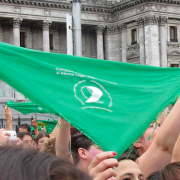
Therefore, on Tuesday the streets will be filled with handkerchiefs, with interventions and rallies in all the cities of the country and various parts of the world. In Córdoba, the federal handkerchief will be at the Museum of Anthropology at 4:00 pm and there will be invited bands. In a collective cry for legal abortion, safe and free, the green wave, returns to the streets and Congress, to be able to decide on our bodies and lives.

Sex education to decide

Contraceptives not to abort

Legal abortion to not die.

¡QueSeaLey!

View this post on Instagram

Seguimos luchando para que nos permitan decidir sobre nuestros cuerpos y vidas ???????? #abortolegalya #CongresoVerde #SeráLey #28M #abortolegal #QueSeaLey #seraley @campaabortolegal.cba

A post shared by Fundeps Argentina (@fundepsargentina) on May 28, 2019 at 7:56am PDT

Author

Laura Villanueva

Contact

Cecilia Bustos Moreschi, cecilia.bustos.moreschi@fundeps.org

28 de May de 2019
Tags: Gender, Legal Interruption of Pregnancy, Sexual and Reproductive Rights, Voluntary Termination of Pregnancy
Share this entry
  • Share on Facebook
  • Share on X
  • Share on WhatsApp
  • Share on LinkedIn
  • Share by Mail
0 0 Comunicaciones Fundeps https://fundeps.org/wp-content/uploads/2026/04/logo-2026-300x120.png Comunicaciones Fundeps2019-05-28 15:06:432024-06-30 16:03:05For the 8th time the IVE project to the Congress is presented
You might also like
Training cycle: Rethinking the Economy, a feminist look
Half a year of legal abortion: progress and challenges
Salta: the doctor guaranteed the rights of the young woman to a legal interruption of pregnancy
National Women’s Council and INAM: what could have been, what was and how will it continue?
With Integral Sex Education you don’t get involved
We have an Ombudsman and she is a feminist
We present amicus curiae in defense of the ILE and the sale of misoprostol in pharmacies
Female quotas YES are required

Tags

Access to Information Access to Justice BID Chinese Investments Citizen Participation Democracy ENTs Environment Environmental Democracy Gender Global Governance Health Healthy nutrition IFIs Infrastructure Financing Legal Interruption of Pregnancy Sexual and Reproductive Rights Social and Environmental Standards Tobacco Control Transparency
See all tags

Acuerdo de Escazú

Emergencia Agroquímica

MOCI - monitoreo ciudadano en proyectos de infraestructura

{el entramado} Contamos historias. Acercamos Realidades.

Instagram

fundepsargentina

Trabajamos para que se garanticen los derechos humanos 🌱⚖️🗣️🌈💜🚭🍎
Promovemos la equidad de #genero, el derecho a la #salud y un #ambiente sano.

Hay ideas que escuchamos tantas veces que a veces Hay ideas que escuchamos tantas veces que a veces ni nos detenemos a pensarlas.

¿Los celos son una forma de cuidado? ¿El silencio significa consentimiento? ¿Poner límites puede arruinar una relación?

Salimos a la calle con una consigna simple: 👍 o 👎
Pero lo más interesante vino después: escuchar por qué.

Porque hablar de ESI también es revisar lo que pensamos sobre los vínculos, el consentimiento, los límites y el cuidado.

¿Vos qué pulgar levantarías?

#CrecíConESI #20AñosDeESI
🫂 El derecho a cuidar, a cuidarnos y a recibir cui 🫂 El derecho a cuidar, a cuidarnos y a recibir cuidados. El acceso a la salud integral con perspectiva de diversidad.

Compartimos un ateneo en el Hospital Aurelio Crespo, de Cruz del Eje, junto a 30 promotoras de salud que abarcan con su trabajo un territorio habitado por alrededor de 500 familias.

🏥Durante el encuentro, reflexionamos sobre lo que implica una «comunidad sana», las desigualdades estructurales que afectan a diferentes poblaciones y conceptos centrales para comprender la diversidad. También abordamos los acompañamientos, las responsabilidades de cada sector y las barreras que persisten para garantizar el acceso a derechos, especialmente en las zonas rurales.

La actividad se realizó en el marco del programa Familia rural sana y de la diplomatura que las promotoras cursan en articulación con la Facultad de Ciencias Médicas de la UNC.

Agradecemos la invitación y la oportunidad de seguir construyendo colectivamente el acceso a la salud integral en el norte de Córdoba.

En el Día Internacional de los Cuidados y el Apoyo, reivindicamos la tarea, muchas veces invisibilizada, que sostienen las promotoras de salud en los distintos territorios de la provincia.
¿Cómo se traduce una ley en la vida cotidiana? ¿Qu ¿Cómo se traduce una ley en la vida cotidiana? ¿Qué aprendizajes nos dejó la ESI en estos 20 años?

A 20 años de la Ley de Educación Sexual Integral, salimos a las calles para conocer qué huellas dejó la ESI, qué nos hubiera gustado aprender antes y qué conversaciones siguen pendientes.

Lo que aprendemos sobre nuestros cuerpos, nuestros vínculos y nuestros derechos también cambia la forma en que nos relacionamos, ponemos límites y tomamos decisiones. ¿Qué lugar tuvo la ESI en tu vida?

#CrecíConESI #ESI20Años
Post pluri seguimos trabajando. Nos encontramos du Post pluri seguimos trabajando. Nos encontramos durante dos días con compañeres de diferentes organizaciones del país, con quienes articulamos diferentes acciones en torno a la agenda de salud sexual y reproductiva 
Nos tenemos! 💜
Follow on Instagram

Twitter

Tweets por @fundeps

Newsletter Subscription

    Fundeps. Córdoba (CP X5000JZH), Argentina. info@fundeps.org
    • Link to X
    • Link to Facebook
    • Link to Instagram
    • Link to Mail
    • Link to Youtube
    • Link to LinkedIn
    • Link to TikTok
    Link to: National government seek to agree a new model of food labeling Link to: National government seek to agree a new model of food labeling National government seek to agree a new model of food labeling Link to: We participated in a talk about the problem of Chacras de la Merced in the Siglo XXI University Link to: We participated in a talk about the problem of Chacras de la Merced in the Siglo XXI University We participated in a talk about the problem of Chacras de la Merced in the Siglo...
    Scroll to top Scroll to top Scroll to top