• ES
  • EN
Fundeps
  • About Fundeps
  • Team
  • Working areas
    • Environment
    • Democracy
    • Gender
    • Global Gorvernance
    • Health
  • News
  • Publications
  • DONATE
  • Click to open the search input field Click to open the search input field Search
  • Menu Menu
Gender, News

For the 8th time the IVE project to the Congress is presented

Today, May 28, on the International Day of Action for Women’s Health, Campaña Nacional por el Aborto Legal, Seguro y Gratuito, which brings together more than 500 feminist, social and political organizations, presents for the eighth time, the bill of legal interruption of pregnancy

“Below, we offer a google translate version of the original article in Spanish. This translation may not be accurate but serves as a general presentation of the article. For more accurate information, please switch to the Spanish version of the website. In addition, feel free to directly contact in English the person mentioned at the bottom of this article with regards to this topic”.

May 28 is the International Day of Action for Women’s Health. It was proclaimed 32 years ago in Costa Rica, during the meeting of members of the World Network of Women for Reproductive Sexual Rights held at the end of the V International Meeting on Women’s Health. The purpose of this date is to reaffirm the right to health as a human right of women that they must access without restrictions or delays or exclusions of any kind, and throughout their lives.
In this context, the Campaña Nacional por el Aborto Legal, Seguro y Gratuito, Safe and Free, will present for the eighth consecutive time before the National Congress, the Law of Voluntary Interruption of Pregnancy (IVE). Already in 2018, the bill achieved the average sanction in the Chamber of Deputies being rejected in the Senate. Since 1921, the Penal Code establishes in article 86 inc 1 and 2, that abortion is legal if the pregnancy represents a danger to the life or health of the person or if it is the product of a violation. However, there were always difficulties for the implementation of public policies that guarantee full access to legal abortion.
In 2012, the Supreme Court of Justice of the Nation issued the ruling F.A.L s / self-satisfying measure, where it instructed the State to end the practice of judicializing, obstructing and / or delaying access to legal abortions. Likewise, he urged the national, provincial and city authorities of Buenos Aires to implement the highest standards and through hospital protocols, to train in good practices and remove all barriers that limit access to health services. In this regard, in 2015 the Ministry of Health of the Nation published the “Protocol for the Comprehensive Care of Persons with the Right to Legal Interruption of Pregnancy”, which represented a major step forward in accessing abortion for women and people with the ability to gestate.
Even so, those who require access to a non-punishable abortion continue to face constant obstacles, such as the institutional violence exerted on them by health professionals, being conscientious objectors and not making the corresponding referrals. These actions and practices, naturalized in the health system, prevent access to safe abortions even in cases where they are protected by law. Particularly in our province, access to this type of abortion has been hampered since 2012 by the amparo filed by Portal de Belén. Even after the favorable ruling of the Superior Court of Justice in this case, the situation that prevents the application of the Provincial Guide for the care of non-punishable abortions has not changed.
In this regard, the World Health Organization states that the criminalization of abortion and restrictive measures, not only affect the exercise of a human right, but generate a serious public health problem because it leaves vulnerable and pushes clandestine and insecure practices that constitute one of the main causes of maternal mortality. The right to abortion is a matter of public health that impacts the lives of girls, adolescents, women and people with the ability to deliver. Sexual and (non) reproductive health are human rights, that is, they are for everyone without any discrimination.
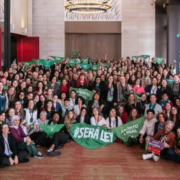
Therefore, on Tuesday the streets will be filled with handkerchiefs, with interventions and rallies in all the cities of the country and various parts of the world. In Córdoba, the federal handkerchief will be at the Museum of Anthropology at 4:00 pm and there will be invited bands. In a collective cry for legal abortion, safe and free, the green wave, returns to the streets and Congress, to be able to decide on our bodies and lives.

Sex education to decide

Contraceptives not to abort

Legal abortion to not die.

¡QueSeaLey!

View this post on Instagram

Seguimos luchando para que nos permitan decidir sobre nuestros cuerpos y vidas ???????? #abortolegalya #CongresoVerde #SeráLey #28M #abortolegal #QueSeaLey #seraley @campaabortolegal.cba

A post shared by Fundeps Argentina (@fundepsargentina) on May 28, 2019 at 7:56am PDT

Author

Laura Villanueva

Contact

Cecilia Bustos Moreschi, cecilia.bustos.moreschi@fundeps.org

28 de May de 2019
Tags: Gender, Legal Interruption of Pregnancy, Sexual and Reproductive Rights, Voluntary Termination of Pregnancy
Share this entry
  • Share on Facebook
  • Share on X
  • Share on WhatsApp
  • Share on LinkedIn
  • Share by Mail
0 0 Comunicaciones Fundeps https://fundeps.org/wp-content/uploads/2026/04/logo-2026-300x120.png Comunicaciones Fundeps2019-05-28 15:06:432024-06-30 16:03:05For the 8th time the IVE project to the Congress is presented
You might also like
Abortion rights advocacy work is collective and international
New international agreement on violence and harassment at work
Now yes: There is updated ILE Protocol
Gender violence and public communication policies in Argentina: advances and setbacks until 2017
Observations on the second draft of the IDB Environmental and Social Policy Framework from a gender perspective
Statement for the appointment of the Attorney General of Córdoba
Mapping of training needs of the Popular, Feminist, Social and Solidarity Economy.
The rights of women in Argentina in times of Covid-19

Tags

Access to Information Access to Justice BID Chinese Investments Citizen Participation Democracy ENTs Environment Environmental Democracy Gender Global Governance Health Healthy nutrition IFIs Infrastructure Financing Legal Interruption of Pregnancy Sexual and Reproductive Rights Social and Environmental Standards Tobacco Control Transparency
See all tags

Acuerdo de Escazú

Emergencia Agroquímica

MOCI - monitoreo ciudadano en proyectos de infraestructura

{el entramado} Contamos historias. Acercamos Realidades.

Instagram

fundepsargentina

Trabajamos para que se garanticen los derechos humanos 🌱⚖️🗣️🌈💜🚭🍎
Promovemos la equidad de #genero, el derecho a la #salud y un #ambiente sano.

TE NECESITAMOS 🧡 Para seguir de cerca el Plan de TE NECESITAMOS 🧡

Para seguir de cerca  el Plan de Saneamiento del Lago San Roque, hay que mirar de cerca todo el proceso. Revisamos información técnica, hacemos seguimiento de la causa y elaboramos informes públicos sobre el cumplimiento del Plan.

Sostener este trabajo en el tiempo requiere recursos. Tu aporte hace posible que continúe.

Doná hoy! (link en bio)
Y todo esto quedó en un papel? No. Ya hay avances. Y todo esto quedó en un papel? No. Ya hay avances. Pero tampoco está resuelto.

Hay plantas de tratamiento que comenzaron a funcionar, obras de cloacas terminadas y establecimientos que fueron auditados por posible contaminación.

➡️ También quedan medidas por cumplir y avances que necesitan seguimiento. Porque mostrar lo que se hizo también sirve para saber qué falta.

Para seguir acompañando este proceso y sosteniendo el trabajo que todavía queda, necesitamos tu apoyo.

Doná hoy.
La Justicia no solo dijo que el lago está contamin La Justicia no solo dijo que el lago está contaminado. También ordenó qué tiene que hacer el Estado para empezar a sanearlo.

La sentencia establece medidas concretas, con plazos y obligaciones que involucran a la Provincia y a los municipios de la cuenca.

Entre ellas: avanzar con las obras cloacales, controlar los vertidos contaminantes, fortalecer la fiscalización y garantizar espacios de participación y transparencia.

Deslizá para conocer qué tiene que pasar para que el saneamiento avance.

Ayudanos a seguir trabajando para que estas medidas se cumplan. Doná hoy.
Hoy, 4 de septiembre, es el Día Mundial de la Salu Hoy, 4 de septiembre, es el Día Mundial de la Salud Sexual. Una fecha que nos invita a volver sobre las discusiones que atraviesan el acceso a la salud sexual y (no) reproductiva: condiciones de acceso para que sea integral y de calidad, desde un enfoque de derechos y con perspectiva de diversidad.

En el mes de junio nos encontramos en el 3° Encuentro Provincial de Redes de Compromiso y Cuidados: Salud sexual Integral con Perspectiva de Diversidad para poner en común experiencias y preguntas sobre estos desafíos.

Hoy recuperamos algunas de las voces que fueron parte de las exposiciones de ese encuentro para volver sobre dos preguntas que siguen abiertas:
¿Cuál es hoy el debate más urgente cuando hablamos de salud integral y diversidad?
¿Por qué es importante encontrarnos en este contexto?

Porque garantizar el derecho a la salud también implica seguir encontrándonos para pensar, discutir y construir respuestas colectivas.
Follow on Instagram

Twitter

Tweets por @fundeps

Newsletter Subscription

    Fundeps. Córdoba (CP X5000JZH), Argentina. info@fundeps.org
    • Link to X
    • Link to Facebook
    • Link to Instagram
    • Link to Mail
    • Link to Youtube
    • Link to LinkedIn
    • Link to TikTok
    Link to: National government seek to agree a new model of food labeling Link to: National government seek to agree a new model of food labeling National government seek to agree a new model of food labeling Link to: We participated in a talk about the problem of Chacras de la Merced in the Siglo XXI University Link to: We participated in a talk about the problem of Chacras de la Merced in the Siglo XXI University We participated in a talk about the problem of Chacras de la Merced in the Siglo...
    Scroll to top Scroll to top Scroll to top