Tobacco industry uses Instagram to illegally promote nicotine pouches and vapes
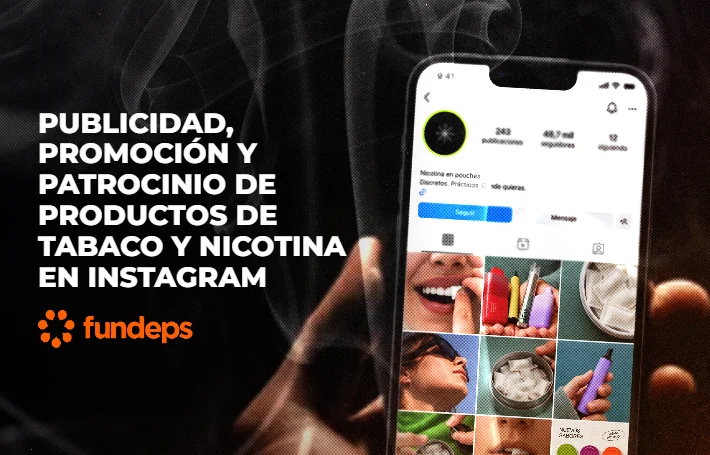
A Fundeps monitoring study found 69 posts that violate Argentina’s National Tobacco Control Law in less than two months. Nearly 9 out of 10 promoted emerging products, using strategies aimed at hooking a new generation of consumers, particularly adolescents and young people. The new regulatory framework approved in 2026 allowed the sale of e-cigarettes and nicotine pouches, but advertising them is still strictly prohibited. We call on the State to monitor and sanction these violations to protect public health.
The tobacco industry systematically breaches the ban on tobacco and nicotine advertising on social media. This is shown in the report “Advertising, promotion and sponsorship of tobacco and nicotine products on Instagram”, produced by the Foundation for the Development of Sustainable Policies (Fundeps).
Between April 20 and June 12, 2026, we identified 69 posts on Instagram that violate Tobacco Control Law No. 26,687. Instagram is one of the most popular platforms among adolescents. These are the main findings:
- 3 out of 4 posts are direct advertising (75.4%), the most evident form of violation under the law.
- Nearly 9 out of 10 promote emerging products: nicotine pouches (56.5%) and e-cigarettes and refill liquids (33.3%).
- The main offenders are the brands themselves, through their official accounts. They are responsible for 56.5% of the posts, and for nicotine pouches the figure rises to 82.1%.
- Influencers, public figures or sports and cultural organizations took part in nearly 3 out of 10 ads. They did so from their own accounts or as collaborators, amplifying the reach of the brands’ content.
- 6 out of 10 come from accounts based abroad (60.9%), but they target Argentine audiences with local influencers, events held in the country and Rioplatense Spanish.
These figures reveal a deliberate commercial strategy, carried out mainly from the accounts of two of the world’s largest tobacco companies: British American Tobacco (BAT), which owns Velo, and Philip Morris International (PMI), which owns ZYN.
Strategies to hook a new generation
The industry does not just show the product. It links it to fun, sports, music and belonging to win over a new generation of consumers. These are some of the main tactics we found:
- Influencers. 85% of Velo’s ads feature local celebrities with hundreds of thousands of followers, in formats such as “Get ready with me” or “POV”. All of them invite people to buy the product through Rappi, a delivery app.
- Elite sports. ZYN sponsors Ferrari and Velo sponsors McLaren in Formula 1. Vaporesso launched a campaign with players from Argentina’s national football team and gave away tickets to the 2026 World Cup.
- Concerts and festivals. ZYN gave away tickets to Lollapalooza, Movistar Arena shows and the Bresh party in Córdoba, and associated its product with the idea of “not missing out on anything”.
- Flavors. 59% of nicotine pouch ads and 75% of e-cigarette ads highlight flavors. The new regulation that allowed these products to be sold explicitly bans flavors: for nicotine pouches, only menthol is allowed, and for e-cigarettes, only tobacco flavor.
- Covert advertising. Memes, viral videos and content that looks like news promote products without disclosing that they are ads.
Adolescents in the industry’s sights
These digital marketing strategies have a particular impact on adolescents and young people. They turn products that are harmful to health into accessories linked to enjoyment, belonging and freedom, as analyzed in the report “Captured Youth” (Juventudes capturadas). The consequences are already visible. According to the latest national survey by Sedronar, Argentina’s Secretariat for Comprehensive Drug Policies, conducted in 2025, e-cigarette use has already overtaken tobacco use among secondary school students: 35.5% have tried them, and among those aged 14 or younger, 27.5% already have.
Nicotine pouches are the newest product and account for most of the illegal advertising. A study by the Center for the Study of State and Society (CEDES), conducted in 2025, found that 3.4% of adolescents aged 12 to 17 had already tried them. Their use is still low, so there is still time to stop them from spreading.
What we demand from the State
The new framework approved in 2026 allowed the sale of e-cigarettes and nicotine pouches, but not their advertising. Advertising, promotion and sponsorship of these products are still prohibited under Law No. 26,687. For most of the monitoring period, the sale of e-cigarettes was banned, yet stores advertised them openly. If this was already happening under the ban, it is fair to ask what capacity the State will have to control these products now that their sale is allowed. It is worth noting that since Law No. 26,687 was passed, the State has not imposed a single sanction for violations.
The industry knows advertising is prohibited and uses it anyway, because no one monitors or sanctions it. Social media cannot be a free-for-all zone for targeting adolescents. We need the State to protect public health, especially the health of young people.
That is why it is essential to:
- Strengthen enforcement in digital environments, with technical teams dedicated to monitoring social media.
- Protect children and young people from direct or indirect exposure to tobacco and nicotine advertising.
- Demand transparency and accountability from platforms, particularly Meta.
- Prioritize monitoring of violations involving emerging products.
- Develop international cooperation mechanisms to tackle cross-border advertising.
- Establish joint liability for tobacco companies, digital platforms and local advertisers.
The law already exists. What is missing is for the State to enforce it and protect the health of adolescents and young people.
Contact:
magamerlov@fundeps.org