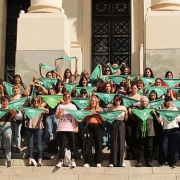
Considerations on the crime of abortion and injuries to the unborn person in the preliminary draft reform of the Penal Code
Following the preliminary draft of Penal Code 2018, a group of professionals and civil society organizations sent a letter to Minister Germán Garavano requesting that he suspend articles 95 and 96 of the preliminary draft because they are regressive for the rights of pregnant persons.
“Below, we offer a google translate version of the original article in Spanish. This translation may not be accurate but serves as a general presentation of the article. For more accurate information, please switch to the Spanish version of the website. In addition, feel free to directly contact in English the person mentioned at the bottom of this article with regards to this topic”
Together with a group of professionals and civil society organizations that work in defense of human rights, we sent a letter to Germán Garavano, Minister of Justice and Human Rights, requesting that he suspend articles 95 and 96 of the preliminary draft because they are regressive for human rights. of pregnant people.
The text proposed in the Draft of Penal Code 2018 does not accept the important modifications approved in the Chamber of Deputies of the Nation in the recent treatment of the bill that decriminalized and legalized the interruption of pregnancy on a voluntary basis until the 14th week of gestation.
1. The proposed wording does not substantially change the conditions and guidelines set forth in arts. 85 and next. of the current penal code in force since 1921, although it uses different expressions and, on the contrary, may be regressive.
2. The fundamental change foreseen in the legal reform debated and approved in Deputies is not contemplated, that is, that the abortion is not punishable when the woman voluntarily decides to interrupt the pregnancy in the first 14 weeks of gestation. Consequently, the grounds for exemption from punishment in the preliminary draft under analysis remain the same as those currently in force: danger to the life and health of women and in case of violation.
3. The new proposed text qualifies health in its physical and mental aspect, while in the current penal code in force, as well as in the project approved in Deputies, only “Health” is spoken, which we consider more correct, because enables the development of the broad concept according to WHO guidelines that does not limit the concept of health to physical and mental aspects only. Therefore, the change is limiting and can be interpreted restrictively, generating greater obstacles when it comes to accessing the legal interruption of pregnancy for this reason, as it is currently planned.
4. The enumeration proposed by the preliminary bill in relation to the grounds for exemption from punishment is also restrictive insofar as it does not expressly contemplate the possibility of deciding to terminate the pregnancy when there is a diagnosis of non-viability of extra-uterine life of the fetus (for example in the case of anencephaly ), as today is accepted and admitted by the jurisprudence for decades, and was expressly consigned in the project that had half sanction.
5. In relation to the amount of the penalties provided for the crime of abortion instead of the current one from 1 to 4 years, it is established from 1 to 3 years, thus reducing the maximum in one year, which may mean greater possibilities that the prison sentence is not effective, although it depends on the judicial criterion since as a general principle in the Preliminary Draft the penalties are effective compliance. It should be noted that the project with a half sanction established a substantially lower penalty: from 3 months to a year with the possibility of being left in suspense at the discretion of the judiciary criteria.
6. In the Preliminary Draft the possibility of suspension is extended and even the benefit is extended with the possibility that the judge decides to leave the penalty without effect, but it should be noted that in addition to being substantially greater than in the project with half sanction, there was a judicial process that occurred when the termination of pregnancy was practiced only after the week 14, ie, from week 15 of pregnancy – and provided that the other causes that do not have a deadline of expiration-, which substantially reduced the universe of cases caught in the criminal sphere.
The circumstance that this Draft incorporates this figure of suspension of punishment or exemption from punishment at the discretion of the criminal judges intervening in proceedings against women, does not improve the clearly punitive and persecutory issue that this crime involves for women. In addition to continuing to prosecute, women are subject to the discretion and discretion of criminal judges, who will graduate the sentence and decide discretionally on its amount, suspension or exemption.
7. We consider it necessary to emphasize that the evolution of comparative law and the most modern tendencies in the criminal field and in the international law of human rights, which permeates and especially affects sexual and reproductive rights in the 21st century, point not only to decriminalization and legalization of the IVE during the first weeks of pregnancy, but consider that the criminal appeal is disproportionate, discriminatory against women and only applicable as a measure of last resort (ultima ratio).
8. As a result, legal systems abandon criminalization and resort to other measures outside the criminal context. Compared legislations abstain from incorporating into the codes new norms that suppose the creation of new crimes or criminal types, such as, for example, abortion in its culpable form, which this preliminary draft incorporates.
The preliminary draft that concerns us deepens this regressive path, creating more criminal figures directly linked to abortion that until now was always contemplated in its intentional form (ie with intention). Creating the crime of wrongful abortion not only strengthens the punitive path, but it also constitutes a direct threat to the professionals involved in health practices, who see a new criminal figure that involves them beyond other criminal figures that will be applied to them. the commission of harmful acts due to malpractice, which are already contemplated.
9. Wrongful abortion is a very scarce figure in comparative legislation. Very few penal codes outside Spain (Article 146 with a prison sentence of three to five months alternative with fine and disqualification in your case from one to three years), where non-punishable abortion is contemplated before 14 weeks of pregnancy; only three countries in Latin America contemplate it – two of them with serious maternal mortality problems – such as Guatemala (article 139 with one to three years imprisonment); Costa Rica (Article 122 sixty to one hundred and twenty days of fine) and El Salvador (Article 137 prison from six months to two years). The Preliminary Draft adopts for this figure the same penalty as El Salvador, one of the Central American countries with the highest criminalization against women.
10. Therefore, we consider it necessary to suppress the crime of miscarriage of the criminal code proposed in the preliminary draft in art. 87 inc.2, which is also public action may be seriously intrusive to the privacy of women.
11. On the same path of punitive increase directly related to the sexual and reproductive rights of women, the preliminary draft incorporates two new offenses: injury to the fetus, called “injury to the unborn person”, in its willful and guilty manner. Nor do we find reception of these figures in comparative law, more than the few examples offered by the laws of Peru that includes the fraudulent figure and Spain, El Salvador and Colombia that admit both intentional and culpable. In the rest of the legislation these criminal types are not contemplated. It could be understood that this crime gives the fetus a certain legal status, alien and different to the body of the woman or pregnant person, trying to equate it with a person already born. This question has been the object of deep analysis in the jurisprudence, in particular by the Supreme Court of Justice of the Nation in the previous FAL and by the Inter-American Court in the Artavía Murillo case whose conclusions do not validate the criterion that informs this crime, but quite the opposite.
12. On the other hand, in the preliminary projects that were made in our country so far this century (2006 and 2014), these figures that are reproduced here are incorporated (in 2006 only the malicious form was included), with many criticisms and observations, including the dissidence presented by one of the members of the Drafting Commission to art. 96 of the Preliminary Draft of the reform created by Dto.678 / 2012, to which we refer (See “Draft of the Criminal Code of the Nation – Det. PEN 678/2012”, Dissident Dra. María Elena Barbagelata). On both occasions, the Public Ministry of Defense also held that in the face of any pretension to incorporate the crime of injury to the fetus, it will be essential to bear in mind that these proposals frequently violate women’s right to choose, encourage social control policies of the pregnancy and motherhood and unjustifiably expand the punishable area (See “Opinion for the preparation of the new Criminal Code of the Nation with a gender perspective” Dra. Stella Maris Martínez – General Office of the National Ombudsman).
For the above, we advise the deletion of arts. 95 and 96 of the preliminary draft of the penal code 2018, especially taking into account that these crimes are also public action. (Articles 71 and following of the Draft).
PEOPLE AND INSTITUTIONS THAT SUBSCRIBED THE DOCUMENT:
ASOCIACIÓN DE ABOGADOS DE BUENOS AIRES (AABA)–
Dras. María del Carmen Besteiro
Dra. Gabriela Nasser
Dra. María Elena Barbagelata
Dra. Julieta Bandirali
Dra. Nelly Minyersky
Dra. Nina Brugo Marcó
Dra. Sandra Mónica González
Dra. Verónica Heredia
Dra. Natalia Ferrari
Dra. Cristina Raquel López
Dr. Ricardo Huñis
Dr. Guillermo Goldstein
Dr. Carlos Alberto López de Belva
Dra. Alba Rocío Cuellar Murillo
FUNDACION MUJERES EN IGUALDAD (MEI)
Sra. Monique Altschul
CEDEM- (Centro de Estudios de la Mujer)
Lic. María Luisa Storani
AMNISTÍA INTERNACIONAL (AI)
Lic. Paola García Rey
CENTRO DE ESTUDIOS LEGALES Y SOCIALES (CELS)
Dra. Edurne Cárdenas
EQUIPO LATINOAMERICANO DE JUSTICIA Y GÉNERO (ELA)
Dra. Natalia Gherardi
UNR- FACULTAD DE DERECHO- PROGRAMA GÉNERO Y SEXUALIDADES
Dra. Analía Aucía
CLADEM ARGENTINA
Lic. Milena Páramo
INTEGRANTES DE LA COMISIÓN DE LOS DERECHOS DE LA MUJER DE LA F.A.C.A:
Dra. Silvia Pedretta
Dra. Marisa Eisaguirre
Dra. Mariela Jesús
Dra. Mabel López
ASOCIACIÓN DE MUJERES PENALISTAS DE ARGENTINA (AMPA)
Dra. Mariana Barbitta
CATOLICAS POR EL DERECHO A DECIDIR
CUERPO DE ABOGADAS FEMINISTAS DE CÓRDOBA (CAF)
FUNDACIÓN PARA EL DESARROLLO DE POLÍTICAS SUSTENTABLES (FUNDEPS)
XUMEK (ASOCIACION PARA LA PROMOCIÓN Y PROTECCIÓN DE LOS DERECHOS HUMANOS (MENDOZA).
MUJERES X MUJERES
MULTISECTORIAL DE MUJERES DE SANTA FE
ALIANZA POR LOS DERECHOS HUMANOS DE LAS MUJERES (RED QUE AGRUPA MAS DE 300 ABOGADAS DE TODO EL PAIS)
Dra. Mariana Romanelli
Dra. Mariana Vargas
Dra. Daniela Fagioli
Dra. María Elisa Vilca
Dra. Mariana Hellin
Dra. Laura Julieta Casas
Dra. Susana Chiarotti
Dra. Mónica Menini
Dra. Soledad Deza
Dra. María Urueña Russo
Dra. Mariana Soledad Alvarez
Dra. Raquel Asensio
Dra. Paula Condrac
Dra. Larisa Moris
Dra. María Renée Carrizo
Dra. Karina Selva Andrade
Dra. Alejandra Perez Scalzi
Dra. Silvia Juliá
Dra. Manuela G. González
Dra. Lucía Puyol
Dra. Mariana Ripa
Dra. Sabrina Frydman
Dra. Patricia Bustamante Quintero
Mg. Cecilia Russo
Dra. Analía Mas
Dra. Andrea Caleri
Dra. Eleonora Lamm
Dra. Lucila Puyol
Dra. Valentina Tarqui Lucero
Dra. María Gabriela Pellegrini Salas (AAMJUS)
Lic. Dora Barrancos
Dra. Celeste Perosino
Lic. Mónica Tarducci
Sra. Marta Alanis
Sra. Julia Martin
Lic. Dolores Fenoy
Lic. Victoria Tesoriero