In Argentina, legislation and public policies on care have made progress but also obstacles. Within the framework of the International Day of Domestic Workers and the 8th anniversary of the enactment of Law 26,844 on the Special Regime of Work Contract for Personnel of Private Houses, we highlight the importance of the legislation and regulation of the work of those who they take care of it in a remunerated way, although we recognize that there is still a lot of hard work in pursuit of its effectiveness and expansion.
“Below, we offer a google translate version of the original article in Spanish. This translation may not be accurate but serves as a general presentation of the article. For more accurate information, please switch to the Spanish version of the website. In addition, feel free to directly contact in English the person mentioned at the bottom of this article with regards to this topic”
In the 1950s, the first laws related to domestic work appeared, in order to define labor relations and their rights as workers.
But it was not until 2013 when Law 26,844 was enacted, which established a special work contract regime for paid workers in private homes. This law regulates the labor relations that are established within private homes or in the sphere of family life and that do not generate a direct profit or economic benefit for the employer. It defines this work as any provision of cleaning, maintenance or other typical household activities services, personal assistance and accompaniment to family members or those who live in the same home with the employer, and the non-therapeutic care of sick or disabled people.
In this process, activism and later the union organization of private house workers, has been key in the fight for their rights. The Union of Auxiliary Personnel of Private Houses (UPACP), which encompasses the workers of private houses, “carries out its tasks of defense and representation of the workers in the sector since the beginning of the last century. Today the workers have a law that regulates the activity, No. 26,844, which equates, as appropriate, the work of domestic service to that of workers from other unions. Now the workers of private homes have the right to vacations, maternity leave, among all labor rights. ”
This law tries to put the rights of private house workers on an equal footing with those of any other worker in a formal and dependent relationship. However, the characteristics of domestic work, related to the private sphere, the invisible, with the duty assigned to women to care for and give love in a disinterested, selfless way and without any type or with little remuneration and recognition, It makes it difficult for these activities to be considered as work and those who perform it, as workers.
Labor market of private house workers
Law 26844 not only establishes the regime of private house workers but also different categories according to the type of work that was developed in the domestic sphere. These categories translate into salary scales:
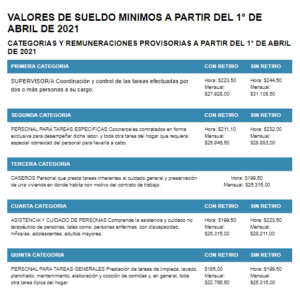
www.upacp.org.ar
However, this recognition is far from meaning the realization of their labor rights.
According to a report by the National Directorate of Economy, Equality and Gender, in Argentina, the main occupation of women is paid domestic service: it represents 16.5% of the total employment of employed women and 21.5% of wage earners. It is the most feminized activity in the market (96.5% are women), the one with the highest informality rate (72.4%) and the one with the lowest average income in the market, constituting the poorest workers of the entire economy. This means that a domestic worker earns 46 pesos for every 100 that a private sector employee receives and 30 pesos for every 100 that a formal worker receives. Compared to men, they earn 26 pesos for every 100 pesos that one of them earns. According to the ILO, this informality and precariousness generates the breach of rights and a space for labor exploitation, even of girls and adolescents.
For Candelaria Botto: “In our country, where the State does not satisfy these needs, the role of domestic workers becomes essential for a large number of households. However, this work takes place mostly in precarious conditions and with low remuneration, which shows the little social value that is given to reproductive work. ”
Even with all these limitations on access to rights, it is likely that a registered employee, whose labor relations are regulated by a legal framework, is in better working conditions.
That the autonomy of some does not take it away from others
Now, who are the women that make up this group of domestic workers?
Mercedes D´Alessandro, in her book “Economía Femini (s) ta”, affirms that the “fairy godmothers” who sustain the lives of those who inhabit the households with the highest income are women in situations of vulnerability and poverty. Many of them have dependent children and most have not been able to complete secondary school (only 2% of them completed a tertiary degree or university). As a result, 40% of poor mothers are private house workers.
They are women who need to work but are not qualified to access other types of employment. In addition, it is usually one of the first job options for women from other countries, although the percentage of internal migrants among these workers is more remarkable. Many young women see this job as a way out of poverty, but end up living in a utility room of a wealthy family that does not pay them a Christmas bonus, vacation or sick days.
At this point, it is important to think about the tense link between paid and unpaid forms of care. Given the unjust social organization that distributes care, paid and unpaid care work falls mainly on women. That is why it is always necessary for a woman to take care of, to “free” another of these tasks. And here, it is not only the stubborn persistence of the sexual division of labor that undermines advances in favor of a more just and equitable society, but it is also other factors of inequality and oppression that overlap with gender. The class and powerful processes of racialization that still persist go through caregiving.
As domestic work is, to a great extent, carried out by poor women, peasants, migrants, representatives of various ethnic groups, with low education and little education, who find in this activity a means of subsistence, it is one of the most devalued jobs not only in economic terms but also in social terms. Thus, families with higher incomes can turn to the market to free up time, which implies hiring another, poorer woman to do domestic and care work.
As D’Alessandro says: “behind every great woman, there is another great woman.”
This invites us to think about care in a feminist and intersectional way, which puts care work at the center of the scene and de-romanticizes it. Because the lack of decent wages and real access to labor rights is not compensated with gratitude and love.
As Sol Minoldo says: “How feminist can a process be in which some women emancipate themselves at the expense of others, leaving the sexual distribution of domestic work intact?
If there is exploitation, it does not stop there because the worker is treated with affection and the trust of our intimate life is opened to her, although it may be noticed a little less. It is time to question the way in which “love” has been used to make it invisible that domestic work is work, whoever does it. That love is not an excuse to deny workers their rights. ”
Although the importance of care and of those who care – especially during the pandemic – has become increasingly visible, this has not yet translated into salary improvements in the case of paid domestic and care work. We still owe a debt to the people they care for. With domestic workers, there are still huge social, cultural and economic gaps to fill. They perform essential work but in precarious and irregular conditions, with miserable wages that are barely enough for them to access the basic food basket.The gaps and obstacles that these workers face every day are an impediment to real access to their rights as workers, as women and as people.
Author

Andrea Repetto Vargas began functions as the new director of the MICI
“Below, we offer a google translate version of the original article in Spanish. This translation may not be accurate but serves as a general presentation of the article. For more accurate information, please switch to the Spanish version of the website. In addition, feel free to directly contact in English the person mentioned at the bottom of this article with regards to this topic”
Upon assuming office on March 16, Repetto Vargas expressed his commitment to work for an MICI “even more open to all the people and communities in the region who need us”, emphasizing his will to “promote institutional learning, which allows us to contribute even more value to the institution and thus reinforce accountability and environmental and social sustainability of IDB Group projects. She, in turn, highlighted the work done by the outgoing director, Victoria Márquez-Mees, and her entire team, pointing out that she allowed the Mechanism to be strengthened and to position it as a benchmark.
From Fundeps we welcome the appointment of Andrea Repetto Vargas as the new Director of the MICI and we hope that this election will allow the process of strengthening and dissemination of the Mechanism that has been taking place since its creation in 2010 to continue.
More information
Author
Contact
Citizen participation in check
“Below, we offer a google translate version of the original article in Spanish. This translation may not be accurate but serves as a general presentation of the article. For more accurate information, please switch to the Spanish version of the website. In addition, feel free to directly contact in English the person mentioned at the bottom of this article with regards to this topic”
Beyond the technical-environmental objections that the project deserves regarding its environmental impact, whose evaluation may imply the denial (or not) of the environmental license, the procedure selected by the provincial authority to the holding of the public hearing.
Is that the call itself established that to proceed with the registration, it was necessary to have “LEVEL 2” of Digital Citizen -CIDI- or, where appropriate, obtain it. Then, once this procedure was completed, it was possible to register through the “participation” service of said portal. Each and every one of these previous steps required having access to the internet, a device with a camera and even knowledge of technologies.
To participate in the public hearing – which is scheduled to begin today – you must have a device that allows you to access the corresponding “Google Meet” session. This adds other variables that make access to the procedure difficult, since the person interested in participating must not only have a good internet connection -due to the number of people present in the same session- but also with computer knowledge and a device appropriate technology. In addition, given the possible attendance of many people, the administration must adopt a good room management mechanism, trusting that the platform does not collapse due to the number of online participants.
All these requirements for the exercise of the right to public participation, in addition to finding their justification in the pandemic context, are based on the regulatory framework created by Provincial Law No. 10,618 and its Regulatory Decree No. 750/19 for the modernization of the administration. This regulation is what makes possible, based on Art. 8, the possibility of digital audiences.
The requirements designed by the provincial administration for the enjoyment of the right to citizen participation in environmental matters, generates certain questions regarding the validity of the procedure and the consequent administrative act. Participation must be open, inclusive, guaranteeing favorable conditions so that it can be adapted to the characteristics of the population, taking into special consideration those sectors that for one reason or another are in a situation of vulnerability. The way in which the digital public hearing has been implemented seems to move away from these guidelines, generating restrictions that have a direct impact on the enjoyment of the right of access to public participation in environmental matters, particularly of those people who do not have devices, knowledge and necessary infrastructure.
More information
Contact
Domestic workers: a fight for their recognition
“Below, we offer a google translate version of the original article in Spanish. This translation may not be accurate but serves as a general presentation of the article. For more accurate information, please switch to the Spanish version of the website. In addition, feel free to directly contact in English the person mentioned at the bottom of this article with regards to this topic”
But it was not until 2013 when Law 26,844 was enacted, which established a special work contract regime for paid workers in private homes. This law regulates the labor relations that are established within private homes or in the sphere of family life and that do not generate a direct profit or economic benefit for the employer. It defines this work as any provision of cleaning, maintenance or other typical household activities services, personal assistance and accompaniment to family members or those who live in the same home with the employer, and the non-therapeutic care of sick or disabled people.
In this process, activism and later the union organization of private house workers, has been key in the fight for their rights. The Union of Auxiliary Personnel of Private Houses (UPACP), which encompasses the workers of private houses, “carries out its tasks of defense and representation of the workers in the sector since the beginning of the last century. Today the workers have a law that regulates the activity, No. 26,844, which equates, as appropriate, the work of domestic service to that of workers from other unions. Now the workers of private homes have the right to vacations, maternity leave, among all labor rights. ”
This law tries to put the rights of private house workers on an equal footing with those of any other worker in a formal and dependent relationship. However, the characteristics of domestic work, related to the private sphere, the invisible, with the duty assigned to women to care for and give love in a disinterested, selfless way and without any type or with little remuneration and recognition, It makes it difficult for these activities to be considered as work and those who perform it, as workers.
Labor market of private house workers
Law 26844 not only establishes the regime of private house workers but also different categories according to the type of work that was developed in the domestic sphere. These categories translate into salary scales:
www.upacp.org.ar
However, this recognition is far from meaning the realization of their labor rights.
According to a report by the National Directorate of Economy, Equality and Gender, in Argentina, the main occupation of women is paid domestic service: it represents 16.5% of the total employment of employed women and 21.5% of wage earners. It is the most feminized activity in the market (96.5% are women), the one with the highest informality rate (72.4%) and the one with the lowest average income in the market, constituting the poorest workers of the entire economy. This means that a domestic worker earns 46 pesos for every 100 that a private sector employee receives and 30 pesos for every 100 that a formal worker receives. Compared to men, they earn 26 pesos for every 100 pesos that one of them earns. According to the ILO, this informality and precariousness generates the breach of rights and a space for labor exploitation, even of girls and adolescents.
For Candelaria Botto: “In our country, where the State does not satisfy these needs, the role of domestic workers becomes essential for a large number of households. However, this work takes place mostly in precarious conditions and with low remuneration, which shows the little social value that is given to reproductive work. ”
Even with all these limitations on access to rights, it is likely that a registered employee, whose labor relations are regulated by a legal framework, is in better working conditions.
That the autonomy of some does not take it away from others
Now, who are the women that make up this group of domestic workers?
Mercedes D´Alessandro, in her book “Economía Femini (s) ta”, affirms that the “fairy godmothers” who sustain the lives of those who inhabit the households with the highest income are women in situations of vulnerability and poverty. Many of them have dependent children and most have not been able to complete secondary school (only 2% of them completed a tertiary degree or university). As a result, 40% of poor mothers are private house workers.
They are women who need to work but are not qualified to access other types of employment. In addition, it is usually one of the first job options for women from other countries, although the percentage of internal migrants among these workers is more remarkable. Many young women see this job as a way out of poverty, but end up living in a utility room of a wealthy family that does not pay them a Christmas bonus, vacation or sick days.
At this point, it is important to think about the tense link between paid and unpaid forms of care. Given the unjust social organization that distributes care, paid and unpaid care work falls mainly on women. That is why it is always necessary for a woman to take care of, to “free” another of these tasks. And here, it is not only the stubborn persistence of the sexual division of labor that undermines advances in favor of a more just and equitable society, but it is also other factors of inequality and oppression that overlap with gender. The class and powerful processes of racialization that still persist go through caregiving.
As domestic work is, to a great extent, carried out by poor women, peasants, migrants, representatives of various ethnic groups, with low education and little education, who find in this activity a means of subsistence, it is one of the most devalued jobs not only in economic terms but also in social terms. Thus, families with higher incomes can turn to the market to free up time, which implies hiring another, poorer woman to do domestic and care work.
As D’Alessandro says: “behind every great woman, there is another great woman.”
This invites us to think about care in a feminist and intersectional way, which puts care work at the center of the scene and de-romanticizes it. Because the lack of decent wages and real access to labor rights is not compensated with gratitude and love.
As Sol Minoldo says: “How feminist can a process be in which some women emancipate themselves at the expense of others, leaving the sexual distribution of domestic work intact?
If there is exploitation, it does not stop there because the worker is treated with affection and the trust of our intimate life is opened to her, although it may be noticed a little less. It is time to question the way in which “love” has been used to make it invisible that domestic work is work, whoever does it. That love is not an excuse to deny workers their rights. ”
Although the importance of care and of those who care – especially during the pandemic – has become increasingly visible, this has not yet translated into salary improvements in the case of paid domestic and care work. We still owe a debt to the people they care for. With domestic workers, there are still huge social, cultural and economic gaps to fill. They perform essential work but in precarious and irregular conditions, with miserable wages that are barely enough for them to access the basic food basket.The gaps and obstacles that these workers face every day are an impediment to real access to their rights as workers, as women and as people.
Author
Argentina seeks to agree with China an investment plan for 30 billion dollars
“Below, we offer a google translate version of the original article in Spanish. This translation may not be accurate but serves as a general presentation of the article. For more accurate information, please switch to the Spanish version of the website. In addition, feel free to directly contact in English the person mentioned at the bottom of this article with regards to this topic”
The President of Argentina, Alberto Fernández, will visit the President of China, Xi Jinping, on May 5. One of the backbones of the meeting will be the negotiations for the entry of the South American nation to the Silk Road project and the landing of 5G technology from the hand of Huawei. In addition, it is expected that other important agreements for the bilateral relationship will be discussed, such as the expansion of the Caucharí solar energy park in Jujuy, infrastructure projects, livestock, investments and financing.
After a 2020 characterized by the health and economic crisis caused by the covid-19 pandemic, the Argentine government advances in investment agreements with China for a value close to 30 billion dollars. Argentina has 15 infrastructure projects on the list to present to China. These agreements are of great importance for the national government, mainly in view of the necessary reactivation of the Argentine economy.
The projects that Argentina prioritizes for investment from China are the rehabilitation plan of the San Martín Railway system, improvements to the Roca Railway line, infrastructure works on the Miter and Urquiza railway, the redefinition of the Belgrano Cargas railway network and the incorporation of rolling stock for passengers. In parallel, the installation of smart pig farms is being discussed. It is estimated that the value of the investment would be around 3.8 billion dollars for a period of four years, in addition to the objective of producing 882 thousand tons of meat for a value of 2.5 billion dollars.
Likewise, the landing of Chinese investments in mining is discussed, especially in the production of copper and lithium in northern Argentina. Regarding lithium, Argentina signed an agreement with Jiangsu Jiankang Automobile (JJA) for the production of vehicles and batteries in the country. The list of projects includes the remodeling of the Chaco-Corrientes bridge, the construction of an aqueduct and water treatment plants, road corridors and the development of a logistics hub in Tierra del Fuego.
Regarding investments in energy, the president has in his portfolio five main works that require large investments that he will request from the Asian giant. This plan prepared by the Secretary of Energy, Darío Martinez, and the Minister of Economy, Martín Guzmán, stands out for the non-inclusion of one of the most demanded works by China: the construction of the fourth nuclear power plant in the country with Chinese technology . This works plan includes the construction of the southern gas pipeline, the electric grid in AMBA, the electric grid in Patagonia, the Mesopotamia pipeline and the construction of a thermal power plant.
The construction of the fourth nuclear power plant began to take shape during the government of Cristina Fernández for a value of 12 billion dollars. With Mauricio Macri in power, the cost was lowered to 9 billion. However, with the economic crisis and Macri’s electoral defeat, the project came to a standstill. The arrival of Alberto Fernandez meant for China the possibility of discussing the realization of the project. Another work that does not appear in this plan is the construction of the Chihuido hydroelectric dam in Neuquén. This work claimed by Russia and China would remain in the hands of Germany.
One year after the start of the pandemic in Argentina and the measures that have been adopted to act accordingly, the link with China has deepened. The Chinese market has become the main destination for beef exports from Argentina. Bilateral trade between the two countries, which in 2000 was around 2 billion dollars, closed in 2019 at a value close to 16.3 billion dollars, with Argentine exports for 7 billion dollars and imports for 9 billion dollars. of dollars. In addition, the Argentine government closed an agreement with the pharmaceutical company Sinopharm in early February for the shipment of 1 million doses and the arrival of another 3 million doses is expected at the end of March.
This new boost to the relationship with China is expected to be strategic, commercially balanced and accompanied by the necessary responsibility in environmental and social matters.
More information
Author
Mariano Camoletto
Contact
Gonzalo Roza, gon.roza@fundeps.org
Public procurement in a pandemic: a year of direct contracting and lack of transparency
“Below, we offer a google translate version of the original article in Spanish. This translation may not be accurate but serves as a general presentation of the article. For more accurate information, please switch to the Spanish version of the website. In addition, feel free to directly contact in English the person mentioned at the bottom of this article with regards to this topic”.
Ruido is a national network made up of journalists, communicators, specialists in open data and referents of civil organizations from 15 provinces that aims to make visible content from all over the country related to issues of transparency, access to public information, corruption and produce investigations, reports and other content related to these topics. From Fundeps we support the creation of the Red Ruido in alliance with FOPEA and with the collaboration of Poder Ciudadano.
These are the results of the first Noise investigation How were public funds used in Argentina for purchases related to the pandemic in 2020?
Through surveys on public portals and requests for access to information, it investigated information on public purchases in pandemic in 13 Argentine provinces and the Autonomous City of Buenos Aires between March and December 2020 to answer the following questions: what bought? how they did it? How much did they pay?
Highlights
Buenos Aires, with the most expensive ambulances in the country
The information obtained is partial and incomplete despite requests for access to the information, which were not answered. The most striking case: the ambulances of more than $ 13 million.
Catamarca, little information and a lot of jet
There are no public portals to access purchases and the information collected on expenses due to Covid-19 is minimal. A health jet purchased in a pandemic cost $ 8,950,000.
Chaco, no frame
There is a shopping portal, but it is impossible to know which ones correspond to the emergency due to the pandemic. The request for access to information was not answered.
CABA, with 210 operations without consignment
It is one of the best organized districts, with the display of public purchases. Although there are 210 operations that cannot be traced. Suppliers to investigate.
Córdoba, with differences
Almost all the data are available online. The Noise survey shows 83% of direct awards. The Government has another interpretation.
Entre Ríos: the dispute to investigate overpricing
The limit for direct purchases in a pandemic was extended to almost $ 5 million. And the ordinary and federal Justices dispute an investigation for overpricing.
Formosa, the impenetrable
There are no web portals or information on hiring in a pandemic. The only response to the request for access was the figure of how much was the total spent.
Mendoza, accessible
The province is one of the most transparent in relation to the publication of contracts. More information here.
Salta, the imprecise
It is not possible to access the information of the final awards. The government did not respond to requests for access to information on Ruido.
Incomplete answer in Santa Cruz
It does not publish official purchase data. Noise got them after access requests, which were answered by five out of seven ministries. The “sensitive data” that is not displayed. More information here.
Santa Fe, with confusing data
There is no coincidence between the few operations that appear on the official shopping portal, reported by Ruido. It is also not clear if they correspond to the emergency due to the pandemic. More information here.
Santiago del Estero: not even paying
It is one of the most opaque provinces: it was not possible to access any public information, despite requests for access. More information here.
Tierra del Fuego: Covid drivers
Partial data was accessed. The hiring of chauffeurs for a secretariat is striking, due to pandemic reasons. More information here.
Tucumán: 5 years to access the information
No information was obtained regarding any public purchases of pandemic expenditures. There is a case about access to information that the Tucumán Justice has not resolved for five years. More information here.
More information
Authors of the Noise survey
Mariela Arias (Santa Cruz), Marcela Arce (Santiago del Estero), María Ester Romero (Buenos Aires and CABA), Yamile González (Formosa), Gabriela Sánchez (Mendoza), Bárbara Maidana (Chaco and Sante Fe), Cristian Pérez and Juan Manuel González (Córdoba), Gabriel Ramonet (Tierra del Fuego), Luciano Garro (Entre Ríos), Gonzalo Guzmán (Salta Transparente), Luis María Ruiz (Tucumán), Sol Minoldo, Julieta Fantini, Andrés Vázquez, Sergio Carreras and Edgardo Litvinoff.
Learn more about El Ruido
Access to Information Agency: organizations request a hearing from Alberto Fernández
“Below, we offer a google translate version of the original article in Spanish. This translation may not be accurate but serves as a general presentation of the article. For more accurate information, please switch to the Spanish version of the website. In addition, feel free to directly contact in English the person mentioned at the bottom of this article with regards to this topic”
Together with ACIJ, Poder Ciudadano, Legislative Directory, Democracia en Red, Vía Libre Foundation and the Regional Alliance for Free Expression and Information, we requested an interview with Alberto Fernández in order to express a series of observations about the candidacy -proposed by the Chief of Cabinet, Santiago Cafiero- for the position of Director of the Agency for Access to Public Information (AAIP).
The public hearing that was held on March 23 to discuss the candidacy of lawyer Gustavo Fuertes as head of the AAIP revealed the need for another profile to be proposed for the position. After a series of challenging statements by numerous individuals and civil society organizations and the candidate’s responses to the observations and questions made, it was clear that the candidate lacks the knowledge and track record to demonstrate his suitability and commitment that a charge of this relevance requires.
Faced with this worrying situation, the organizations request to meet urgently with the President of the Nation, trusting that we will be able to state the reasons why a new candidacy must be sent that meets the requirements of suitability and autonomy for the position.
Access the letter
Contact
Nina Sibilla, ninasibilla@fundeps.org
The Chief of Staff must propose another person to direct the Access to Public Information Agency
“Below, we offer a google translate version of the original article in Spanish. This translation may not be accurate but serves as a general presentation of the article. For more accurate information, please switch to the Spanish version of the website. In addition, feel free to directly contact in English the person mentioned at the bottom of this article with regards to this topic”
On March 23, the public hearing was held to evaluate the candidacy proposed by the Executive Power for the Agency for Access to Public Information, which promotes Attorney Gustavo Fuertes for the position. Contrary to what is established by current regulations, and what should have even happened due to the nature of the position under discussion, the hearing was not broadcast live for the general public, which restricted the number of listeners and access by part of journalists.
The candidate presented some work proposals, but his answers to the questions asked – generally incomplete and limited – showed the lack of specific knowledge regarding access to information and protection of personal data, which corroborates that his professional career in other areas of the public sector do not make him a person qualified for the task that is intended to entrust him. Far from reaffirming that he is the most suitable person for the position, the candidate acknowledged on several occasions the need to study the issues on which he was asked and the existence of people with a greater background in the matter.
The hearing revealed what numerous civil society organizations raised in their challenges: the candidate lacks the knowledge and track record to show his suitability and commitment for the position. Dozens of male and female speakers presented their objections over almost 5 hours. All the people who spoke agreed on the need for another candidacy to be sent to ensure the proper functioning and autonomy of this fundamental body, while no person came forward to argue in favor of the candidacy.
Public hearings must be an instance of substantive participation of the citizens that result in better decision-making by the State. Otherwise, they become a mere formality. It is clear from the results of this hearing that the candidacy of the Executive Power for the position does not meet the requirements of the law.
We ask the Chief of the Cabinet of Ministers, Santiago Cafiero, to withdraw this candidacy and send that of a person who demonstrates his suitability and commitment to the position, in compliance with articles 20 and 21 of Law 27,275 on the Right of Access to the Public information.
The 2021 Annual Meeting of Governors of the IDB and IDB Invest was held
“Below, we offer a google translate version of the original article in Spanish. This translation may not be accurate but serves as a general presentation of the article. For more accurate information, please switch to the Spanish version of the website. In addition, feel free to directly contact in English the person mentioned at the bottom of this article with regards to this topic”
Each year, the IDB holds its Annual Meeting of the Board of Governors in one of the member countries. This year, the Assembly was held in the city of Barranquilla, Colombia, and its agenda was crossed by two central themes: the economic recovery of Latin America and the Caribbean in the face of the crisis caused by the pandemic, and the capitalization of the Bank.
First, the Bank’s president, Mauricio Claver-Carone, affirmed the IDB’s commitment to helping countries recover from the current economic crisis, reaffirming support for the financing needs of governments and assistance for access and negotiation in the purchase of vaccines. Based on this, Claver-Carone is committed to promoting the agenda that the Bank baptized as “Vision 2025”: reinvesting in the Americas, a decade of opportunities ”.
This agenda establishes five areas in which the IDB will focus in our region. These areas are: regional integration, strengthening value chains, supporting small and medium-sized enterprises, promoting the digital economy and prioritizing responses to gender and climate change issues.
On the other hand, Claver-Carone emphasized the work of the IDB Group during 2020, which in response to the COVID-19 emergency, approved loans for almost US $ 24,000 million, both to companies and governments, reaching record levels in the granting of loans. Faced with this, the president referred to the Bank’s capitalization: “I ask you to reinvest in us so that we can decisively reinvest in the region (…) The region will have a committed partner to help countries face these historical challenges and be well equipped with the financial resources necessary to make a big difference ”.
The Assembly then approved a resolution authorizing the work necessary to consider a potential capital increase of around US $ 80 billion. This amount was authorized by the United States Senate and was described by the Bank’s president as “the largest capitalization in its history.” Capitalization is a process that will increase the IDB’s creditworthiness and lending capacity. Through this, the Bank’s capital will be revalued and will allow it to face its need to address the financing problems of the region.
Finally, Claver-Carone referred to the need for the participation of women in the labor market to promote economic growth in Latin America and the Caribbean and made known new contributions for the Amazon region between Colombia and Brazil to promote development sustainable through an environmental approach.
Undoubtedly, this year’s Assembly leaves us with a clear forecast of what the IDB Group will do in our region, crossed by the needs generated by the pandemic, by a new Bank presidency and by new agendas to be implemented, supported by the new capitalization. In this sense, it is worth noting that this capitalization process should be accompanied by a series of necessary internal reforms at the institutional level, which effectively ensure greater transparency and protection of social and environmental rights in projects financed by the Bank or its clients. .
At the same time, the process of citizen participation and relationship with civil society should be strengthened. The way in which spaces such as the Board of Governors are structured and planned, for example, reflect the Bank’s little predisposition to create effective spaces for exchange and dialogue with civil society and affected communities. We hope that these are some of the points to be reviewed by the Bank in view of a possible capitalization.
More information
Author
Contact
Statement for the appointment of the Attorney General of Córdoba
“Below, we offer a google translate version of the original article in Spanish. This translation may not be accurate but serves as a general presentation of the article. For more accurate information, please switch to the Spanish version of the website. In addition, feel free to directly contact in English the person mentioned at the bottom of this article with regards to this topic”
Today the Legislature of Córdoba is voting for the nomination of Juan Manuel Delgado to the position of Attorney General of the province of Córdoba. The position, by Constitutional mandate, is proposed by the provincial executive and must have the agreement of the Legislature.
Last Thursday, March 11, we attended the Public Hearing that was held and presented observations on some aspects that we consider critical. In this sense, we highlight the lack of independence that we consider to exist when nominating a person who is currently serving in the executive branch, as well as the lack of training and experience in criminal matters, human rights, gender and diversities and environmental problems.
Today, more than 30 organizations made public our concerns regarding the appointment of the proposed Prosecutor. Although they take up some of the points raised at the Hearing, this open letter places special emphasis on the threat that we warn regarding the validity of the sexual and (non) reproductive rights that have been achieved, given the candidate’s previous connections and his statements in the Commission. of Constitutional Affairs.
Pronouncement
Contact
Nina Sibilla, ninasibilla@fundeps.org
Mayca Balaguer, maycabalaguer@fundeps.org
Public Hearing for the position of Attorney General of the Province of Córdoba
“Below, we offer a google translate version of the original article in Spanish. This translation may not be accurate but serves as a general presentation of the article. For more accurate information, please switch to the Spanish version of the website. In addition, feel free to directly contact in English the person mentioned at the bottom of this article with regards to this topic”
It was carried out after Governor Juan Schiaretti sent to the Unicameral Legislature of Córdoba, through file No. 32245 / P / 21, the formal proposal for the purpose of requesting agreement for the appointment of Juan Manuel Delgado as Attorney General of the province.
Juan Manuel Delgado, is a lawyer, and currently works as Procurator of the Treasury of the Province of Córdoba (since May 2019). In addition, he was Secretary of the Arbitration Court of the Cordoba Stock Exchange (2012/2018), Member of the Board of Directors of the Cordoba Stock Exchange (2019), Secretary of the Stock Exchange (2018), and Director of the Institute of Legal and Business Investigations of the Córdoba Stock Exchange (2017-2019).
On this occasion, we leave raised the following aspects, which we consider extremely worrying: 1) First, the serious impact on the institutional quality of the province with the application to occupy the highest position of the Public Ministry to a person who has just practiced as a lawyer within the executive power, precisely as a Procurator of the Treasury of the Province of Córdoba, which depends on the State Prosecutor’s Office of the province. This strongly undermines the constitutional mandate of independence among the powers of the State; 2) Secondly, and according to the only information available about the applicant’s career, there is an obvious lack of knowledge and experience in criminal matters, the area of main activity of the Attorney General of the province. In addition to this, there is no evidence in the applicant of training and / or background in human rights, environmental law and in the perspective of gender and diversity.
Finally, we leave it exposed that, beyond the training, experience and trajectory in these topics, which we consider of great relevance, we are interested in the applicant showing a commitment to active work in these matters. The Attorney General’s Work Plan, which defines the priorities of criminal policy, must be public to all citizens and must incorporate these issues.
Contact
Without proper authority in the AAIP, the right of access to public information is in danger
“Below, we offer a google translate version of the original article in Spanish. This translation may not be accurate but serves as a general presentation of the article. For more accurate information, please switch to the Spanish version of the website. In addition, feel free to directly contact in English the person mentioned at the bottom of this article with regards to this topic”
On February 17, the Chief of Staff of the Nation proposed as Director of the Agency for Access to Public Information (AAIP) of the Executive Branch the lawyer Gustavo Juan Fuertes, who does not have a track record related to transparency issues, access to public information or protection of personal data –see published CV-.
The Access to Information Agency has a task that is irreplaceable in the protection of this human right, which is in turn essential for a quality democracy in which citizens can know and actively participate in public affairs.
Their roles include not only that of resolving the claims of the petitioners and monitoring the proactive publication of information, but also of ensuring that the best standards are applied in the matter and that a citizen and state practice is stimulated that allows counting with an Open State based on the pillars of transparency, citizen participation and accountability. To this is added that it is the body in charge of protecting personal data and ensuring that the right to privacy is respected in our country.
The proper functioning of the AAIP requires officials with a high commitment in the subject and proven suitability in the matter. Otherwise, there is a risk that lower levels of transparency and openness of information will be tolerated in the hands of all the institutions under the orbit of the Executive Power (centralized, decentralized public administration bodies, State companies, concession companies public services, universities, political parties).
For this reason, and within the framework of the selection process open to citizens, it is important that the authorities are receptive to this type of objection from civil society and provide answers regarding the concerns raised. The Executive Power’s commitment to the right of access to public information must be reflected in the type of profile proposed to occupy this position, otherwise the right to know is at stake.
The organizations signing the petition are: Collective Action – Civil Association for Equality and Justice (ACIJ) – Concepción Data – Network Democracy – Environment and Natural Resources Foundation (FARN) – Open Knowledge Foundation – Legislative Directory Foundation – Guest Foundation – Women in Equality Foundation – Nuestra Mendoza Foundation – Foundation for the Study and Research of Women (FEIM) – Fundamentals for Education (FundaEdu) – Foundation for the Development of Sustainable Policies (Fundeps) – Institute for Comparative Studies in Criminal and Social Sciences ( Inecip) – Public Policy Laboratory – PARES – Citizen Power – Our Córdoba Citizen Network – Transparent Salta.
The reception of observations on the proposed candidacy is open until March 15, as well as the registration period for the virtual public hearing -which will be held on March 23 at 9 a.m.- for the appointment of the authority of the AAIP of the Executive power. It is important that citizens participate in these processes, which help to strengthen democracy. Enrollment link
IDB Invest presented a revised version of the Implementation Manual for its Sustainability Policy
“Below, we offer a google translate version of the original article in Spanish. This translation may not be accurate but serves as a general presentation of the article. For more accurate information, please switch to the Spanish version of the website. In addition, feel free to directly contact in English the person mentioned at the bottom of this article with regards to this topic”
After being approved by the Board of Executive Directors on April 10, 2020, the new IDB Invest Environmental and Social Sustainability Policy came into effect on December 15. The latest revised version of the Implementation Manual for said policy was presented on February 25 through a virtual session in which more than 20 representatives of civil society organizations participated.
The new Implementation Manual is based on the Bank’s Sustainability Framework composed of the Sustainability Policy and the policies and standards that accompany it, such as the Access to Information Policy, the IFC Performance Standards, the MICI Policy, among others. The purpose of this Manual is to guide clients in their actions according to the different factors and environments that may arise, taking into account the principles and requirements of the IDB Invest Sustainability Framework. Also, the Manual addresses, in a general way, the activities that the project cycle contemplates and the accountability mechanisms that people and communities can access in case the project affects them.
On the other hand, it considers the risk factors that may occur or that already occur in the environment where the project is carried out. Among the topics and risk factors mentioned in the Manual are vulnerable groups, human rights, the inclusion and participation of stakeholders in the project, working conditions, among others.
An important advance is the incorporation of the Exclusion List that lists the activities that IDB Invest will not finance due to adverse environmental and social effects.
However, the application of the Manual is not mandatory for clients or the Bank since it constitutes rather a roadmap that contemplates the requirements of the Environmental and Social Sustainability Framework, and international good practices and lessons learned that clients may or may not apply. In addition, although it addresses the options available to the Bank in the event of non-compliance with the Sustainability Policy by its clients, there is little precision regarding the manner and requirements in which these options would be applied.
In this way, it remains to be seen if this manual ends up being really effective in filling the gaps left by the Sustainability Policy in force. Key to this will not only be a strong commitment on the part of the Bank and its clients, but also a work of monitoring and follow-up to the effective implementation of the policy by civil society.
More information
Environmental and Social Sustainability Policy – IDB Invest
Implementation Manual for the Environmental and Social Sustainability Policy – IDB Invest
IDB Invest Exclusion List for Environmental and Social Effects – IDB Invest
CSOs point out the weaknesses of the new Environmental and Social Sustainability Policy of IDB Invest – Fundeps
Regional statement regarding the IDB presidential elections – Fundeps
Contact
Gonzalo Roza, gon.roza@fundeps.org