As part of our work monitoring public policies regulating the media, we identify situations of media and symbolic violence and carry out the corresponding complaints. On this occasion, it was about the broadcasts of two television programs: on the one hand, “Los angeles de la mañana” on Canal 13 and, on the other, “Animales sueltos” on América TV.
“Below, we offer a google translate version of the original article in Spanish. This translation may not be accurate but serves as a general presentation of the article. For more accurate information, please switch to the Spanish version of the website. In addition, feel free to directly contact in English the person mentioned at the bottom of this article with regards to this topic”.
What happened in “Los angeles de la mañana”?
In the program broadcast on May 14, “Los Angeles de la mañana” (a magazine directed by Ángel De Brito) made a “change of look” to Cinthia Fernández, which consisted of a haircut. During the same, Cinthia said repeatedly that he did not want to be cut, but gave in to the insistent pressure from his colleagues. In this situation, he mentioned that he did not want to be cut too much, and that he wanted to see how far they cut it, setting the limits for the intervention. Its manifestations were reduced with comments like “it is not elegant what you have”, “do not be silly, hair grows”, “you do not have to see it”, “they brought you here to be better”.
During the haircut Cinthia was seen nervous, scared, pressed and uncomfortable with the situation. The driver and the panelists were all the time commenting about their appearance in a demeaning way and without letting it intervene. “I want to cry, I’m serious,” “I’m having a hard time,” he said, about the end.
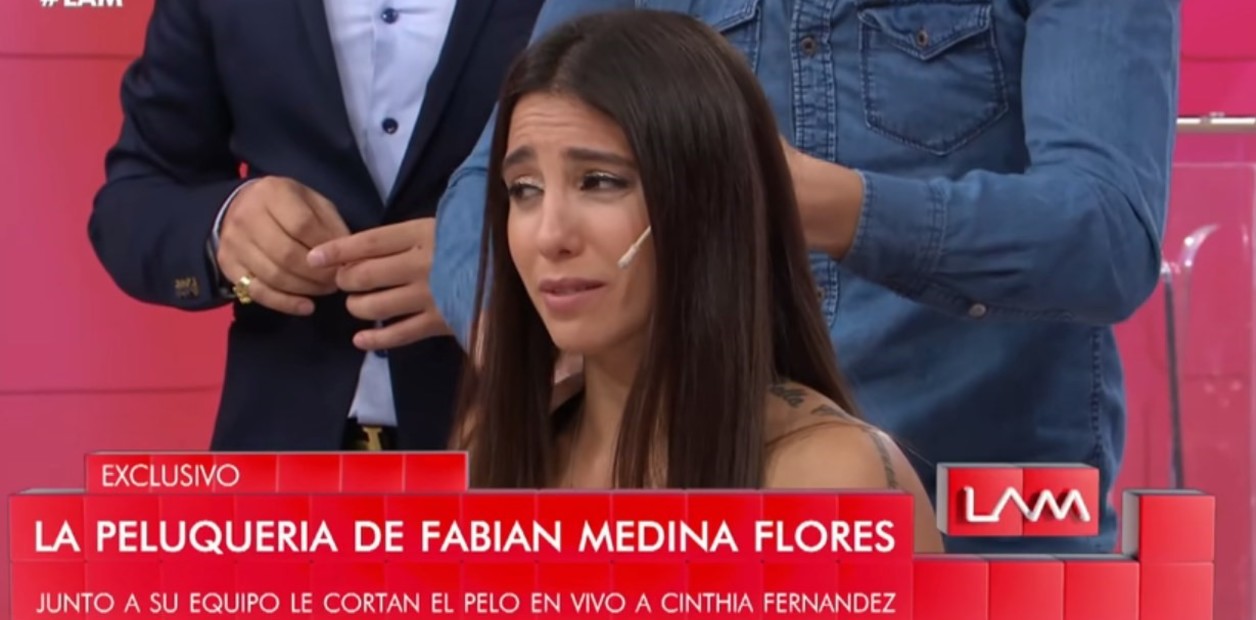
We are concerned that television exposes such a violent situation, especially the exercise of acts on the body of women without their consent. It is clear that she consented to agree to the change of look, but this was not carried out under her terms, but was systematically pressed and all her comments and expressions of desire were minimized.
What happened in “Animals loose”?
On May 16, in the program broadcast by America, media and symbolic violence was again committed. Towards the end of the program, Alejandro Fantino asked the panelist Romina Manguel: “But stop, that’s how you came?”, Referring to his clothes. The driver, ignoring the discomfort of the journalist, continued saying: “Focus on Manguel”, asking him to show his clothes and parade.
Manguel’s reaction was a nervous laugh and ask him to stop. The driver continued, insisting that the cameras focus on her and insinuating that she could find a partner. All this intervention, although brief and only at the end of the program, was extremely violent for Romina and stereotyped for women. This was accompanied by the complicity and laughter of the rest of the panel made up of men, who did nothing to stop these moments of uncomfortable reification of the only female panelist of the program.
Why are we talking about media violence and what laws protect our complaints?
Both media contents are humiliating and discriminatory, and constitute cases of mediatic and symbolic violence. Recall that the Law of Comprehensive Protection for Women 26.485 defines media violence as “that publication or dissemination of stereotyped messages and images through any mass media, that directly or indirectly promotes the exploitation of women or their images , injure, defame, discriminate, dishonor, humiliate or threaten the dignity of women, as well as the use of women, adolescents and girls in pornographic messages and images, legitimizing inequality of treatment or construct sociocultural patterns that reproduce inequality or generators of violence against women “. In this sense, according to articles 70 and 71 of the Audiovisual Communication Services Law 26,522 all media outlets are obliged to comply with 26.485 in addition to “avoiding content that promotes or incites discriminatory treatment based on race, color, sex, sexual orientation, language, religion, political or other opinions, national or social origin, economic status, birth, physical appearance, the presence of disabilities or that undermine human dignity or induce to behaviors that are harmful to the environment or to the health of people and the integrity of children or adolescents “.
What organisms do we denounce and what for?
Attentive to this normative framework, as well as to the great responsibility -particularly in Argentine society- of the media to construct meaning and form an opinion, we have denounced these situations in front of the Ombudsman’s Office, the INADI radio and television Observatory and the Observatory of symbolic and media violence of the INAM. We hope that these agencies take the necessary actions in this regard and we commit ourselves to continue ensuring the effective execution of existing public policies, as well as promoting those that still need to be created to fight against this and all types of gender violence.
More info:
Denunciamos a Eduardo Feinamm por sus dichos homo-odiantes sobre Facundo Nazareno Saxe
Denunciamos a TN por violencia mediática y simbólica
Denuncia al programa Animales Sueltos por tratamiento discriminatorio de la información
El Show de la Mañana otra vez incurrió en violencia mediática
Author:
Mariana Barrios Glanzmann
Contact:
Cecilia Bustos Moreschi, cecilia.bustos.moreschi@fundeps.org

The Consultative Council of the INAM met
“Below, we offer a google translate version of the original article in Spanish. This translation may not be accurate but serves as a general presentation of the article. For more accurate information, please switch to the Spanish version of the website. In addition, feel free to directly contact in English the person mentioned at the bottom of this article with regards to this topic”.
On June 10, INAM convened in Buenos Aires the civil society organizations that are part of the Advisory Council. The meeting reported on the budgetary execution of the agency, as well as on the progress made in the implementation of the National Plan of Action for the Prevention, Assistance and Eradication of Violence against Women 2017-2019.
Likewise, progress was made in measuring the implementation of the Plan, as well as the construction of the national budget from the perspective of gender policies, including not only the Institute’s budget but also all other government portfolios. Finally, ways of interaction between the organizations representing each province and the women’s bodies and federal advisers corresponding to each jurisdiction were discussed.
We appreciate that these instances of participation for civil society be maintained and we hope that the INAM will continue strengthening the institutionality of the Consultative Council, as a space committed to the rights of women. The contributions of the organizations that are in the field are fundamental in the elaboration, implementation and evaluation of gender policies and that serve to keep alive the reason of being of the INAM: to assure to the women a full life, free of violence and worthy of be lived.
More info
Somos parte del Consejo Consultivo del Instituto Nacional de las Mujeres
Presentamos reporte anual ante el INAM y manifestamos preocupación por su inactividad
Author
Carolina Tamagnini
Contact
Cecilia Bustos Moreschi, cecilia.bustos.moreschi@fundeps.org
We participated in the consultation of UN Women for Beijing + 25
“Below, we offer a google translate version of the original article in Spanish. This translation may not be accurate but serves as a general presentation of the article. For more accurate information, please switch to the Spanish version of the website. In addition, feel free to directly contact in English the person mentioned at the bottom of this article with regards to this topic”.
The Beijing Declaration and Platform is a program developed in 1995 with a large participation of civil society, to give tools to States, the private sector and the third sector, to promote gender equality. Every five years, a revision process is carried out, at a general level and at the level of the States, to finally make recommendations that allow to continue advancing in the fulfillment of the measures established in said platform.
The national reviews contribute to the global review and evaluation that UN Women will prepare and present during the 64th session of the Commission on the Status of Women (CWS 64), which will take place in March 2020 in New York . The reports are composed not only of the information provided by the State, but also by the contributions of civil society. In this context, INAM, the agency in charge of coordinating gender policies in Argentina, openly called social organizations, the women’s movement and trade unions.
Considering that the Beijing Platform has been a key document for international policy, it has been revised in the light of the Sustainable Development Goals by 2030. In this sense, four axes were identified in which Beijing + 25 and the 2030 Agenda:
Regarding inclusive development, the challenge we face has to do with the difficulties faced by women and diversities in their access to work and, within it, the limits to their possibilities of promotion. This is linked to the lack of equal opportunity policies at the level of public policies and within these companies, according to research carried out in media companies and advertising agencies. Specifically, the critical axis is maternity and care, due to the lack of conciliation policies regarding parental leave, extension of leave time, leave for care (due to illness, family disability, care for the elderly), flexible forms of work (home office) or problems around day care centers. In the event that these types of actions are implemented, they respond to particular demands, so they are not institutionalized or systematized.
Regarding the eradication of violence, stigmas and stereotypes, we are particularly concerned that the public bodies set up to watch over situations of media and symbolic violence – applying Law 26.485 and 26.522 – present irregularities, even when there are commitments assumed by the government and resources from international cooperation to strengthen the fight against gender violence. This is especially noticeable in the ways open to society, for example, the mouths of denunciation.
In our experience, the Media Observatory of INAM and ENACOM have little or no response level to complaints, while the Ombudsman’s Office, with greater activity in this regard, continues to accept it since 2015.
As we understand that the eradication of gender violence implies its visibility and the transformation of naturalized sociocultural patterns and reproduced in daily practices, we make recommendations for the inclusion of awareness, training and gender perspective training in the media and advertising agencies , starting from the areas of university or tertiary professional training.
Finally, on the point of institutions with a gender perspective, we consider that the enactment of the Micaela Law is a good way to incorporate it into State bodies. However, we must insist on adherence by the provinces and state institutions.
Likewise, we recognize public and private schools as institutions endorsed by the State to provide formal education. As such, they must abide by the legislation on the implementation of the ESI and be responsible – and therefore susceptible to being sanctioned – in cases where actions are taken that impede the right to receive or provide sex education.
Within the consultation, topics related to the importance of including the rights of sexual diversity, in particular of transgender people, labor inclusion, vocational training and representation and political participation were also mentioned in all the axes. In order to celebrate the 25th anniversary of what happened in Beijing, the anniversary finds the feminist movement in the midst of the struggle to continue expanding the rights of women, transgender people and dissent.
More information
Country review processes for Beijing + 25:
Beijing + 25 background
Beijing Declaration and Platform for Action
Author
Carolina Tamagnini
Contact
María Cecilia Bustos Moreschi, cecilia.bustos.moreschi@fundeps.org
Again macho soup in the media
“Below, we offer a google translate version of the original article in Spanish. This translation may not be accurate but serves as a general presentation of the article. For more accurate information, please switch to the Spanish version of the website. In addition, feel free to directly contact in English the person mentioned at the bottom of this article with regards to this topic”.
What happened in “Los angeles de la mañana”?
In the program broadcast on May 14, “Los Angeles de la mañana” (a magazine directed by Ángel De Brito) made a “change of look” to Cinthia Fernández, which consisted of a haircut. During the same, Cinthia said repeatedly that he did not want to be cut, but gave in to the insistent pressure from his colleagues. In this situation, he mentioned that he did not want to be cut too much, and that he wanted to see how far they cut it, setting the limits for the intervention. Its manifestations were reduced with comments like “it is not elegant what you have”, “do not be silly, hair grows”, “you do not have to see it”, “they brought you here to be better”.
During the haircut Cinthia was seen nervous, scared, pressed and uncomfortable with the situation. The driver and the panelists were all the time commenting about their appearance in a demeaning way and without letting it intervene. “I want to cry, I’m serious,” “I’m having a hard time,” he said, about the end.
We are concerned that television exposes such a violent situation, especially the exercise of acts on the body of women without their consent. It is clear that she consented to agree to the change of look, but this was not carried out under her terms, but was systematically pressed and all her comments and expressions of desire were minimized.
What happened in “Animals loose”?
On May 16, in the program broadcast by America, media and symbolic violence was again committed. Towards the end of the program, Alejandro Fantino asked the panelist Romina Manguel: “But stop, that’s how you came?”, Referring to his clothes. The driver, ignoring the discomfort of the journalist, continued saying: “Focus on Manguel”, asking him to show his clothes and parade.
Manguel’s reaction was a nervous laugh and ask him to stop. The driver continued, insisting that the cameras focus on her and insinuating that she could find a partner. All this intervention, although brief and only at the end of the program, was extremely violent for Romina and stereotyped for women. This was accompanied by the complicity and laughter of the rest of the panel made up of men, who did nothing to stop these moments of uncomfortable reification of the only female panelist of the program.
Why are we talking about media violence and what laws protect our complaints?
Both media contents are humiliating and discriminatory, and constitute cases of mediatic and symbolic violence. Recall that the Law of Comprehensive Protection for Women 26.485 defines media violence as “that publication or dissemination of stereotyped messages and images through any mass media, that directly or indirectly promotes the exploitation of women or their images , injure, defame, discriminate, dishonor, humiliate or threaten the dignity of women, as well as the use of women, adolescents and girls in pornographic messages and images, legitimizing inequality of treatment or construct sociocultural patterns that reproduce inequality or generators of violence against women “. In this sense, according to articles 70 and 71 of the Audiovisual Communication Services Law 26,522 all media outlets are obliged to comply with 26.485 in addition to “avoiding content that promotes or incites discriminatory treatment based on race, color, sex, sexual orientation, language, religion, political or other opinions, national or social origin, economic status, birth, physical appearance, the presence of disabilities or that undermine human dignity or induce to behaviors that are harmful to the environment or to the health of people and the integrity of children or adolescents “.
What organisms do we denounce and what for?
Attentive to this normative framework, as well as to the great responsibility -particularly in Argentine society- of the media to construct meaning and form an opinion, we have denounced these situations in front of the Ombudsman’s Office, the INADI radio and television Observatory and the Observatory of symbolic and media violence of the INAM. We hope that these agencies take the necessary actions in this regard and we commit ourselves to continue ensuring the effective execution of existing public policies, as well as promoting those that still need to be created to fight against this and all types of gender violence.
More info:
Denunciamos a Eduardo Feinamm por sus dichos homo-odiantes sobre Facundo Nazareno Saxe
Denunciamos a TN por violencia mediática y simbólica
Denuncia al programa Animales Sueltos por tratamiento discriminatorio de la información
El Show de la Mañana otra vez incurrió en violencia mediática
Author:
Mariana Barrios Glanzmann
Contact:
Cecilia Bustos Moreschi, cecilia.bustos.moreschi@fundeps.org
An approach to the Asian Investment Bank in Infrastructure
The Supreme Court rejected the action initiated by the mining company Barrick Gold against the Law of Glaciers
“Below, we offer a google translate version of the original article in Spanish. This translation may not be accurate but serves as a general presentation of the article. For more accurate information, please switch to the Spanish version of the website. In addition, feel free to directly contact in English the person mentioned at the bottom of this article with regards to this topic”.
The proposals of the mining company and the province of San Juan, focused on questioning: a) the legislative procedure for the enactment of Law 26,639 (of Glaciers); b) The unconstitutionality of the aforementioned regulations for advancing on regulatory competences specific to the Province as holder of the original domain of natural resources. The company Barrick and the province of San Juan converged on this last point arguing that the law in question, hypothetically, posed an affront to the possibilities of exploitation by the mining company and management of natural resources by the province.
In view of this situation, the Court analyzed whether the necessary requirements were met for the organ to enter into the analysis of the parties’ claims, that is, if there was a “judicial case” (subject that may be subject to a process). The conclusion reached was that there was no sufficient accredited legal interest, or a so-called “act in the making” (administrative act necessary to consider the existence of a judicial case) that endangers the rights of the parties. He also considered that the lack of completion of the Glacier Inventory (ordered to the Executive Branch by the glaciers law), necessarily implied the inexistence of the “act in the making”, since this inventory was a basic budget for the operation of the attacked law by the parties.
As a consequence of the inexistence of the justiciable case, the Supreme Court held that as regards the conflict between the provincial and national jurisdiction alleged by the province of San Juan, the judicial power should not intervene, while the environmental policy issues should be resolved by the federal dialogue before the intervention of the judges.
However, even though it was not necessary according to the conclusions regarding the inexistence of a justiciable “case”, the ministers of the Court held that the process by which the Glaciers Law had been sanctioned had been valid from the point of view constitutional, according to the background and regulations of the Chamber of Senators.
On the other hand, in a convincing “environmental” message, the Court expressed its opinion regarding the validity of the Glaciers Law, in the face of the arguments that raised its unconstitutionality, thus outlining its position regarding a future “judicial case”. Among some of the arguments offered by the high judicial body, the following can be highlighted:
In short, the Supreme Court of Justice of the Nation, rejected the action of Barrick Gold and the province of San Juan on the grounds that there was no “judicial case” and did not resolve the substantive claim on the constitutionality or otherwise of the Law of Glaciers. However, in a blunt message, he left his position before an eventual proposal of similar characteristics: Glaciers law, protects a supraindividual environmental good, which, faced with a conflict against an individual right, must be weighted based on criteria of sustainability , Intergenerationality, biodiversity, under an eco-centric or systemic paradigm (not anthropocentric). Between the lines, the Glaciers Law … is constitutional.
Read the full ruling of the Supreme Court of Justice
Juan Bautista Lopez, juanbautistalopez@fundeps.org
We presented an amicus curiae in defense of the right to health and food in Colombia
“Below, we offer a google translate version of the original article in Spanish. This translation may not be accurate but serves as a general presentation of the article. For more accurate information, please switch to the Spanish version of the website. In addition, feel free to directly contact in English the person mentioned at the bottom of this article with regards to this topic”.
On January 21, Red Papaz requested the Constitutional Court of Colombia to review the decisions issued against it, in the framework of the actions filed against the SIC and INVIMA to review the accuracy of the advertising of HIT drinks of Postobon and Fruper of Alpina, considering that the procedures related to the protection of children and adolescents are not being prioritized.
The reported commercials contain deceptive and risky messages. Fruper of Alpina in its advertising highlights that the drink is ideal for children, with vitamins and minerals that contribute to their health and growth. Message contrary to reality, since, as researched by Red Papaz, it contains approximately ten times the level of sugar recommended by the Pan American Health Organization (PAHO). On the other hand, Hit of Postobón, emphasizes that its product comes from fruits, reason why to consume them is advisable for the health of the NNA. When in truth, it has a very small amount of fruit, for which reason, it is not possible to affirm that they are recommendable or ideal for children, or that they can be called as juices.
The deceptive advertising of unhealthy food products addressed to NNA that Red Papaz denounces, promotes the “obesogenic environment”, that is, an environment that promotes obesity in populations and responds to the role played by environmental factors (physical, economic, legislative and sociocultural) both in nutrition and in physical activity. The influence of the environment on food and physical activity is essential. Practices, knowledge and beliefs and socio-economic and geographical differences affect habits.
Hence, we made a presentation approaching the court grounds that seek to prove that the absence of complete, clear and accurate responses by the SIC and INVIMA, in the face of the denouncement of misleading advertising, mean a violation of human rights obligations to health, information and a balanced diet, especially of children and adolescents. While the Colombian state fails to comply with the recommendations of monitoring bodies of the Human Rights Treaties, ratified by the latter, on how to deal with the epidemic of obesity and chronic noncommunicable diseases (NCDs). At the same time they weaken the possibilities of responding to a global epidemic of malnutrition and obesity.
Finally, scientific evidence was presented regarding the positive impacts of this type of policies that promote the restriction of advertising and marketing of unhealthy foods, among a set of policies that, when implemented correctly, are effective in generating healthy environments and preventing development of obesity and malnutrition.
We made the presentation convinced and convinced that a favorable resolution in this regard, attentive to the great impact both globally and regionally that these judicial processes have, would generate a valuable jurisdictional precedent on the important theme of healthy eating.
Author
Laura Alesso
Contact
Agustina Mozzoni, agustinamozzoni@fundeps.org
We launched the website “Emergencia Agroquímica”
“Below, we offer a google translate version of the original article in Spanish. This translation may not be accurate but serves as a general presentation of the article. For more accurate information, please switch to the Spanish version of the website. In addition, feel free to directly contact in English the person mentioned at the bottom of this article with regards to this topic”.
The website is structured based on three objectives. The first of them aimed at the visibility of socio-environmental conflicts related to the use of agrochemicals in the province of Córdoba. Second, it seeks to provide information and legal resources as necessary tools for the empowerment of communities and for the protection of their rights to health and a healthy environment. Third, it seeks to reinforce the visibility of conflicts through a collaborative platform in which new conflicts can be incorporated, thus expanding the content.
For such purposes, a conflict mapping was prepared based on an analysis of information compiled since 2008, mainly from newspaper articles and online publications related to 18 communities affected by the application of agrochemicals.
The examination of the data revealed relevant characteristics regarding the problem. In this way, it was observed that the vast majority of these conflicts arise from illegal or irregular fumigation, residues of agrochemicals deposited in prohibited places (uncultivated land and fields), fumigating machines that transit through urban centers, damage to biodiversity by the application of chemical products and as a consequence of all the irregularities mentioned, the serious problems in the health of the members of the fumigated communities.
Likewise, the survey revealed similar concerns and demands on the part of the communities regarding the application of agrochemicals. Thus, as a common denominator, these require: ordinances that establish Environmental Reserved Areas with respect to urban areas; the completion of the provincial law that regulates the requirements and minimum distances of application, the carrying out of health studies, among other claims. Other populations, as is the case of the town of Dique Chico, tend to an alternative to “agroecological reconversion” guiding the production from a sustainable and healthy perspective.
The survey work carried out demonstrates the “agrochemical emergency” that exists in numerous localities in the province of Córdoba. The use of agrochemicals without adequate control by the authorities, the non-compliance with current regulations regarding application distances, which also become ineffective for the protection of populations, are factors that not only affect the environment but also constitute a serious public health problem.
In this sense, the statistics show alarming data regarding the existence of certain diseases. For example, from the year 2017 onward, more than half of the deaths in the town of Canals, had their origin in a carcinogenic disease; or the case of the Monte Maíz locality in which the cases of deaths due to cancer exceed three times the average, in addition to being observed in all the localities surveyed numerous cases of malformations, respiratory diseases, spontaneous abortions and other infrequent diseases such as lupus, rematoidea arthritis, among others. These data shed light on the urgent attention that the problem deserves on the part of those who have the responsibility of adapting the controls in the application and to formulate a law respectful of the environment and health, paying attention above all to the needs of those populations most affected.
Access to the site Emergencia Agroquímica
Authors
Ananda Lavayén
María Laura Carrizo
Contact
Juan Bautista López, juanbautistalopez@fundeps.org
The summit OGP left more questions than answers
“Below, we offer a google translate version of the original article in Spanish. This translation may not be accurate but serves as a general presentation of the article. For more accurate information, please switch to the Spanish version of the website. In addition, feel free to directly contact in English the person mentioned at the bottom of this article with regards to this topic”.
The Open Government Partnership (OGP or Alliance for Open Government), is a multilateral initiative formed in 2008 at the suggestion of the President of the United States, Barack Obama before the General Assembly of the UN. Since then, the imprint of this ‘institution’ has been to get governments around the world to implement more and better public policies of transparency, openness and citizen participation.
Through action plans that last two years, the States commit themselves to design policies closer to the citizen’s reality, which transparent the acts of governments and allow social participation. It is about short and concrete actions, whose purpose is to achieve the construction of more solid, inclusive and reliable institutions.
The OGP, from its conception, carries out ‘Global Summits’ that serve as a space for the exchange of experiences and good practices in terms of open government. In 2019, the sixth summit was held, with more than 1000 participants from approximately 90 countries of the world and more than 80 panels of experts and experts.
However, after having toured the Summit and participated in the discussions, more questions and doubts appear, than answers. Although the spaces of the Global Summits serve to know the reality of open government in other parts of the world, the real objective is to ensure that this exchange provides tools to bring the government closer to the general public. The key idea has always been How to make government openness change people’s lives and bring solutions to current social problems?
To achieve progress in this area, it is crucial to be able to include those who do not have access to technology, those whose rights are violated and those who do not have a voice when making decisions.
Within the debates of this year, the little and almost negligible number of commitments related to citizen participation and inclusion was highlighted. In spite of this, it was good to know that Latin America is the most powerful region in this regard, with more than half of the commitments in this area. It’s enough? No. There is still a long way to go and solve. Without going any further, Latin America is also the most dangerous region for human rights defenders.
In what way can open government correct this contradiction? We are the region that has made the most progress in terms of transparency, but the most dangerous for those who seek to participate in decision-making. The general levels of openness have improved, but people have never been more suspicious of institutions. The space of the Summit should have served to put these problems on the table.
It is important to be able to discuss what happens after transparency, what happens after the publication of data, how does that translate into higher quality, informed and participatory public policies? How can we be more inclusive and ensure that these policies represent all social groups? At the summit many problems were raised but few solutions. It is necessary to get governments committed to developing more transformative plans that strengthen the institutions from their foundations, and not initiatives of two years (or less) that then do not translate into stable practices. Again, how is the transcendence of open government achieved? How can we prevent this from becoming a passing fad that changes when the governments in power give way to new political actors?
By the year 2020, Argentina will have the presidency of OGP and the Global Summit will move here. It will be an excellent opportunity to include those who were not present this year, and to discuss the issues that take us away from our places of conformity and privilege. It is time for ‘open government’ to stop being something that is discussed in circles of ‘enlightened’ and elites, so that it finally achieves that those who should be included can participate effectively and without fear.
More information:
Global Summit of OGP 2019
Regional OGP Summit for the Americas 2017
Contact:
Agustina Palencia – agustinapalencia@fundeps.org
We participated in a talk about the problem of Chacras de la Merced in the Siglo XXI University
“Below, we offer a google translate version of the original article in Spanish. This translation may not be accurate but serves as a general presentation of the article. For more accurate information, please switch to the Spanish version of the website. In addition, feel free to directly contact in English the person mentioned at the bottom of this article with regards to this topic”.
During the meeting, members of the Omas organization reported the structural and environmental problems that have been affecting the Chacras de la Merced district for years, the current situation and the strategies adopted. From Fundeps, we share the actions carried out throughout these years, the legal and advocacy tools used in public policies, and the possible strategies to follow in the face of lethargic, if not non-existent, action by the Municipal, Provincial States. and National.
The articulation between diverse actors was shaped as a fundamental pillar in the struggle for the respect of human rights, from the contributions that each civil society organization can provide for such purposes. Then, the students participated together with the teachers, expressing their concerns, reflections and contributions from a human rights and environmental perspective.
We appreciate the invitation made by the Siglo XXI University through the chairs of environmental law of the career of Advocacy and its Social Sustainability Center. We consider propitious these spaces of encounter and debate, not only for the articulation of actions of incidence and fight in pursuit of the environment, but as spaces of reflection and commitment with those problems that afflict certain sectors of our society, by those who for years we participate in them, and of those students who in the near future will be part of the fight for the right.
Contact:
Juan Bautista Lopez – juanbautistalopez@fundeps.org
For the 8th time the IVE project to the Congress is presented
“Below, we offer a google translate version of the original article in Spanish. This translation may not be accurate but serves as a general presentation of the article. For more accurate information, please switch to the Spanish version of the website. In addition, feel free to directly contact in English the person mentioned at the bottom of this article with regards to this topic”.
Sex education to decide
Contraceptives not to abort
Legal abortion to not die.
¡QueSeaLey!
Laura Villanueva
Contact
Cecilia Bustos Moreschi, cecilia.bustos.moreschi@fundeps.org
National government seek to agree a new model of food labeling
“Below, we offer a google translate version of the original article in Spanish. This translation may not be accurate but serves as a general presentation of the article. For more accurate information, please switch to the Spanish version of the website. In addition, feel free to directly contact in English the person mentioned at the bottom of this article with regards to this topic”.
At the national level, according to the World School Health Survey (2012), in the last five years, in the group of adolescents aged 13 to 15 years increased excess weight from 24.5% to 28.6%. In turn, the prevalence of obesity increased from 4.4% to 5.9%. The seriousness of the current situation of overweight and obesity in Argentina and in particular the fact of seeing alarming trends among children and adolescents urgently requires health protection policies.
Among them, the advance towards a system of frontal warnings in food products with a high level of critical nutrients (sodium, sugar and fats) is a step in the direction of recommendations by specialized health protection organizations. These measures already have the support of scientific evidence from countries such as Chile, where the warning system has been in force for several years. The Ministry of Health itself recognizes it as the most effective system in its report on frontal nutrition labeling of food published at the end of 2018. In the same sense we have pronounced together with the National Coalition to Prevent Childhood Obesity in Children and Adolescents.
It is very important that the limits to establish these categories are based on guidelines such as the Nutrient Profile of the Pan American Health Organization (PAHO). Based on the experience of other countries, it is expected that the food industry press so that the content levels to which these warnings apply are very high. Therefore, it is important that it be based on guidelines from a specialized public health agency such as PAHO.
Recently, the current Secretary of Health of the Nation said in the Clarín newspaper that a dialogue has been started with the Ministry of Production to reach a food labeling model that informs the population about the content of critical nutrients (sugar, fats, sodium), and that in turn alert when those nutrients are present above the recommended amounts. The combination of a warning system with other labeling modifications to provide better information on all products in general can be positive as long as it is supported by scientific evidence.
In addition, it is important to keep in mind the interests of the different institutions that participate in these dialogues. In a public health crisis, the criteria that must be prioritized are those that protect the right to health and not so much the economic interests that are channeled through dependencies such as the Ministry of Production. In the same sense and from civil society, attention should be paid to possible conflicts of interest that may exist. For example, in the aforementioned Clarín note, the Center for Studies on Food Policy and Economics (CEPEA) is mentioned, which in the report of the Ministry of Health confirms that it receives financing from the food industry.
Contact
Agustina Mozzoni, agustinamozzoni@fundeps.org
Organizations promote an Open State law in Salta
“Below, we offer a google translate version of the original article in Spanish. This translation may not be accurate but serves as a general presentation of the article. For more accurate information, please switch to the Spanish version of the website. In addition, feel free to directly contact in English the person mentioned at the bottom of this article with regards to this topic”.
After more than a year of delay in fulfilling a commitment assumed by the province of Salta regarding transparency, the organizations finally managed to unblock the discussion and accede to the draft of the Open State Law. It is a commitment that Urtubey undertook within the framework of the Third National Plan of Open Government Action, a work plan signed in 2017 together with areas of the National Executive Power, the Congress, the Council of the Magistracy and other 10 provinces that added subnational commitments.
“Salta does not yet have a law that guarantees access to public information and transparency, if the government fulfills its commitment, and the Open State Law is sanctioned, we will have taken a significant step in terms of institutional and democratic quality.” , says Gonzalo Guzmán Coraita, Director of Transparent Salta.
The bill aims to regulate access to information and transparency in the province, one of the few that does not have this regulation. From the Civil Society the proposal is clear: it is necessary that it be law, and for this the project must finally reach the Legislature and that the debate be open and facing the citizenship to continue participating in the process of formation of the law, for ensure that the regulations are complete and comprehensive, as proposed.
It is fundamental that the regulations reach as mandatory subjects all the powers of the provincial State, that make available not only administrative information but also the relative to the particular work of each area and that are clear the functions and autonomy of the guarantor body, how it will be constituted and its members will be elected.
Salta Transparente, a local organization that heads the work of civil society on issues of transparency, access to information and public ethics, has been working together with the Fundación Directorio Legislativo and provincial organizations to monitor commitments undertaken by governments on transparency and accountability. We worked on recommendations and contributions with organizations from different parts of the country such as Legislative Directory, Citizen Power, Our Mendoza Foundation, Open Knowledge Foundation, Fundeps, CLADH, School of Prosecutors, FEIM, Transparencia Ciudadana Foundation, among others.
On May 21, Governor Urtubey sent the project to the legislature, with some of the changes presented by civil society to the original project. We have not yet received a response and justification on the incorporation of the high comments. The approval of this norm means a great advance at the provincial level in terms of access to information, transparency and open government. It would set a precedent for the advance of the rest of the country in more robust legislation on access to information.
More information:
Contact:
Agustina Palencia – agustinapalencia@fundeps.org