Within the long list of Chinese investments in Argentina, the case of aqueducts in the province of Entre Ríos has been one of the most controversial. Irregularities in the bidding process, approval and execution of the project have aroused the suspicion and the demands of various sectors of civil society.
“Below, we offer a google translate version of the original article in Spanish. This translation may not be accurate but serves as a general presentation of the article. For more accurate information, please switch to the Spanish version of the website. In addition, feel free to directly contact in English the person mentioned at the bottom of this article with regards to this topic.”
In a changing international context, in which the most important actors have been changing, Argentina has encountered difficulties in accessing traditional sources of financing. Over the last few years, especially since the Kirchner administration, the scenario of foreign investment in Argentina has been marked by the preponderance of the PRC. Several of the major infrastructure projects that are being carried out are behind the backing of Asian companies.
There are two projects that have been working between the Nation and the province of Entre Ríos for some years and had to do with the possibility of building two aqueducts for irrigation in the north of Entre Ríos. For the construction of these, the provincial government and the China State Construction Engineering Corporation (CSCEC) signed a commitment letter for the supply of fresh water, incorporating 200,000 hectares of irrigation.
In mid-June 2013 the CSCEC expressed its interest in investing in infrastructure works in the province of Entre Ríos. During a meeting with representatives of the company, developed at the House of Entre Ríos in Buenos Aires, Governor Sergio Urribarri “proposed three basic lines of action: irrigation works, Paraná-Santa Fe metropolitan link and port development.” According to the governor, the development of the works would be linked to a great extent to increase the productive capacity of the province.
The agreement with China for the construction of the two aqueducts was signed on July 18, 2014. Within the framework of strategic agreements for infrastructure works, signed in the Casa Rosada between Xi Jinping and Cristina Fernadez de Kirchner, meeting in which Urribarri participated.
The aqueducts will have a total length of 546 kilometers between main branch and secondary branches. Two works, the first in the Arroyo Mandisoví basin in the Federation department to implement a collective irrigation system, from the Uruguay River, for rice, citrus and fruit-horticultural production. The second in the department of La Paz to build an aqueduct of the North Entre Ríos, with the contribution of water from the Paraná River and provide a marginal area of access to water for irrigation.
The costs of the works total an amount close to USD 98,000,000, according to the data presented by the “Provincial Agricultural Services Program” in its feasibility reports of which the province should contribute 20%. However, the budget of the CSCEC was USD 430,387,552 awarded without competitive bidding. Funding would come from ICBC, with a credit of USD 366 million at 15 years (with a grace period of 5) with a LIBOR rate of 4.5%. Likewise, the credit agreement provides as applicable law the same as that of England.
The project provoked rejections in some sectors, such as the organizations nucleated within the Multisectoral in Defense of the Heritage of the Entrerrianos, which promoted the nullity of the law that, among other points, enabled the direct granting, without public bidding, of the work to A Chinese capital company, as well as a debt exceeding $ 430 million. The M’biguá Foundation and Environmental Justice also warned about the lack of transparency and information about the project.
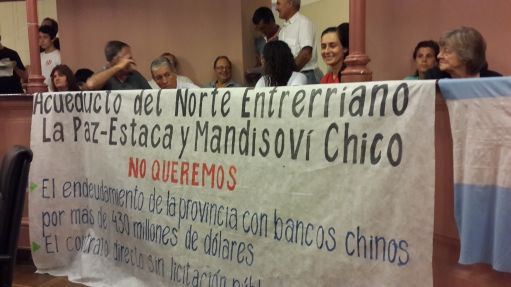
The case of aqueducts is the first to reach justice. As discussed above, the Multisectoral for the Defense of the Patrimony of the Entrerrianos presented an unconstitutionality action with respect to the law No. 10.352 that authorized the Provincial Executive to become indebted to the financial institution of China. This action is based on the fact that this law has not fulfilled the formal requirements that the provincial constitution urges for its approval, for example: there was no Environmental Impact Assessment, there is no opinion from the commissions of Finance and Economy, or the prosecution Of state, among other irregularities. The total lack of controls in the legislative process, the treatment on tables of the norm, the absence of debate on the subject and, especially, the secrecy with which the government was managed not to make known the project, is another aspect Demand.
Among the main points of the complete demand are:
– Ineffectiveness of Law 10.352 for irregularities in its processing.
– Non-observance of the principle of reasonableness.
Authorization to the Governor to agree and keep secret the contract with the Chinese Bank.
– Authorization to the Governor to contract with the Chinese Bank ICBC a loan in which Entre Ríos accepts to be governed by the English legislation.
– Violation of the constitutional duty to publicize acts of government.
– Deprivation of information as a human right.
– The previous and precautionary implementation of Environmental Impact Studies and its evaluation processes with the due Public Hearings and the dictating of the Administrative Acts prior to the authorization of contracting of the work and the authorization of the conclusion of investment agreements and / Or indebtedness.
– Violation of the Public Accounting Law. (Arrogating thus the P.E. unconstitutionally own powers of the Legislative Power).
– Violation of the Public Works Law.
– The constitutional guarantees contained in Section II – Economic, Labor and Sustainable Development of the Provincial Constitution were ignored.

According to local media: “From a commission of five million dollars that the provincial state must pay for the operation, up to the costs not calculated of interest, expropriation of land for the work and other costs, contemplating also the implementation of increases Tributary to cover the payment of the credit, the economic questions to the norm are numerous. The first of these, in any case, is the amount of the credit: nobody understands very well how the entrerriano government arrived to calculate both works by more than 430 million dollars when Prosap had budgeted, some months before, less than 100 million” .
According to Jorge Daneri, a member of the M’biguá Foundation, a package of potential mega investments in the region is being formed which, in addition to the aqueducts, would include a hydroelectric dam project between the provinces of Corrientes and Santa Fe on the northern border Of Entre Ríos. According to Dr. Daneri, the mechanism is the same in all projects: there is no parliamentary debate on the projects, let alone in the provinces involved, therefore, the silence of federalism of social consultation and citizen consultation.
From FUNDEPS we have been working on the follow-up of the case of trunk gas pipelines in the province of Cordoba, which also have Chinese funding. Part of the process of approval and execution of this project, can be identified with what happened in Entre Ríos. The lack of transparency in certain issues such as the presentation and publication of the environmental impact study, sound an alarm with respect to environmental standards and DD.HH.
In addition, we consider it of special importance to highlight that the recent importance of the People’s Republic of China in terms of investments in infrastructure projects translates into a need for civil society to monitor the design, approval and implementation processes of these projects. The irregularities mentioned above are the result of policies that still lack transparency and are not part of a accountability paradigm.
More information
A Chinese Agreement
Entre Ríos: “with the pretext of building two aqueducts is to consummate a very large swindle”
Law of aqueducts: filed suit against the “scam” of Urribarri
Law of aqueducts: the Multisectorial will collect signatures to repeal the text
Mid Paraná Dam, aqueducts and China, the spring of hope
Contact
Gonzalo Roza, gon.roza@fundeps.org

Reporte sombra para el Comité de la CEDAW – Mujeres rurales e indígenas – November 2016
Acceso a los recursos naturales de las mujeres rurales en la región del Gran Chaco Argentino. Participamos y apoyamos la elaboración de un informe realizado por la Fundación Plurales, en coalición con Fundapaz, Redes Chaco y otras, sobre el acceso a los recursos naturales de las mujeres rurales y campesinas del Gran Chaco Americano, contemplando su vinculación con otros derechos interrelacionados. El mismo fue presentado en la 65ª sesión del Comité para la Eliminación de la Discriminación contra la Mujer.
Reporte sombra para el Comité de la CEDAW – Violencia Mediática – November 2016
Estuvimos presentes en la 65ª sesión del Comité para la Eliminación de la Discriminación contra la Mujer, en la que se presentó el resultado del trabajo realizado sobre violencia de género y políticas públicas de comunicación. Este informe fue realizao por FUNDEPS, junto con la Asociación Civil Comunicación para la Igualdad, enfocándose en el grado de cumplimiento de Argentina del artículo 5 de la Convención, que compromete a los Estados a la eliminación de los patrones socioculturales que perpetúen la inferioridad de la mujer en comparación al hombre.
Participation in discussions on the legal framework of native forests in Córdoba
As part of Environment Forum Cordoba, FUNDEPS participated with other institutions recognized technical, in preparing a proposal on updating of native forests in the province of Cordoba, which seeks to overcome the weak arguments proposal Cartez (Confederation of Rural Associations Third Zone).
“Below, we offer a google translate version of the original article in Spanish. This translation may not be accurate but serves as a general presentation of the article. For more accurate information, please switch to the Spanish version of the website. In addition, feel free to directly contact in English the person mentioned at the bottom of this article with regards to this topic”
As the National Law No. 26,331 of Minimum Standards for Environmental Protection of Native Forests and its Regulatory Decree No. 91/2009, each province should make its Native Forest Planning and updated every five years through a participatory process and according to environmental sustainability criteria set out in its articles and annex.
The province of Cordoba sanctioned the Provincial Land Use Law of Native Forests No. 9814 on August 5, 2010, in a process in which the participatory body that guaranteed the national law was not respected. The maturity of these regulations occurred on 5 August 2015. Our province faces a duty to update its regulations, seize the moment to meet the minimum standards established by national law; and ensure wide participation of different social actors in this new process of building the land management of native forests.
This process is strictly in updating the vector map approved by Law 9814, which recognize that the amount of remaining native forests in the province, establishing different conservation categories (Category I (red), Category II (yellow) and Category III (green)). This categorization will be done depending on the environmental value of the different units of native forest and environmental services they provide, such as avoiding floods, desertification of soils, elevation of groundwater, drought, effects and impacts of climate change, extinction of native flora and fauna, etc.
The proposal made with Environment Forum Cordoba, Core DiverSus Research on Diversity and Sustainability, the Multidisciplinary Institute of Plant Biology (CONICET-UNC), the IDEA Civil Association, the Institute for Diversity and Animal Ecology (CONICET-UNC) and the Centre Ecology and Renewable Natural Resources (FCEFyN, UNC) is entitled “Why is it necessary to keep the surface of native forests with Category I (Red) in the province of Cordoba as the vector map of the Act 9814? critical analysis of the proposal Land Management of Native Forests for the Northwest Córdoba arc “produce Store preserving and producing” developed by Cartez “. The aim in the document is to refute environmental, legal and social foundations proposal Cartez unreasonably argues that the Category II (yellow) is better than Category I (red) to protect and preserve the native forest, starting this proposal a conceptual interpretation is all wrong and contrary to the objectives and budgets of the National Law 26,331 and the Provincial Law 9814 lights.
From FUNDEPS, we hope that this process involves as many actors in society because of the importance that implies the protection and conservation of native forests. We also hope that the upgrade process guarantees the principle of non-environmental regressivity and respect for the rights of environmental democracy, including access to information and citizen participation enshrined in the Rio Declaration on Environment and development 1992.
More information:
– Working Paper: Why is it necessary to keep the surface of native forests with Category I (Red) in the province of Cordoba as the vector map of the Act 9814?
– La Voz del Interior: “Again the debate on how much can be removed hardens” (10/28/2016)
– Response to FAA on OTBN – Cordoba Environmental Forum (November 2016)
Contact:
María Elena Martínez Espeche, Coordinadora del Eje Ambiente.
malemartinez@fundeps.org
FUNDEPS presented report at the 65th session of the United Nations CEDAW Committee
Our team will be present at the 65th session of the Committee on the Elimination of Discrimination against Women, in which the result of work done on gender violence and public policy communication will be presented.
The Committee on the Elimination of Discrimination against Women is a body of independent United Nations experts that monitors implementation of the Convention on the Elimination of All Forms of Discrimination Against Women (CEDAW English). All States parties must submit periodic reports to the Committee to account for compliance with international obligations assumed by signing CEDAW.
Organizations of each country, according to their experience and work performed, can submit a “shadow report” to account for the reality of women in the state, so that the Committee have the necessary for the development of tools the final recommendations made.
The report presented by FUNDEPS, along with the Civil Association for Equality Communication, focuses on the degree of compliance of Argentina Article 5 of the Convention, which commits States to “Modify the social and cultural patterns of conduct of men and women, with a view to achieving the elimination of prejudices and customary and all other practices which are based on the idea of the inferiority or superiority of either of the sexes or on stereotyped roles practices of men and women. ”
The data provided in this “report shadow” are the result of monitoring of public communication policies and gender, in force in Argentina, which was made using requests for access to information, surveys and interviews with members of organizations, and monitoring media by the signatory organizations. This monitoring was reflected in the publication entitled “Gender violence and public communication policies“.
Also, our teams participated in and supported the development of two reports: one submitted by the InterAmerican Heart Foundation, FEIM and other organizations on public policy on the control of snuff that currently allow the development of industry strategies aimed specifically at women; and another by the Plurales Foundation in coalition with Fundapaz, Chaco and other networks on access to natural resources by rural and peasant women of the Gran Chaco.
More information:
– Publication: “Gender violence and public communication policies”
– Shadow report to the CEDAW Committee
Contact:
Virginia Pedraza – Coordinadora del Área de Derechos Humanos – Eje de género y diversidad sexual
vir.pedraza@fundeps.org
Lack of information from the World Bank Project on non-communicable diseases
On June 11, 2015, the World Bank Board approved a project to Argentina for a 350 million dollars in the health area. This project focused on the Protection of Vulnerable Population against NCDs, supported the strategy of the Ministry of Health for these diseases, in search of improved the access to prevention and control services to 3.2 million adults between 40 and 60 years who takes greater risks. We presented a request for information to the World Bank because of the lack of official information project and the non-reply from the Ministry of Health of the Nation and the province of Cordoba.
“Below, we offer a google translate version of the original article in Spanish. This translation may not be accurate but serves as a general presentation of the article. For more accurate information, please switch to the Spanish version of the website. In addition, feel free to directly contact in English the person mentioned at the bottom of this article with regards to this topic”
Noncommunicable diseases such as cardiovascular disease, cancer and chronic respiratory diseases are responsible for 81% of deaths in Argentina. However, a considerable part of these diseases can be prevented or controlled, reducing risk factors, among which we can find: a diet with excess sugars, refined flour, fat and salt, and low fiber intake; overweight and obesity; snuff consumption; hypertension; and a high level of blood glucose.
The project aims to work to improve the capacity of primary care to provide quality services in early detection and continuous monitoring of obesity, hypertension, diabetes and chronic obstructive pulmonary disease. Added to that, at provincial and municipal level are expected to perform aimed at promoting healthy diets, promoting physical activity and consumption of snuff control interventions.
Despite the importance of the project from the Ministry of Health of the Nation, it has only produced an early report, but it has not been updated, or have incorporated references to the way it is being implemented.
In this context, from FUNDEPS -together with FIC Argentina- present public information requests to the agencies of the Ministry of Health of the Nation, to learn about the progress of the project. Likewise, we consulted about the existence of instances of citizen participation and if the project monitoring mechanisms are foreseen by Civil Society Organizations.
In addition, information particularly referred to the contribution of funds requested by YPF, as expressed in the portal of the Government of the Province of Tierra del Fuego.
Finally, given the lack of response by the Ministry of Health of the Nation, we request the information by the means provided to apply directly to the World Bank, financer of the project.
Lack of information undermines its objectives and hinders proper coordination with provincial authorities. Of journalistic sources it is known that some governments have deposited more funds are not enabled to run.
From FUNDEPS as members of the Argentina Coalition for the Prevention of Non-Communicable Chronic Diseases with other organizations that share the mission to work in preventing these diseases from different perspectives (medical, consumer, human rights, advocacy, academic ) we are monitoring this project.
More information:
– The Minister of Health of the Nation received the Governor of Tierra del Fuego (Prensa Tierra del Fuego – 19/05)
– Ricardo Cardozo manages resources to the nation for the Province (Diario La Republica 13/09)
– Investment of U $ S 437 million in protection against chronic noncommunicable diseases (Telam 08/10)
Contact:
Franco De Grandis, francodegrandis@fundeps.org
María Victoria Gerbaldo, victoriagerbaldo@fundeps.org
Chinese investments in Argentina: the aqueducts in Entre Ríos
Within the long list of Chinese investments in Argentina, the case of aqueducts in the province of Entre Ríos has been one of the most controversial. Irregularities in the bidding process, approval and execution of the project have aroused the suspicion and the demands of various sectors of civil society.
“Below, we offer a google translate version of the original article in Spanish. This translation may not be accurate but serves as a general presentation of the article. For more accurate information, please switch to the Spanish version of the website. In addition, feel free to directly contact in English the person mentioned at the bottom of this article with regards to this topic.”
In a changing international context, in which the most important actors have been changing, Argentina has encountered difficulties in accessing traditional sources of financing. Over the last few years, especially since the Kirchner administration, the scenario of foreign investment in Argentina has been marked by the preponderance of the PRC. Several of the major infrastructure projects that are being carried out are behind the backing of Asian companies.
There are two projects that have been working between the Nation and the province of Entre Ríos for some years and had to do with the possibility of building two aqueducts for irrigation in the north of Entre Ríos. For the construction of these, the provincial government and the China State Construction Engineering Corporation (CSCEC) signed a commitment letter for the supply of fresh water, incorporating 200,000 hectares of irrigation.
In mid-June 2013 the CSCEC expressed its interest in investing in infrastructure works in the province of Entre Ríos. During a meeting with representatives of the company, developed at the House of Entre Ríos in Buenos Aires, Governor Sergio Urribarri “proposed three basic lines of action: irrigation works, Paraná-Santa Fe metropolitan link and port development.” According to the governor, the development of the works would be linked to a great extent to increase the productive capacity of the province.
The agreement with China for the construction of the two aqueducts was signed on July 18, 2014. Within the framework of strategic agreements for infrastructure works, signed in the Casa Rosada between Xi Jinping and Cristina Fernadez de Kirchner, meeting in which Urribarri participated.
The aqueducts will have a total length of 546 kilometers between main branch and secondary branches. Two works, the first in the Arroyo Mandisoví basin in the Federation department to implement a collective irrigation system, from the Uruguay River, for rice, citrus and fruit-horticultural production. The second in the department of La Paz to build an aqueduct of the North Entre Ríos, with the contribution of water from the Paraná River and provide a marginal area of access to water for irrigation.
The costs of the works total an amount close to USD 98,000,000, according to the data presented by the “Provincial Agricultural Services Program” in its feasibility reports of which the province should contribute 20%. However, the budget of the CSCEC was USD 430,387,552 awarded without competitive bidding. Funding would come from ICBC, with a credit of USD 366 million at 15 years (with a grace period of 5) with a LIBOR rate of 4.5%. Likewise, the credit agreement provides as applicable law the same as that of England.
The project provoked rejections in some sectors, such as the organizations nucleated within the Multisectoral in Defense of the Heritage of the Entrerrianos, which promoted the nullity of the law that, among other points, enabled the direct granting, without public bidding, of the work to A Chinese capital company, as well as a debt exceeding $ 430 million. The M’biguá Foundation and Environmental Justice also warned about the lack of transparency and information about the project.
The case of aqueducts is the first to reach justice. As discussed above, the Multisectoral for the Defense of the Patrimony of the Entrerrianos presented an unconstitutionality action with respect to the law No. 10.352 that authorized the Provincial Executive to become indebted to the financial institution of China. This action is based on the fact that this law has not fulfilled the formal requirements that the provincial constitution urges for its approval, for example: there was no Environmental Impact Assessment, there is no opinion from the commissions of Finance and Economy, or the prosecution Of state, among other irregularities. The total lack of controls in the legislative process, the treatment on tables of the norm, the absence of debate on the subject and, especially, the secrecy with which the government was managed not to make known the project, is another aspect Demand.
Among the main points of the complete demand are:
– Ineffectiveness of Law 10.352 for irregularities in its processing.
– Non-observance of the principle of reasonableness.
Authorization to the Governor to agree and keep secret the contract with the Chinese Bank.
– Authorization to the Governor to contract with the Chinese Bank ICBC a loan in which Entre Ríos accepts to be governed by the English legislation.
– Violation of the constitutional duty to publicize acts of government.
– Deprivation of information as a human right.
– The previous and precautionary implementation of Environmental Impact Studies and its evaluation processes with the due Public Hearings and the dictating of the Administrative Acts prior to the authorization of contracting of the work and the authorization of the conclusion of investment agreements and / Or indebtedness.
– Violation of the Public Accounting Law. (Arrogating thus the P.E. unconstitutionally own powers of the Legislative Power).
– Violation of the Public Works Law.
– The constitutional guarantees contained in Section II – Economic, Labor and Sustainable Development of the Provincial Constitution were ignored.
According to local media: “From a commission of five million dollars that the provincial state must pay for the operation, up to the costs not calculated of interest, expropriation of land for the work and other costs, contemplating also the implementation of increases Tributary to cover the payment of the credit, the economic questions to the norm are numerous. The first of these, in any case, is the amount of the credit: nobody understands very well how the entrerriano government arrived to calculate both works by more than 430 million dollars when Prosap had budgeted, some months before, less than 100 million” .
According to Jorge Daneri, a member of the M’biguá Foundation, a package of potential mega investments in the region is being formed which, in addition to the aqueducts, would include a hydroelectric dam project between the provinces of Corrientes and Santa Fe on the northern border Of Entre Ríos. According to Dr. Daneri, the mechanism is the same in all projects: there is no parliamentary debate on the projects, let alone in the provinces involved, therefore, the silence of federalism of social consultation and citizen consultation.
From FUNDEPS we have been working on the follow-up of the case of trunk gas pipelines in the province of Cordoba, which also have Chinese funding. Part of the process of approval and execution of this project, can be identified with what happened in Entre Ríos. The lack of transparency in certain issues such as the presentation and publication of the environmental impact study, sound an alarm with respect to environmental standards and DD.HH.
In addition, we consider it of special importance to highlight that the recent importance of the People’s Republic of China in terms of investments in infrastructure projects translates into a need for civil society to monitor the design, approval and implementation processes of these projects. The irregularities mentioned above are the result of policies that still lack transparency and are not part of a accountability paradigm.
More information
A Chinese Agreement
Entre Ríos: “with the pretext of building two aqueducts is to consummate a very large swindle”
Law of aqueducts: filed suit against the “scam” of Urribarri
Law of aqueducts: the Multisectorial will collect signatures to repeal the text
Mid Paraná Dam, aqueducts and China, the spring of hope
Contact
Gonzalo Roza, gon.roza@fundeps.org
Comentarios al plan nacional sobre violencia a mujeres – October 2016
En septiembre de 2016 se presentaron los 17 principios para una comunicación convergente, anunciados por el Ente Nacional de Comunicaciones (ENACOM) con vistas a la redacción de un nuevo proyecto que regule el sector de las comunicaciones; y el Plan Nacional de Acción para la Prevención, Asistencia y Erradicación de la Violencia contra las Mujeres 2017-2019, presentado por el Consejo Nacional de las Mujeres. Tanto los 17 principios para una comunicación convergente como el Plan Nacional de Violencia contra las Mujeres, son medidas que colaboran en el diseño de un nuevo mapa vinculado a las políticas públicas de comunicación y género, con características diversas al vigente hasta diciembre del 2015. Junto a la Asociación Comunicación para la Igualdad hacemos una lectura crítica de las disposiciones en el presente documento
Hearing in Cordoba for the creation of the Office for Dialogue and Citizen Participation in the Congress of the Nation
La Audiencia Abierta para la creación de la Oficina de Diálogo y Participación Ciudadana, tiene como objeto la formación de un espacio que permita opinar, debatir, y mejorar el proyecto de ley presentado en la Honorable Cámara de Diputados de la Nación en el año 2010.
La Audiencia Abierta para la creación de la Oficina de Diálogo y Participación Ciudadana, tiene como objeto la formación de un espacio que permita opinar, debatir, y mejorar el proyecto de ley presentado en la Honorable Cámara de Diputados de la Nación en el año 2010.
En este sentido, la necesidad de mejorar los canales de comunicación entre la ciudadanía y el Honorable Congreso de la Nación y la certeza de que el impulso de nuevas herramientas de participación ciudadana contribuyen al fortalecimiento de las instituciones de la democracia es que resulta necesario diseñar e implementar políticas concretas para reducir la brecha existente entre el Poder Legislativo y las Organizaciones de la Sociedad Civil.
El proyecto, entre otros puntos, propone la creación de un espacio físico en el ámbito del Congreso de la Nación que permita a la sociedad contar con una herramienta más de participación, buscando mayor interacción entre la actividad legislativa y los temas con los que trabajan las numerosas Organizaciones de todo el país. Al mismo tiempo, se busca potenciar el trabajo de los legisladores nacionales contando con una fuente de recursos materiales e intelectuales provenientes de la Sociedad Civil.
La consulta a realizarse en la ciudad de Córdoba, se enmarca en una serie de audiencias y reuniones que se vienen realizando con distintas organizaciones y ámbitos académicos para mejorar y potenciar el contenido del proyecto, realizando sugerencias y propuestas al texto ya elaborado.
La primera audiencia se realizó en diciembre de 2010 en el Congreso Nacional. En la misma participaron más de 250 personas representando a más de 90 organizaciones.
Lugar, Fecha y Hora de la Audiencia: Viernes 18 de marzo a las 10:00 hs. en la Sala de Comisiones 1 del edificio anexo de la Legislatura de la Provincia de Córdoba, Rivera Indarte 33 PB. Córdoba.
Se ruega confirmar asistencia a info@fundeps.org
Información técnica: el proyecto fue presentado en el periodo legislativo 2010 bajo el número de expediente 4397D2010. Los firmantes del proyecto son los diputados nacionales: Flores (CC), Amadeo (PF), Costa (UCR), Alonso (PRO) y Alcuaz (GEN).
Se puede encontrar mayor información en http://www.oficinadedialogo.info/
Documentos:
Proyecto de Ley de Creacion de la Oficina de Dialogo y Participacion Ciudadana en el Congreso
Carta Invitacion Audiencia Abierta Córdoba
The National Executive presented a draft for the approval of the Convention on the Protection of Human Rights of Older Persons
On August 8 , the National Executive presented a bill before Congress for the approval of the Inter-American Convention on the Protection of Human Rights of Older Persons. Although Argentina played a key role in the negotiation process in the OAS, it has not yet been ratified by our country.When ratified, a convention is incorporated into State law; hence there is great value to this initiative of the National Executive. The elderly are a vulnerable group, and this implies for the State an obligation: to promote measures of special protection for such groups to enable them to exercise their rights and freedoms.
Esta convención tiene como objetivo promover, proteger y asegurar el reconocimiento y el pleno goce y ejercicio, en condiciones de igualdad, de todos los derechos humanos y libertades fundamentales de las personas mayores. La misma fue aprobada el 15 de junio de 2015 por la OEA. Si bien Argentina cumplió un rol fundamental en el proceso de negociación en la OEA, aún no ha sido ratificada por nuestro país.
La adopción de esta convención constituiría una herramienta fundamental para el avance por los derechos de las personas mayores y, en definitiva, la protección de los derechos humanos consagrados en los distintos tratados aceptados por nuestro país.
Al ratificar la convención, Argentina se obliga internacionalmente a adoptar las medidas legislativas, institucionales y de cualquier otra índole, necesarias para hacer efectivos los derechos y libertades que en dicha convención consagran; además, la misma se incorpora como parte del derecho vigente del Estado. De allí el valor y la importancia que tiene ésta iniciativa del Poder Ejecutivo Nacional.
Apoyamos el proyecto de ley e instamos a su efectiva sanción recordando que los adultos mayores constituyen un grupo vulnerable, y esto implica para el Estado una obligación reforzada: el deber de impulsar medidas de protección especiales que les permitan el ejercicio de sus derechos y libertades.
Más información:
– “La OEA aprobó la Convención que protege los derechos de las personas mayores” (Página web FUNDEPS)
– “Avances en el proyecto de ley de protección integral de las personas mayores” (Página web FUNDEPS)
– Proyecto del Poder Ejecutivo presentado ante el Congreso de la Nación
Contacto:
Agustina Mozzoni – agustinamozzoni@fundeps.org
Relevamiento de la normativa de agroquímicos en Córdoba y otras provincias – August 2016
Este documento se propone desarrollar un relevamiento descriptivo y comparativo de la normativa de la provincia de Córdoba, de diecinueve de sus municipios, y de otras ocho provincias argentinas, sobre las regulaciones de las distancias que deben respetarse para la aplicación de agroquímicos, teniendo en cuenta si las fumigaciones son terrestres o aéreas y las clases de productos pueden utilizarse en las mismas.
Sumarios de juriprudencia sobre agroquímicos – August 2016
En el presente documento, se han seleccionado una serie de fallos dictados por tribunales de diferentes instancias judiciales, y de distintas jurisdicciones, que dan cuenta de la problemática de las aplicaciones de agroquímicos en nuestro país.
Recomendaciones de FUNDEPS y FIC Argentina al informe del Relator – July 2016
El pasado 10 de julio participamos en la consulta del Relator Especial de Naciones Unidas sobre el derecho a la alimentación. Junto con FIC Argentina, presentamos un documento con recomendaciones en alimentación saludable y la necesidad de regular las prácticas comerciales, que promueven una alimentación no nutritiva y que constituye un factor de incidencia para las Enfermedades Crónicas No Transmisibles (ENTs). Más información: Consulta del Relator sobre derecho a la alimentación: ENTs y derechos humanos