• ES
  • EN
Fundeps
  • About Fundeps
  • Team
  • Working areas
    • Environment
    • Democracy
    • Gender
    • Global Gorvernance
    • Health
  • News
  • Publications
  • DONATE
  • Click to open the search input field Click to open the search input field Search
  • Menu Menu
Gender, News

We held the second meeting “Networks of Commitment and Care”
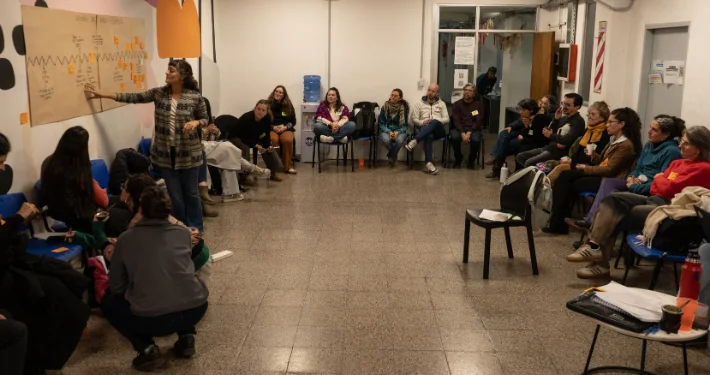
Encuentro de profesionales de la salud sobre aborto seguro con enfoque de diversidad y derecho

More than 40 healthcare professionals from across the province took part in the meeting held on August 2. It was a space for training and exchange aimed at strengthening access to sexual and reproductive health with a diversity perspective and a rights-based approach.

With the participation of more than 40 healthcare professionals, we held the second meeting “Networks of Commitment and Care” on August 2 in the city of Córdoba. It was a space for training, active listening, and exchange, aimed at strengthening capacities, sharing experiences, and highlighting good practices in sexual and (non) reproductive health with a diversity perspective and a rights-based approach.

This initiative, promoted by the Gender and Diversity area of Fundeps in collaboration with Belén Carcedo from the Comprehensive Health Clinic and Sofía Menoyo, member of Socorristas en Red, brought together professionals from various localities: Agua de Oro, La Granja, Jesús María, Santa Rosa de Calamuchita, Villa Dolores, Huinca Renancó, La Paquita, Corral de Bustos, Bell Ville, Paso Viejo, Alta Gracia, and Villa Los Aromos.

On this occasion, the meeting focused, on the one hand, on the medical practice of Manual Vacuum Aspiration (MVA) as a safe, outpatient method of pregnancy termination recommended by the World Health Organization; and, on the other hand, on the challenges related to providing care with a rights-based approach for children, youth, and trans masculinities.

At a time when defunding of public health policies and stigmatization are affecting access to pregnancy termination, we updated and provided legal tools for healthcare teams that continue to guarantee the right to safe and free abortion in our province, under the terms of Law 27.610. Fundeps attorneys Mayca Balaguer and Luz Baretta offered an overview of the current legal framework on health from a human rights perspective. The emphasis was placed on the rights of children and adolescents, in light of key principles such as progressive autonomy and the best interests of the child, incorporated into the Civil and Commercial Code in 2015—principles that guide various health practices, including voluntary and legal termination of pregnancy.

In the afternoon, we began the work session coordinated by Santiago Merlo, a teacher and trans activist, member of the Trans Fatherhood Network, with whom we reflected on approaches within the health system from a diversity perspective. We reviewed the importance of dismantling our own prejudices and making room for trans experiences within the consultation space, using inquiry as a primary tool when faced with uncertainty: “There is no need for us to assume the sexual orientation or gender identity of those seeking care; asking them is a relief both for them and for health professionals. It is a fundamental resource,” Santiago stated.

Finally, we collectively reconstructed the milestones that enabled us to advance the implementation of AMEU practices in the province. We discussed the main challenges faced in each territory and the strategies that we can continue to strengthen through network-based work, which is one of our main commitments at Fundeps.

When asked what “accompanying” means, Camila Recalde, a family physician from the Cruz del Eje area, explained: “For me, it is about being able to put oneself in the place of the other, in that moment, and understanding that the people who come to consultations are subjects of rights, and that we are there to accompany decisions and processes with a respectful and compassionate perspective toward what that person is experiencing at that time.”

This was yet another opportunity to recharge our energies and continue working together to strengthen access to comprehensive sexual health care in Córdoba, with a diversity perspective and a rights-based approach.

Contact:

Romina Pezzelato – romina.pezzelato@fundeps.org
28 de August de 2025
Tags: Gender, Legal Interruption of Pregnancy, Sexual and Reproductive Rights, Voluntary Termination of Pregnancy
Share this entry
  • Share on Facebook
  • Share on X
  • Share on WhatsApp
  • Share on LinkedIn
  • Share by Mail
https://fundeps.org/wp-content/uploads/2025/08/Encuentro-efectores-de-salud.webp 375 710 Paula Hernández https://fundeps.org/wp-content/uploads/2026/04/logo-2026-300x120.png Paula Hernández2025-08-28 17:30:172025-08-28 17:30:40We held the second meeting “Networks of Commitment and Care”
You might also like
Complaints for school practices contrary to ESI
We denounce the FASTA educational network before the Ministry of Education of Córdoba
Worrying situation of the Public Defender’s Office
We conquer the right to decide: the Voluntary Interruption of Pregnancy is law
The interruption of pregnancy as a health problem: approved the first university chair of the country
Challenges in the implementation of abortion: the Meeting of the National Alliance of Lawyers for the Human Rights of Women was held
Debates around the Feminist Economy from the sustainability of life
Blame it on the media

Tags

Access to Information Access to Justice BID Chinese Investments Citizen Participation Democracy ENTs Environment Environmental Democracy Gender Global Governance Health Healthy nutrition IFIs Infrastructure Financing Legal Interruption of Pregnancy Sexual and Reproductive Rights Social and Environmental Standards Tobacco Control Transparency
See all tags

Acuerdo de Escazú

Emergencia Agroquímica

MOCI - monitoreo ciudadano en proyectos de infraestructura

{el entramado} Contamos historias. Acercamos Realidades.

Instagram

fundepsargentina

Trabajamos para que se garanticen los derechos humanos 🌱⚖️🗣️🌈💜🚭🍎
Promovemos la equidad de #genero, el derecho a la #salud y un #ambiente sano.

Y todo esto quedó en un papel? No. Ya hay avances. Y todo esto quedó en un papel? No. Ya hay avances. Pero tampoco está resuelto.

Hay plantas de tratamiento que comenzaron a funcionar, obras de cloacas terminadas y establecimientos que fueron auditados por posible contaminación.

➡️ También quedan medidas por cumplir y avances que necesitan seguimiento. Porque mostrar lo que se hizo también sirve para saber qué falta.

Para seguir acompañando este proceso y sosteniendo el trabajo que todavía queda, necesitamos tu apoyo.

Doná hoy.
La Justicia no solo dijo que el lago está contamin La Justicia no solo dijo que el lago está contaminado. También ordenó qué tiene que hacer el Estado para empezar a sanearlo.

La sentencia establece medidas concretas, con plazos y obligaciones que involucran a la Provincia y a los municipios de la cuenca.

Entre ellas: avanzar con las obras cloacales, controlar los vertidos contaminantes, fortalecer la fiscalización y garantizar espacios de participación y transparencia.

Deslizá para conocer qué tiene que pasar para que el saneamiento avance.

Ayudanos a seguir trabajando para que estas medidas se cumplan. Doná hoy.
Hoy, 4 de septiembre, es el Día Mundial de la Salu Hoy, 4 de septiembre, es el Día Mundial de la Salud Sexual. Una fecha que nos invita a volver sobre las discusiones que atraviesan el acceso a la salud sexual y (no) reproductiva: condiciones de acceso para que sea integral y de calidad, desde un enfoque de derechos y con perspectiva de diversidad.

En el mes de junio nos encontramos en el 3° Encuentro Provincial de Redes de Compromiso y Cuidados: Salud sexual Integral con Perspectiva de Diversidad para poner en común experiencias y preguntas sobre estos desafíos.

Hoy recuperamos algunas de las voces que fueron parte de las exposiciones de ese encuentro para volver sobre dos preguntas que siguen abiertas:
¿Cuál es hoy el debate más urgente cuando hablamos de salud integral y diversidad?
¿Por qué es importante encontrarnos en este contexto?

Porque garantizar el derecho a la salud también implica seguir encontrándonos para pensar, discutir y construir respuestas colectivas.
🕰Han pasado 84 años… y seguimos hablando del Lago 🕰Han pasado 84 años… y seguimos hablando del Lago San Roque.
Bueno, no tanto. Pero sí llevamos más de cuatro años trabajando para que el saneamiento de la cuenca deje de ser una promesa y se convierta en una realidad.

En 2022 presentamos un amparo colectivo junto a la comunidad de la cuenca. En abril de 2025, la Justicia reconoció el daño ambiental y ordenó sanear el lago.

❗¿El problema? Un fallo no alcanza por sí solo. El Plan de Saneamiento ya está en marcha y todavía queda mucho por hacer.

En este carrusel te contamos qué pasó y por qué seguimos hablando del Lago San Roque.

Si querés que este trabajo continúe, podés sumarte con una donación. [link en bio]
Follow on Instagram

Twitter

Tweets por @fundeps

Newsletter Subscription

    Fundeps. Córdoba (CP X5000JZH), Argentina. info@fundeps.org
    • Link to X
    • Link to Facebook
    • Link to Instagram
    • Link to Mail
    • Link to Youtube
    • Link to LinkedIn
    • Link to TikTok
    Link to: A law for Córdoba to take the lead on healthy eating Link to: A law for Córdoba to take the lead on healthy eating A law for Córdoba to take the lead on healthy eatingPresentación del proyecto de Ley de Alimentación Saludable en la Legislatura de Córdoba Link to: From Fundeps, Fundación Sanar and Anfibia Podcast, we launch the second season of “Exceso de Todo.” Link to: From Fundeps, Fundación Sanar and Anfibia Podcast, we launch the second season of “Exceso de Todo.” From Fundeps, Fundación Sanar and Anfibia Podcast, we launch the second season...
    Scroll to top Scroll to top Scroll to top