Equity in the media: why and for what?

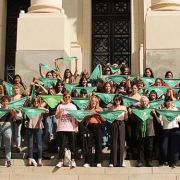
In the early morning of June 11, the Law of Equity in the Representation of Genders in the Communication Services of the Argentine Republic was enacted. A Lley product of the feminist struggles in favor of a democratization in the media organizations in both labor spheres and as producers of meaning.
“Below, we offer a google translate version of the original article in Spanish. This translation may not be accurate but serves as a general presentation of the article. For more accurate information, please switch to the Spanish version of the website. In addition, feel free to directly contact in English the person mentioned at the bottom of this article with regards to this topic”.
The media have a fundamental role in the construction and reproduction of meanings and representations about social and subjective reality. As such, they can contribute to the support and justification of inequalities or they can question them, both from their speeches through the content they produce and disseminate as well as within themselves, being understood as work spaces with a specific labor organization.
Investigating how media content is produced, who produces it, what is their training and trajectory, and what place each one occupies within the media allows us to have a map of the situation to address the violence and structural gender inequalities that they reproduce within these spaces.
The media companies, specifically the large commercial media, are characterized by their work structure founded from an androcentric approach. What has conditioned the income, permanence, development and work performance of women and, of course, has excluded transvestite, trans, intersex and non-binary people.
This is visible in the labor trajectories differentiated by gender:

Source: Chaher and Pedraza (2018). Media and gender organizations. Córdoba: Fundeps, Communicate Equality.
To make this graph, only binary data were obtained in terms of gender, that is why it has not been possible to reconstruct work trajectories taking into account the diversity of identities, such as transvestites, trans, intersex and non-binary people. At the time the investigation was carried out, there was only a single trans person working in one of the Córdoba media. Currently there is some progress in this regard, although it remains insufficient. It is possible to recognize the structural gender inequalities that make it difficult, even more than for cisgender women, to access employment, particularly in these types of companies with diverse and dissident identities.
Now, when observing the graph, it is possible to notice that although most of the people who graduate from careers related to communication in the city of Córdoba and Buenos Aires are women, less than half of them go to work in the media commercial. Even fewer are promoted to higher positions, a situation that is reproduced again, although with a deeper inequality, in union spaces.
These career paths are traversed by personal paths. Unpaid domestic and care work falls mainly on women and femininity, affecting their autonomy. As a result, they are the majority among part-time workers and hired under precarious regimes in order to reconcile their working life with unequally distributed care responsibilities. To this must be added micro-chauvinisms and all types of violence that are combined with masculinity pacts, which perpetuate these unequal and exclusive structures.
The lack of gender and care policies, as well as the lack of gender awareness and training in a transversal manner, or the delegation of this responsibility to feminist communicators and gender editors, are some of the obstacles that many of the media companies most important in the country have not been able to overcome. Even in a context of profound changes in favor of gender equality and the demands of the audiences.
What does the law say?
The recently enacted Law of Equity in the Representation of Genders in Communication Services of the Argentine Republic is inserted in a national and international legal framework and of historical claims of various social and feminist movements, of which it is the result. Claims that were previously reflected in national legislation, such as Law 26,485 on Comprehensive Protection to prevent, punish and eradicate violence against women in the areas in which they develop their interpersonal relationships, Law 26,743 on Gender Identity and the Law 26,522 of Audiovisual Communication Services, among others. As well as public policies, such as the creation of the Public Defender’s Office and the AFSCA, were the result of the commitments assumed by the State in the fight against gender violence.
Its purpose is “to promote equity in the representation of genders from a perspective of sexual diversity in communication services, whatever the platform used” in all the country’s communication media, although it is only mandatory for those of management state. This law does not seek parity, but goes further: it is based on the principle of equity and the inclusion of all gender gender identities in all positions of the media labor structures, breaking with binarism. the promotion of democratization and diversity of voices and their labor structures.
This democratization process from a gender and diversity perspective is understood as gradual, gradual and only mandatory for state-run media, while privately managed media will be encouraged through the preference in assigning official guidelines in cases to carry out measures in the sense proposed by this law.
These positive action measures move away from the punitive paradigm to establish proactive policies that encourage transformations respecting the times and processes of each privately managed media.
In turn, the corresponding authority will be created for the implementation of the law in order to guarantee its compliance.
We celebrate these legal advances that are the result of the insistent struggle of feminist movements, especially feminist communicators and journalists who in their daily practices sustained, and still do, transformations inside and outside their work spaces. We are aware that the struggle does not end with the enactment of a law, but requires a comprehensive and intersectional implementation plan to achieve real equality and make the rights formally sanctioned tangible.
We will keep our attention on the implementation of the law and the public policies designed and carried out to achieve it.
Más información:
- Informe Organizaciones de medios y género
- Informe Sector publicitario y género
- Foro Nacional de Políticas de género en comunicación y publicidad
- Algunas denuncias por violencia mediática y simbólica: