Gender, media companies and unions: Where are we and where are we going?
After a year of research work between FUNDEPS and Comunicar Igualdad, with the collaboration of the Fundación Heinrich Böll, we present in Córdoba and Buenos Aires the partial results obtained on the participation of women and LGTBI people in media companies, universities and unions. The figures warn of their scarce participation in these sectors and the need to transform the rigid union and business structures that hinder their access and permanence.
“Below, we offer a google translate version of the original article in Spanish. This translation may not be accurate but serves as a general presentation of the article. For more accurate information, please switch to the Spanish version of the website. In addition, feel free to directly contact in English the person mentioned at the bottom of this article with regards to this topic”.
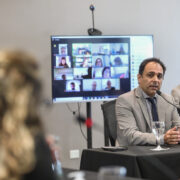
Within the framework of some intense weeks in which the women’s movement filled the streets with color and raised its voice claiming rights for so long postponed, on Friday, June 8 we presented in the Faculty of Communication Sciences some conclusions that make visible the permanence of gender violence within one of the most relevant areas in terms of their social role: media companies.
In this instance, the specialists Pate Palero (journalist, member of the PAR Network), Silvana Zanelli (journalist and trade unionist CISPREN), Sandra Chaher (journalist and Communication Director for Equality), Rossana Rodriguez (SATSAID union member Cordoba) joined. , Paula Morales (teacher and researcher specializing in gender and communication), Analía Barrionuevo (director of the Gender Program of the UNC) and Virginia Pedraza (lawyer and coordinator of the gender team of FUNDEPS).
During the talk, the current situation of women and people in the LGTBI community was discussed in terms of access to equal professional opportunities in the media, and the obstacles they face in accessing the positions of decision making and management positions. Possible actions were also proposed to reverse the situation of inequality from different spaces such as media companies, unions and educational institutions related to communication and the measures that the State can take to address the problem.
Some of these points were presented as results of our research in order to visualize the most problematic axes and to put them in discussion during the day.
Glass ceiling: women who do not have access to hierarchical positions
“(…) In the first 1,500 companies listed on Wall Street, there are more directors called John, Robert, William or James than female directors.” (D’Alessandro, 2017, p.101).
The scarcity of women in decision-making positions within companies is a feature that can be seen in many of the Latin American companies: only 4.2% hold executive positions and 8.5% board meetings, while the In most of the countries in the region, women participate in almost 30% in management positions. The media companies of our country do not escape this trend.
Of the 30 media companies analyzed in Buenos Aires and Córdoba, women participate in 27.72% of the property and managerial positions. However, this percentage becomes more unfavorable in the case of Córdoba: only 12% of women occupy these positions.
The panorama of the unions reflects figures of equal concern. In Córdoba, trade union leaderships that include media workers are occupied by 17.79%. Numbers worrying if we consider that, in 2016, women graduates of journalistic careers constituted 69.04%, but currently they only make up 23.29% of the media workers analyzed in the city of Córdoba.
As for transgender people, it was revealed that only one works in the media, which demonstrates the structural problems that cross this group and make it one of the most vulnerable, marginalized and precarious. Trans people are the most affected because they have greater structural impediments that make it difficult for them to obtain a decent job and complete their studies. In some media, there are policies to include diversity for people with disabilities, but not for trans people.
On the other hand, the institutes of journalistic formation showed their shortcomings in terms of specific and obligatory subjects on gender and of curricula that contemplate the gender perspective as a transversal axis to all the contents.
Why are there no more women in the hierarchical positions of media companies or unions? What barriers make up this glass ceiling that hinders women’s access to these positions?
One of the shortcomings detected within the analyzed media companies is the lack of a gender perspective and measures to guarantee equal opportunities, as well as their translation into institutionalized and sustainable policies that are capable of transforming labor structures. . This leads to the invisibility and reproduction of violence, especially the symbolic violence that is the one that silently and latent crosses the daily practices within the media companies.
These violence are made palpable in practices such as the selection and promotion of personnel. The lack of training in the areas of Human Resources perpetuates naturalized violence, making entry difficult, but particularly the rise of women to positions of hierarchy. In this framework, lobbying (carried out among those who already occupy hierarchical positions, most of them male) and the lack of clear promotion criteria are some of the most important factors when selecting personnel for decision-making positions.
Another barrier that makes up this glass ceiling is the sexual division of labor and its reproduction within the media and union companies. Thus, women occupy feminized positions or deal with “soft” issues, linked to the tasks of care and care (and frivolity) with which they have been associated. We speak of women personal secretaries, producers, in Human Resources and Institutional Relations, in the editorial offices of areas such as health, spectacles and gender, in the Ministries of Culture, Communication and Gender. This type of tasks and topics are considered of lower rank compared to those in which males predominate.
This makes it difficult for women to access others that allow them to gain experience and advance, even to those who have a professional training superior to that of their male peers. In this way, the glass ceiling and the sexual division of work impose gender roles, stereotypes and prejudices that are internalized by women generating a vicious circle that affects their confidence, self-esteem and personal initiative that demotivates and reduces the possibility of doing career within these companies.
This is possible because women are the most important and great supporters of a system and a labor market with a patriarchal matrix that forces them to relegate their professional careers to a second level in order to dedicate themselves to other unpaid work: that of the home. The women who are mothers and in whom they relay the tasks of care, demand greater flexibility through extended licenses, practices like the flex time or home office and the reduction of hours that, in some cases, implies a salary reduction and job insecurity. The result: Few women enter competitions in media companies or are part of lists in the unions to access higher positions, have fewer possibilities than men, and stay, at best, in the middle managers or in devalued positions, having lower salaries than men.
Inequality of gender and possibilities of transformation
The data obtained from this research demonstrate the persistence of structural gender inequalities that are reproduced within media companies and unions. However, these spaces revealed, for the most part, a clear interest in reversing this situation. Now the question is: how to achieve more egalitarian work spaces and union activism? How to mainstream the gender perspective in media companies, unions and journalism training institutes?
There are structural problems that the State has to counter. However, it is important that there is an articulation and commitment between different areas. In the first place, it is necessary to have effective public policies with a gender perspective that address and counteract structural gender inequalities.
Second, proactive policies on the part of media companies that imply the incorporation of a gender perspective that can be institutionalized are required. That is to say, that gender offices are created from where mechanisms to denounce cases of gender violence are implemented, which make the problem visible and give it a corresponding treatment.
Third, internal training in gender issues acquires importance, which involves not only trade unions and media companies, but also educational institutions dedicated to the training of communication professionals. These institutions have the role of training professionals who will then construct and communicate interpretations of realities. Great advances have been made in education regarding the incorporation of gender issues. However, in the case of Córdoba, although work is being done, the creation of curricula with a gender perspective and compulsory subjects that deal with the subject in a timely manner is still pending.
Finally, the Cordovan unions must enhance their role as spokespersons for the media companies, focusing on the pressures they have to make towards these companies, in terms of offering training and protecting those and those they represent, in order to guarantee rights and promote measures that exceed those already in place. For this to be a reality, it is necessary that these spaces also break with their own internal machista structures
In short, the greater presence of women and trans people in media companies and unions means that public policies aimed at achieving gender equity, representation and diversification and democratization of voices, equal opportunities, are also implemented. the transformation in the sexist logic involved in the selection of personnel and in the labor market itself, and the (de) construction of friendly and egalitarian work spaces that eliminate the reproduction of gender violence and the sexual division of labor.
Bibliography and links:
- D’Alessandro, M. (2017). Economía feminista. Cómo construir una sociedad igualitaria (sin perder el glamour). Ciudad Autónoma de Buenos Aires: Editorial Sudamericana.
- OIT (2017). La mujer en la gestión empresarial: Cobrando impulso en América Latina y el Caribe. Recuperado de: http://www.ilo.org/public/spanish/dialogue/actemp/downloads/events/2017/lima_conf/wibm_fullreport_2017_sp.pdf
To see the full video of the Conversation on equal opportunities in media: https://www.facebook.com/FUNDEPS/videos/1791850930878652/
Author
María Cecilia Bustos Moreschi
Contacto: