
• ES
  • EN
Fundeps
  • About Fundeps
  • Team
  • Working areas
    • Environment
    • Democracy
    • Gender
    • Global Gorvernance
    • Health
  • News
  • Publications
  • DONATE
  • Click to open the search input field Click to open the search input field Search
  • Menu Menu

Tag Archive for: Gender

Gender, News

Equity in the media: why and for what?

In the early morning of June 11, the Law of Equity in the Representation of Genders in the Communication Services of the Argentine Republic was enacted. A Lley product of the feminist struggles in favor of a democratization in the media organizations in both labor spheres and as producers of meaning.

“Below, we offer a google translate version of the original article in Spanish. This translation may not be accurate but serves as a general presentation of the article. For more accurate information, please switch to the Spanish version of the website. In addition, feel free to directly contact in English the person mentioned at the bottom of this article with regards to this topic”.

The media have a fundamental role in the construction and reproduction of meanings and representations about social and subjective reality. As such, they can contribute to the support and justification of inequalities or they can question them, both from their speeches through the content they produce and disseminate as well as within themselves, being understood as work spaces with a specific labor organization.
Investigating how media content is produced, who produces it, what is their training and trajectory, and what place each one occupies within the media allows us to have a map of the situation to address the violence and structural gender inequalities that they reproduce within these spaces.
The media companies, specifically the large commercial media, are characterized by their work structure founded from an androcentric approach. What has conditioned the income, permanence, development and work performance of women and, of course, has excluded transvestite, trans, intersex and non-binary people.
This is visible in the labor trajectories differentiated by gender:

Source: Chaher and Pedraza (2018). Media and gender organizations. Córdoba: Fundeps, Communicate Equality.

To make this graph, only binary data were obtained in terms of gender, that is why it has not been possible to reconstruct work trajectories taking into account the diversity of identities, such as transvestites, trans, intersex and non-binary people. At the time the investigation was carried out, there was only a single trans person working in one of the Córdoba media. Currently there is some progress in this regard, although it remains insufficient. It is possible to recognize the structural gender inequalities that make it difficult, even more than for cisgender women, to access employment, particularly in these types of companies with diverse and dissident identities.

Now, when observing the graph, it is possible to notice that although most of the people who graduate from careers related to communication in the city of Córdoba and Buenos Aires are women, less than half of them go to work in the media commercial. Even fewer are promoted to higher positions, a situation that is reproduced again, although with a deeper inequality, in union spaces.
These career paths are traversed by personal paths. Unpaid domestic and care work falls mainly on women and femininity, affecting their autonomy. As a result, they are the majority among part-time workers and hired under precarious regimes in order to reconcile their working life with unequally distributed care responsibilities. To this must be added micro-chauvinisms and all types of violence that are combined with masculinity pacts, which perpetuate these unequal and exclusive structures.

The lack of gender and care policies, as well as the lack of gender awareness and training in a transversal manner, or the delegation of this responsibility to feminist communicators and gender editors, are some of the obstacles that many of the media companies most important in the country have not been able to overcome. Even in a context of profound changes in favor of gender equality and the demands of the audiences.

What does the law say?

The recently enacted Law of Equity in the Representation of Genders in Communication Services of the Argentine Republic is inserted in a national and international legal framework and of historical claims of various social and feminist movements, of which it is the result. Claims that were previously reflected in national legislation, such as Law 26,485 on Comprehensive Protection to prevent, punish and eradicate violence against women in the areas in which they develop their interpersonal relationships, Law 26,743 on Gender Identity and the Law 26,522 of Audiovisual Communication Services, among others. As well as public policies, such as the creation of the Public Defender’s Office and the AFSCA, were the result of the commitments assumed by the State in the fight against gender violence.

View this post on Instagram

A post shared by El Resaltador (@el_resaltador)

Its purpose is “to promote equity in the representation of genders from a perspective of sexual diversity in communication services, whatever the platform used” in all the country’s communication media, although it is only mandatory for those of management state. This law does not seek parity, but goes further: it is based on the principle of equity and the inclusion of all gender gender identities in all positions of the media labor structures, breaking with binarism. the promotion of democratization and diversity of voices and their labor structures.

This democratization process from a gender and diversity perspective is understood as gradual, gradual and only mandatory for state-run media, while privately managed media will be encouraged through the preference in assigning official guidelines in cases to carry out measures in the sense proposed by this law.

These positive action measures move away from the punitive paradigm to establish proactive policies that encourage transformations respecting the times and processes of each privately managed media.

In turn, the corresponding authority will be created for the implementation of the law in order to guarantee its compliance.

We celebrate these legal advances that are the result of the insistent struggle of feminist movements, especially feminist communicators and journalists who in their daily practices sustained, and still do, transformations inside and outside their work spaces. We are aware that the struggle does not end with the enactment of a law, but requires a comprehensive and intersectional implementation plan to achieve real equality and make the rights formally sanctioned tangible.

We will keep our attention on the implementation of the law and the public policies designed and carried out to achieve it.

View this post on Instagram

A post shared by Comunicación para la Igualdad (@comunicarigualdad)

Más información:

  • Informe Organizaciones de medios y género 
  • Informe Sector publicitario y género
  • Foro Nacional de Políticas de género en comunicación y publicidad
  • Algunas denuncias por violencia mediática y simbólica: 
    • Violencia mediática y simbólica: bajo la lupa de una nueva Defensoría del Público
    • Otra vez sopa machista en los medios
18 de June de 2021
https://fundeps.org/wp-content/uploads/2021/06/leyequidad-1374x687-1.jpeg 687 1374 Comunicaciones Fundeps https://fundeps.org/wp-content/uploads/2026/04/logo-2026-300x120.png Comunicaciones Fundeps2021-06-18 18:18:232024-11-14 13:27:42Equity in the media: why and for what?
News

Advances and stagnations in the rights of LGBTIQA + people: towards material equality

May 17 corresponds to the date on which the World Health Organization removed (31 years ago, in 1990) homosexuality from the list of mental illnesses. That is why on this day the “International Day for the Fight against Discrimination due to Sexual Orientation and Gender Identity” is celebrated and particularly in the province of Córdoba the “Provincial Day for Equality and Non-Discrimination due to Sexual Orientation, Identity and Gender Expression ”. These advances are accompanied by laws that demonstrate achievements but also obstacles in their implementation.

“Below, we offer a google translate version of the original article in Spanish. This translation may not be accurate but serves as a general presentation of the article. For more accurate information, please switch to the Spanish version of the website. In addition, feel free to directly contact in English the person mentioned at the bottom of this article with regards to this topic”

May 17 is a fundamental day to make visible and raise awareness about the multiple violence suffered by LGBTIQ + people.

By virtue of the incorporation of international human rights treaties into our constitution, eradicating discrimination based on gender is a duty assumed by the State and also a commitment by all of us who want to live in a more just and equitable society.

There are various tools to eradicate violence, one of them is the formation and creation of laws, which imply the recognition of rights. Among them we can name Law 26,485 on Comprehensive Protection to Prevent, Punish and Eradicate Violence; the 26,743 of gender identity; Law 26,150 on comprehensive sexual education; among other. Despite its recognition, in law there are two fundamental concepts: on the one hand, formal equality, and on the other, material equality. The first corresponds to what we have been talking about, the recognition and promotion of equal rights written in the law, but the second is the opposite. That is, it allows us to identify if what is written is reflected in everyday life and these rights are specified, generating real equality, or if they are simply statements narrated on paper.

According to updated data from Amnesty International, people who identify as lesbian, gay, bisexual, transgender or intersex, or are perceived as such, are at greater risk of being harassed and victims of violence because of their sexual orientation or gender identity. The life expectancy of the transvestite-trans population in Argentina is 35 to 41 years. In this sense, it is important to remember the case of Tehuel De La Torre, a trans boy who disappeared on March 11 of this year, when he left his home for a job interview. To this day Tehuel does not appear, there are few clues about his whereabouts since the last people who saw him alive do not provide information, and it is a case that does not have enough repercussion and dissemination in the hegemonic media. The Tehuel case highlights the reality of the country’s trans population: the situation of extreme vulnerability and exposure to multiple gender-based violence.

Among the discriminations that people suffer due to their sexual orientation or gender identity there are homophobia, lesbophobia and transphobia, which are irrational hatred towards people whose sexual orientation is different from heterosexuality and / or their gender identity does not matches your biological sex. An example of this is the rejection that was generated by a sector of Cordoba society towards the LGBTIQA + flag that was hung by the Municipality of the capital in Sarmiento Park. On that occasion, there were clear reactions of violence and hate mobilizations against him, even reaching the fact that on several occasions the flag was removed, including acts of physical violence against LGBTIQA + people.

The aforementioned regulations suffer some difficulties at the time of their implementation due to the resistance of conservative groups that hinder the development of this policy in society. Whether through legal litigation, media campaigns, legislative lobbies, and particularly resistance in teaching spaces such as schools. These sites are important institutions for socialization and learning, where issues of promoting equality and non-discrimination must be addressed early.

What has been said so far, makes it clear that despite having rights recognized in various laws (formal equality), even so, people continue to suffer multiple violence because of their sexual orientation and / or gender orientation (material equality) when they do not conform to the heterocisnorm. Therefore, the need for a comprehensive plan to eradicate violence is evident. The enactment of a law is not enough, but comprehensive public policies are required that provide true responses to the problem and a profound cultural change.

20 de May de 2021
https://fundeps.org/wp-content/uploads/2021/05/bandera.jpg 550 750 Comunicaciones Fundeps https://fundeps.org/wp-content/uploads/2026/04/logo-2026-300x120.png Comunicaciones Fundeps2021-05-20 21:11:332024-11-14 13:27:43Advances and stagnations in the rights of LGBTIQA + people: towards material equality
Gender, News

Domestic workers: a fight for their recognition

In Argentina, legislation and public policies on care have made progress but also obstacles. Within the framework of the International Day of Domestic Workers and the 8th anniversary of the enactment of Law 26,844 on the Special Regime of Work Contract for Personnel of Private Houses, we highlight the importance of the legislation and regulation of the work of those who they take care of it in a remunerated way, although we recognize that there is still a lot of hard work in pursuit of its effectiveness and expansion.

“Below, we offer a google translate version of the original article in Spanish. This translation may not be accurate but serves as a general presentation of the article. For more accurate information, please switch to the Spanish version of the website. In addition, feel free to directly contact in English the person mentioned at the bottom of this article with regards to this topic”

In the 1950s, the first laws related to domestic work appeared, in order to define labor relations and their rights as workers.

But it was not until 2013 when Law 26,844 was enacted, which established a special work contract regime for paid workers in private homes. This law regulates the labor relations that are established within private homes or in the sphere of family life and that do not generate a direct profit or economic benefit for the employer. It defines this work as any provision of cleaning, maintenance or other typical household activities services, personal assistance and accompaniment to family members or those who live in the same home with the employer, and the non-therapeutic care of sick or disabled people.

In this process, activism and later the union organization of private house workers, has been key in the fight for their rights. The Union of Auxiliary Personnel of Private Houses (UPACP), which encompasses the workers of private houses, “carries out its tasks of defense and representation of the workers in the sector since the beginning of the last century. Today the workers have a law that regulates the activity, No. 26,844, which equates, as appropriate, the work of domestic service to that of workers from other unions. Now the workers of private homes have the right to vacations, maternity leave, among all labor rights. ”

This law tries to put the rights of private house workers on an equal footing with those of any other worker in a formal and dependent relationship. However, the characteristics of domestic work, related to the private sphere, the invisible, with the duty assigned to women to care for and give love in a disinterested, selfless way and without any type or with little remuneration and recognition, It makes it difficult for these activities to be considered as work and those who perform it, as workers.

Labor market of private house workers

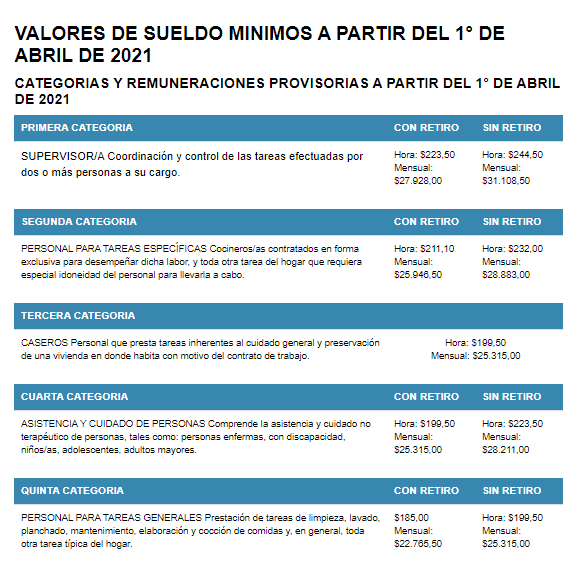
Law 26844 not only establishes the regime of private house workers but also different categories according to the type of work that was developed in the domestic sphere. These categories translate into salary scales:

www.upacp.org.ar


However, this recognition is far from meaning the realization of their labor rights.

According to a report by the National Directorate of Economy, Equality and Gender, in Argentina, the main occupation of women is paid domestic service: it represents 16.5% of the total employment of employed women and 21.5% of wage earners. It is the most feminized activity in the market (96.5% are women), the one with the highest informality rate (72.4%) and the one with the lowest average income in the market, constituting the poorest workers of the entire economy. This means that a domestic worker earns 46 pesos for every 100 that a private sector employee receives and 30 pesos for every 100 that a formal worker receives. Compared to men, they earn 26 pesos for every 100 pesos that one of them earns. According to the ILO, this informality and precariousness generates the breach of rights and a space for labor exploitation, even of girls and adolescents.

For Candelaria Botto: “In our country, where the State does not satisfy these needs, the role of domestic workers becomes essential for a large number of households. However, this work takes place mostly in precarious conditions and with low remuneration, which shows the little social value that is given to reproductive work. ”

Even with all these limitations on access to rights, it is likely that a registered employee, whose labor relations are regulated by a legal framework, is in better working conditions.

That the autonomy of some does not take it away from others

Now, who are the women that make up this group of domestic workers?

Mercedes D´Alessandro, in her book “Economía Femini (s) ta”, affirms that the “fairy godmothers” who sustain the lives of those who inhabit the households with the highest income are women in situations of vulnerability and poverty. Many of them have dependent children and most have not been able to complete secondary school (only 2% of them completed a tertiary degree or university). As a result, 40% of poor mothers are private house workers.

They are women who need to work but are not qualified to access other types of employment. In addition, it is usually one of the first job options for women from other countries, although the percentage of internal migrants among these workers is more remarkable. Many young women see this job as a way out of poverty, but end up living in a utility room of a wealthy family that does not pay them a Christmas bonus, vacation or sick days.

At this point, it is important to think about the tense link between paid and unpaid forms of care. Given the unjust social organization that distributes care, paid and unpaid care work falls mainly on women. That is why it is always necessary for a woman to take care of, to “free” another of these tasks. And here, it is not only the stubborn persistence of the sexual division of labor that undermines advances in favor of a more just and equitable society, but it is also other factors of inequality and oppression that overlap with gender. The class and powerful processes of racialization that still persist go through caregiving.

As domestic work is, to a great extent, carried out by poor women, peasants, migrants, representatives of various ethnic groups, with low education and little education, who find in this activity a means of subsistence, it is one of the most devalued jobs not only in economic terms but also in social terms. Thus, families with higher incomes can turn to the market to free up time, which implies hiring another, poorer woman to do domestic and care work.

As D’Alessandro says: “behind every great woman, there is another great woman.”

This invites us to think about care in a feminist and intersectional way, which puts care work at the center of the scene and de-romanticizes it. Because the lack of decent wages and real access to labor rights is not compensated with gratitude and love.

As Sol Minoldo says: “How feminist can a process be in which some women emancipate themselves at the expense of others, leaving the sexual distribution of domestic work intact?

If there is exploitation, it does not stop there because the worker is treated with affection and the trust of our intimate life is opened to her, although it may be noticed a little less. It is time to question the way in which “love” has been used to make it invisible that domestic work is work, whoever does it. That love is not an excuse to deny workers their rights. ”

Although the importance of care and of those who care – especially during the pandemic – has become increasingly visible, this has not yet translated into salary improvements in the case of paid domestic and care work. We still owe a debt to the people they care for. With domestic workers, there are still huge social, cultural and economic gaps to fill. They perform essential work but in precarious and irregular conditions, with miserable wages that are barely enough for them to access the basic food basket.The gaps and obstacles that these workers face every day are an impediment to real access to their rights as workers, as women and as people.

Author

  • Cecilia Bustos Moreschi, cecilia.bustos.moreschi@fundeps.org
31 de March de 2021
https://fundeps.org/wp-content/uploads/2021/03/Web-Fundeps.jpg 375 710 Comunicaciones Fundeps https://fundeps.org/wp-content/uploads/2026/04/logo-2026-300x120.png Comunicaciones Fundeps2021-03-31 19:43:452024-11-14 13:27:45Domestic workers: a fight for their recognition
Democracy, Gender, News

Statement for the appointment of the Attorney General of Córdoba

A group of more than 30 organizations in Córdoba prepared a letter expressing our concern over the eventual appointment of Juan Manuel Delgado as Attorney General of the province of Córdoba.

“Below, we offer a google translate version of the original article in Spanish. This translation may not be accurate but serves as a general presentation of the article. For more accurate information, please switch to the Spanish version of the website. In addition, feel free to directly contact in English the person mentioned at the bottom of this article with regards to this topic”

Today the Legislature of Córdoba is voting for the nomination of Juan Manuel Delgado to the position of Attorney General of the province of Córdoba. The position, by Constitutional mandate, is proposed by the provincial executive and must have the agreement of the Legislature.

Last Thursday, March 11, we attended the Public Hearing that was held and presented observations on some aspects that we consider critical. In this sense, we highlight the lack of independence that we consider to exist when nominating a person who is currently serving in the executive branch, as well as the lack of training and experience in criminal matters, human rights, gender and diversities and environmental problems.

Today, more than 30 organizations made public our concerns regarding the appointment of the proposed Prosecutor. Although they take up some of the points raised at the Hearing, this open letter places special emphasis on the threat that we warn regarding the validity of the sexual and (non) reproductive rights that have been achieved, given the candidate’s previous connections and his statements in the Commission. of Constitutional Affairs.

  • Pronouncement

Contact

Nina Sibilla, ninasibilla@fundeps.org

Mayca Balaguer, maycabalaguer@fundeps.org

17 de March de 2021
https://fundeps.org/wp-content/uploads/2021/03/delgado.jpg 662 993 Admi2024FunDEPS https://fundeps.org/wp-content/uploads/2026/04/logo-2026-300x120.png Admi2024FunDEPS2021-03-17 16:34:022024-11-14 13:27:46Statement for the appointment of the Attorney General of Córdoba
Democracy, Environment, Gender, News

Public Hearing for the position of Attorney General of the Province of Córdoba

This Thursday we participated in the Public Hearing to discuss the application of the lawyer Juan Manuel Delgado to the position of Attorney General of the Province of Córdoba, convened on 03/04/2021 through the Official Gazette.

“Below, we offer a google translate version of the original article in Spanish. This translation may not be accurate but serves as a general presentation of the article. For more accurate information, please switch to the Spanish version of the website. In addition, feel free to directly contact in English the person mentioned at the bottom of this article with regards to this topic”

It was carried out after Governor Juan Schiaretti sent to the Unicameral Legislature of Córdoba, through file No. 32245 / P / 21, the formal proposal for the purpose of requesting agreement for the appointment of Juan Manuel Delgado as Attorney General of the province.

Juan Manuel Delgado, is a lawyer, and currently works as Procurator of the Treasury of the Province of Córdoba (since May 2019). In addition, he was Secretary of the Arbitration Court of the Cordoba Stock Exchange (2012/2018), Member of the Board of Directors of the Cordoba Stock Exchange (2019), Secretary of the Stock Exchange (2018), and Director of the Institute of Legal and Business Investigations of the Córdoba Stock Exchange (2017-2019).

On this occasion, we leave raised the following aspects, which we consider extremely worrying: 1) First, the serious impact on the institutional quality of the province with the application to occupy the highest position of the Public Ministry to a person who has just practiced as a lawyer within the executive power, precisely as a Procurator of the Treasury of the Province of Córdoba, which depends on the State Prosecutor’s Office of the province. This strongly undermines the constitutional mandate of independence among the powers of the State; 2) Secondly, and according to the only information available about the applicant’s career, there is an obvious lack of knowledge and experience in criminal matters, the area of ​​main activity of the Attorney General of the province. In addition to this, there is no evidence in the applicant of training and / or background in human rights, environmental law and in the perspective of gender and diversity.

Finally, we leave it exposed that, beyond the training, experience and trajectory in these topics, which we consider of great relevance, we are interested in the applicant showing a commitment to active work in these matters. The Attorney General’s Work Plan, which defines the priorities of criminal policy, must be public to all citizens and must incorporate these issues.

Contact

  • Nina Sibilla, ninasibilla@fundeps.org
12 de March de 2021
https://fundeps.org/wp-content/uploads/2021/03/audiencia-publica.jpg 589 1072 Comunicaciones Fundeps https://fundeps.org/wp-content/uploads/2026/04/logo-2026-300x120.png Comunicaciones Fundeps2021-03-12 19:02:322024-11-14 13:27:46Public Hearing for the position of Attorney General of the Province of Córdoba
Gender, News

Other‌ ‌economies: the‌ ‌self-management‌ ‌from‌ a‌ ‌perspective of‌ ‌la‌ Sustainability‌ ‌of‌ la‌ ‌Life

After a year of research and collective work together with the Espacio de Economía Feminista de Córdoba, we published a report that reveals the self-managed experiences of the city of Córdoba and Valle de Punilla related to Feminist Economy, Ecological Economy, Popular Economy and Social Economy and Solidarity.

“Below, we offer a google translate version of the original article in Spanish. This translation may not be accurate but serves as a general presentation of the article. For more accurate information, please switch to the Spanish version of the website. In addition, feel free to directly contact in English the person mentioned at the bottom of this article with regards to this topic”

In Córdoba, self-management, cooperative and entrepreneurial spaces made up of dissident feminities and identities have developed in recent years, starting from the visibility of the feminist struggle, and with their collective organization. Its existence, strategies and forms of organization, production and consumption, have gained essential importance in local economies, and are presented as a real alternative to the hegemonic capitalist model.

This research makes a reading from the Feminist Economy of these experiences, which allows (de) constructing practices that reproduce inequalities and violence against women and dissident sex-generic identities within the spaces in which they develop, and expand the horizon towards a socioeconomic equity that is nothing more than gender equity.

In this line, it is intended to explore, learn about and analyze various self-managed and community experiences of the City of Córdoba and the Punilla Valley, and make visible their contributions to the construction of an alternative to the neoliberal model and investigate the actions of the State in development of public policies that contribute to this alternative. The place from which this report is intended to be narrated is from the perspective of the territorialized experiences themselves in dialogue with the perspective built from a diverse interdisciplinary field full of nuances and a dynamic construction generated in the exchange of Feminist Economy with the Popular Economy, the Ecological Economy and the Social and Solidarity Economy.

To this end, together with the Feminist Economy Space and with the support of the Heinrich Böll Foundation, we interviewed 16 community organizations, cooperatives and self-managed spaces in the area. The visibility of these practices enriches the dialogue between the theoretical proposals about them and will collaborate in the construction of new knowledge. At the same time, it offers first-hand information, necessary to promote public debate on the needs, views and contributions of these organizations to economies founded from paradigms that put life at the center, instead of profit and exclusion. Knowing these experiences allows us to identify their concrete contributions to the construction and maintenance of other economies, which propose alternatives to neoliberal capitalism and hetero-patriarchy, and seek to sustain human and non-human lives.

Questions that open up others: Do community organizations and self-managed enterprises constitute an alternative to the neoliberal capitalist model?

This first approach, achieved through this research, leads us to conclude that most of the community organizations, cooperatives and self-managed enterprises interviewed constitute, or at least try to establish themselves, as an alternative to the neoliberal and heterocispatriarchal model, putting in the center the lives and care that make them possible.

On the other hand, it is shown that, in practice, and from the perspective of the organizations analyzed, the contribution of the State to the development of these alternatives is insufficient, characterized by ineffective public policies and in some cases nonexistent, in line with the role that the State is expected to occupy in a neoliberal economic model.

Se espera que el presente trabajo, aporte a la visibilización, reconocimiento y fortalecimiento de espacios autogestivos cuyas prácticas apunten a poner a la vida en el centro, desde una necesaria mirada local y a la vez crítica. Se sostiene —y en el contexto actual está evidenciado— que la sostenibilidad de la vida debe estar en el centro del debate. Se debe seguir pensando y construyendo colectivamente la economía que se desea y necesita para que todas las vidas que habitan este planeta lo hagan de una manera digna. Por esto queremos aportar a la visibilización de las organizaciones que apuestan cada día a otro mundo posible.

Download research “Other‌ ‌economies: the‌ ‌self-management‌ ‌from ‌a‌ ‌perspective‌ of‌ ‌la‌ ‌Sustainability‌ ‌of‌ ‌la‌ ‌Life‌”

Contact

Cecilia Bustos Moreschi, cecilia.bustos.moreschi@fundeps.org

8 de February de 2021
https://fundeps.org/wp-content/uploads/2021/02/Sin-titulo.png 375 710 Admi2024FunDEPS https://fundeps.org/wp-content/uploads/2026/04/logo-2026-300x120.png Admi2024FunDEPS2021-02-08 14:28:582024-11-14 13:27:47Other‌ ‌economies: the‌ ‌self-management‌ ‌from‌ a‌ ‌perspective of‌ ‌la‌ Sustainability‌ ‌of‌ la‌ ‌Life
Gender

Other‌ ‌economies: the‌ ‌self-management‌ ‌from‌ a‌ ‌perspective of‌ ‌la‌ Sustainability‌ ‌of‌ la‌ ‌Life

Together with the Córdoba Feminist Economy Space, we present a report that rereads the self-managed experiences of the city of Córdoba and Valle de Punilla related to Feminist Economy, Ecological Economy, Popular Economy and Social and Solidarity Economy.

Descargar Documento / Download File
8 de February de 2021
https://fundeps.org/wp-content/uploads/2021/02/Fundeps_Informe-Presentacion_PortadaWeb.jpg 375 710 Admi2024FunDEPS https://fundeps.org/wp-content/uploads/2026/04/logo-2026-300x120.png Admi2024FunDEPS2021-02-08 13:52:522024-11-14 13:27:47Other‌ ‌economies: the‌ ‌self-management‌ ‌from‌ a‌ ‌perspective of‌ ‌la‌ Sustainability‌ ‌of‌ la‌ ‌Life
Gender, News

The Ministry of Health responds to a request for information on the implementation of the ILE in Córdoba

After the request for information presented in October, the Ministry of Health provided data on the implementation of the Legal Interruption of Pregnancy in the province, starting from the entry into force of the local protocol that had been suspended.

“Below, we offer a google translate version of the original article in Spanish. This translation may not be accurate but serves as a general presentation of the article. For more accurate information, please switch to the Spanish version of the website. In addition, feel free to directly contact in English the person mentioned at the bottom of this article with regards to this topic”

With the fall of the precautionary measure that suspended the application of the provincial guide for the care of non-punishable abortions, the health services of the province of Córdoba began to guarantee the practice in those cases where the pregnancy was the result of rape, or implied a risk to the life or health of the pregnant person, as indicated in art. 86 of the Penal Code.

As indicated in the response sent on December 3, 2020, from September 1, 2019 (the court case was terminated on the 24th of that month) until November 30, 2020, a total of 949 were registered in the province. Legal Interruption of Pregnancy practices: 112 correspond to 2019 and 837 to 2020.

Of this total, the most invoked cause was the risk to comprehensive health, for which 906 practices were carried out (96%). Because it was a risk to life, 20 practices were carried out (2%). The causal violation was invoked in a total of 22 practices (the other 2%).

ILE quantity

From September 2019 to November 2020
Causal health hazard - 95.6%
Causal violation - 2.3%
Causal danger to life - 2.1%

With regard to training and training instances, the agency reported that 6 weekly virtual meetings were held by the National Directorate of Sexual and Reproductive Health of the Ministry of Health of the Nation (in June and July 2020), and 1 meeting virtual organized by the National Directorate of Sexual and Reproductive Health, articulated with the Provincial Program Maternity and Responsible Paternity, in June 2020.

Regarding the purchase and distribution of medicines and supplies to carry out the practice, the Ministry reported that in 2019, 135 misoprostol treatments were used, all from the National Directorate, and in 2020 a total of 1,248. among which 698 come from the National Directorate or clearing operations with other provinces, and 550 were purchased directly by the provincial Ministry.

Incomplete information

Despite having responded to the request for information, the Ministry of Health failed to answer all the questions regarding how conscientious objection operates by health professionals and how referrals for this reason are in practice. It also did not answer questions related to the budget for these services.

It is not the first time that the Ministry of Health fails to comply with a request for access to public information. In 2019, after submitting a request on the same issue, the Administration only responded after we went to court, through an injunction for delay. Even so, the information that he presented in the context of the file was incomplete, so we continue to demand before the courts that he fulfill his duty to provide public information in a timely manner.

The province of silence

There were 7 years in which the local guide to access abortion for reasons contemplated in the Penal Code was suspended. During all that time, pregnant people who needed to access the practice had to do so in health centers in other jurisdictions or, directly, in hiding. It was the feminist networks that generated channels to refer cases and assist them despite the judicial blockade.

Today the new law 27,610 on Voluntary Interruption of Pregnancy is in force throughout the national territory. With its publication in the Official Gazette on January 18, and having entered into force on January 24, it is striking that the Ministry of Health of Córdoba has not yet ruled on the matter. No public statement has yet been made on how the province’s health services will be organized for law enforcement purposes.

But the right to interrupt the pregnancy freely until the 14th week of gestation, along with abortion for reasons, is enforceable and must be guaranteed in Córdoba and throughout the country.

More information

  • Response to the request for info

Contact

  • Mayca Balaguer, maycabalaguer@fundeps.org
5 de February de 2021
https://fundeps.org/wp-content/uploads/2021/02/DATA_ART_2545542.jpg 715 1072 Comunicaciones Fundeps https://fundeps.org/wp-content/uploads/2026/04/logo-2026-300x120.png Comunicaciones Fundeps2021-02-05 14:13:052024-11-14 13:27:47The Ministry of Health responds to a request for information on the implementation of the ILE in Córdoba
Democracy, Environment, Gender, Global Governance, Health, News

What has been the impact of COVID-19 on the Sustainable Development Goals?

We present a document analyzing the impact of the COVID-19 pandemic on the Sustainable Development Goals of the United Nations.

“Below, we offer a google translate version of the original article in Spanish. This translation may not be accurate but serves as a general presentation of the article. For more accurate information, please switch to the Spanish version of the website. In addition, feel free to directly contact in English the person mentioned at the bottom of this article with regards to this topic”.

The Sustainable Development Goals (SDGs) were adopted in 2015 by the UN Member States, with the purpose of ending poverty, protecting the planet and guaranteeing peace and prosperity for all people by the year 2030. The SDGs There are 17 integrated objectives in which the actions or impacts on one will affect another / s.

The situation generated by the pandemic is not at all encouraging, since pre-existing unfavorable issues such as increasing poverty and hunger, increasing inequalities, rising unemployment, the health and sanitation crisis, the economic recession, restricted access to education, the setback regarding gender equality, among other aspects.

Thus, the document “Impact of COVID-19 on the Sustainable Development Goals“, prepared in a collaborative way, analyzes and reflects on the impact of COVID-19 on the SDGs, the positive and negative consequences of the global pandemic on each of the 17 objectives.

The current context has posed challenges for States and international organizations in decision-making, and in the establishment of truly effective actions to prevent this type of situation from recurring. In this way, the current context made us have to rethink whether the current system is effective or whether we should build another model for the future, one that is more equitable, inclusive, fair and sustainable. Therefore, the situation that the world is going through may mean an opportunity to rethink what future we want to build from now on.

More information

  • Download analysis on the impact of COVID-19 on the Sustainable Development Goals.

Contact

Gonzalo Roza, gon.roza@fundeps.org

11 de January de 2021
https://fundeps.org/wp-content/uploads/2021/01/Sin-titulo-1.jpg 375 710 Comunicaciones Fundeps https://fundeps.org/wp-content/uploads/2026/04/logo-2026-300x120.png Comunicaciones Fundeps2021-01-11 14:13:402024-11-14 13:27:48What has been the impact of COVID-19 on the Sustainable Development Goals?
Democracy, Environment, Gender, Global Gorvernance, Health

Impact of COVID-19 on the Sustainable Development Goals

(ONLY SPANISH) The COVID-19 pandemic has had an unprecedented global impact in the modern era. Many countries are in a health, economic and social emergency due to the negative consequences of the fight against the new coronavirus.

Undoubtedly, the Sustainable Development Goals (SDGs) established for the United Nations 2030 Agenda will be affected. In this paper we analyze some of the positive and negative impacts on the SDGs, although we anticipate that in general the outlook is negative, especially if we focus on the effects it will have on community health and the increase in inequalities due to the economic slowdown. world.

Descargar Documento / Download File
11 de January de 2021
https://fundeps.org/wp-content/uploads/2021/01/Sin-titulo-2-1.jpg 375 710 Comunicaciones Fundeps https://fundeps.org/wp-content/uploads/2026/04/logo-2026-300x120.png Comunicaciones Fundeps2021-01-11 14:08:122024-11-14 13:27:48Impact of COVID-19 on the Sustainable Development Goals
Gender, News

We conquer the right to decide: the Voluntary Interruption of Pregnancy is law

After almost 12 hours of session, with 38 votes in favor, 29 votes against, 1 abstentions and 4 absent senators, the Senate approved the Law of Voluntary Termination of Pregnancy. The Campaign for Legal, Safe and Free Abortion, after 15 years of struggle, celebrated the historic day at the end of the vigil at the gates of Congress and in public spaces throughout the country.

“Below, we offer a google translate version of the original article in Spanish. This translation may not be accurate but serves as a general presentation of the article. For more accurate information, please switch to the Spanish version of the website. In addition, feel free to directly contact in English the person mentioned at the bottom of this article with regards to this topic”.

In the early hours of the morning, this Wednesday, December 30, the presentations by senators and senators ended and the Voluntary Termination of Pregnancy law was called to vote. The bill already had the half-approval of the Chamber of Deputies, who approved it with 131 votes, against 117 negative votes and 6 abstentions.

A law to decide what lives we want to live

The law establishes the right of women and people with other gender identities with the capacity to gestate to decide the interruption of pregnancy, request and access abortion care, and receive post-abortion care in the health system services.

Free access is foreseen until week 14 of gestation. Outside this period, access can only be made in the event of rape or if the life or integral health of the pregnant person is in danger (that is, the causes that are already recognized in our legal system through Art. 86 of the Penal Code , with the interpretation made by the Supreme Court in the FAL ruling).

15 years of a huge federal struggle

With a presence in more than 120 cities and towns throughout the country, simultaneously, the National Campaign for the Right to Legal, Safe and Free Abortion participated in this historic day. By raising their green handkerchiefs high, symbol of the struggle for the right to decide throughout the world, they were finally able to celebrate having conquered the law, which is the product of the struggle of thousands and thousands for more than 15 years.

This triumph will inspire us to continue expanding rights in each space we inhabit. And not to give up. We know that the conquest of the law is only the first step. We will continue working for its effective application and the guarantee that all pregnant people can decide which lives to live.

4 de January de 2021
0 0 Comunicaciones Fundeps https://fundeps.org/wp-content/uploads/2026/04/logo-2026-300x120.png Comunicaciones Fundeps2021-01-04 11:35:392024-11-14 13:27:48We conquer the right to decide: the Voluntary Interruption of Pregnancy is law
Global Gorvernance

Gender and International Financial Institutions: the case of the Inter-American Development Bank

This document proposes a descriptive and evaluative analysis of the implementation of the Gender Policy in the Inter-American Development Bank (IDB) and its main objective is to investigate such implementation based on the weaknesses and strengths identified in the Bank’s gender policy. , in order to continue making progress in incorporating elements and tools that guarantee women’s rights and diversity.

Descargar Documento / Download File
23 de December de 2020
0 0 Admi2024FunDEPS https://fundeps.org/wp-content/uploads/2026/04/logo-2026-300x120.png Admi2024FunDEPS2020-12-23 21:16:592024-11-14 13:27:48Gender and International Financial Institutions: the case of the Inter-American Development Bank
Page 6 of 16«‹45678›»

Tags

Access to Information Access to Justice BID Chinese Investments Citizen Participation Democracy ENTs Environment Environmental Democracy Gender Global Governance Health Healthy nutrition IFIs Infrastructure Financing Legal Interruption of Pregnancy Sexual and Reproductive Rights Social and Environmental Standards Tobacco Control Transparency
See all tags

Acuerdo de Escazú

Emergencia Agroquímica

MOCI - monitoreo ciudadano en proyectos de infraestructura

{el entramado} Contamos historias. Acercamos Realidades.

Instagram

fundepsargentina

Trabajamos para que se garanticen los derechos humanos 🌱⚖️🗣️🌈💜🚭🍎
Promovemos la equidad de #genero, el derecho a la #salud y un #ambiente sano.

Este viernes 31 de julio realizamos un nuevo encue Este viernes 31 de julio realizamos un nuevo encuentro de formación en derechos sexuales y (no) reproductivos. 

En articulación con el Consultorio de Salud Integral y con el aval de la DAJA, compartimos la jornada de capacitación con profesionales del Hospital Vicente Agüero de Jesús María.

Más de 15 profesionales de diversas disciplinas se dieron cita, para conocer diferentes aspectos de la práctica de AMEU y fortalecer su trabajo diario, en pos del acceso al aborto legal, seguro y gratuito.

Como en cada instancia, celebramos el compromiso de cada participante y agradecemos especialmente a la Dra. Kenia Torres y al Director del Hospital, Dr. Javier Díaz, por la predisposición para recibirnos.
La información como herramienta ya está disponible La información como herramienta ya está disponible en Aprender con Fundeps.

Aprendé a ejercer el derecho de acceso a la información pública y a usarlo para defender derechos, monitorear decisiones e impulsar procesos de incidencia.

En este curso vas a aprender:

📌 Cómo hacer solicitudes de acceso a la información pública.
📌 Qué hacer cuando un organismo no responde.
📌 Cómo acceder a información sobre proyectos financiados por organismos internacionales.

💻 Curso virtual, gratuito y autoadministrado.
🔗 Inscribite en aprender.fundeps.org
🌎 Hace un año, la @corteidhoficial emitió su histó 🌎 Hace un año, la @corteidhoficial emitió su histórica Opinión Consultiva sobre la emergencia climática.

✊ Una victoria para quienes defienden el ambiente en América Latina y el Caribe: la Corte confirmó que proteger a las personas defensoras del ambiente no es opcional. Es una obligación legal.

⚖️ Para explicar qué exige esa protección, la Corte se apoyó en el Acuerdo de Escazú. Resultado: la gran mayoría de Estados de América Latina y el Caribe no pueden ignorar los estándares de Escazú, incluso si aún no han ratificado el tratado.

🔎 La implicación es clara: los países de la región deben fortalecer el acceso a la información, la participación pública, la justicia ambiental y la protección de quienes defienden el ambiente. 

📝 La Opinión abre nuevas rutas para frenar la criminalización de personas defensoras, responder a las restricciones al espacio cívico y defender la participación pública en países como Costa Rica, Guatemala y Perú. Compartimos el análisis de  @manizalmigrante del @ciel_org

📣 La discusión ya no es si los países de América Latina y el Caribe deben proteger a quienes defienden el ambiente. Eso ya está claro. Ahora hay que usar la Opinión: en tribunales, reformas, debates públicos y procesos de movilización para exigir mejores garantías y mayor protección.

🔗 Lee el análisis completo en el link en www.ciel.org/corte-idh-escazu-personas-defensoras/
Seguimos compartiendo algunos momentos del 3° Encu Seguimos compartiendo algunos momentos del 3° Encuentro Provincial de Redes de Compromiso y Cuidados 🧡

Creemos que no hay mejor manera de cerrar una jornada de formación, intercambio y construcción colectiva que encontrándonos también desde el arte. Porque la música y la poesía también nos invitan a imaginar otros mundos posibles.

Así vivimos Revuelo Sur, Íntimas, el espectáculo de Susy Shock junto al Dúo Bazán-Bonillo, que acompañó el cierre de este encuentro.

Gracias a todas las personas que se acercaron y fueron parte de esta jornada.
Follow on Instagram

Twitter

Tweets por @fundeps

Newsletter Subscription

    Fundeps. Córdoba (CP X5000JZH), Argentina. info@fundeps.org
    • Link to X
    • Link to Facebook
    • Link to Instagram
    • Link to Mail
    • Link to Youtube
    • Link to LinkedIn
    • Link to TikTok
    Scroll to top Scroll to top Scroll to top