The Province called a table to update the map of law 9.814. The different positions of the rural sectors and the environmentalist and ecological NGOs do not reach an agreement that allows to raise a project. According to expert studies, the province has 3.6 million hectares of native forest.
“Below, we offer a google translate version of the original article in Spanish. This translation may not be accurate but serves as a general presentation of the article. For more accurate information, please switch to the Spanish version of the website. In addition, feel free to directly contact in English the person mentioned at the bottom of this article with regards to this topic.”
As in 2009, when the law that created it was enacted, the territorial planning of the native forests (OTBN) of Cordoba continues to pose irreconcilable differences between the rural sector and environmentalism.
This year, the Province convened a table to update the map of Law 9.814, which paints these ecosystems in three colors, according to their state of conservation and permitted activities. But in this space, the different positions of the rural sectors and environmentalist NGOs and environmentalists do not reach an agreement that allows to raise a consensual project for the Legislature to approve.
A few days ago, the Argentine Agrarian Federation (FAA) made clear its position that Cordoba’s OTBN is “oversized” and requires a sincere.
“We believe that the forest cover ‘native forest’ in the province should not exceed two million hectares, corresponding to the red category between 500 thousand and 600 thousand, and to the yellow category around 1.5 million hectares,” a document Presented at this dialogue table. But according to expert studies, the province has 3.6 million hectares of native forest, or 1.6 million hectares more than the FAA.
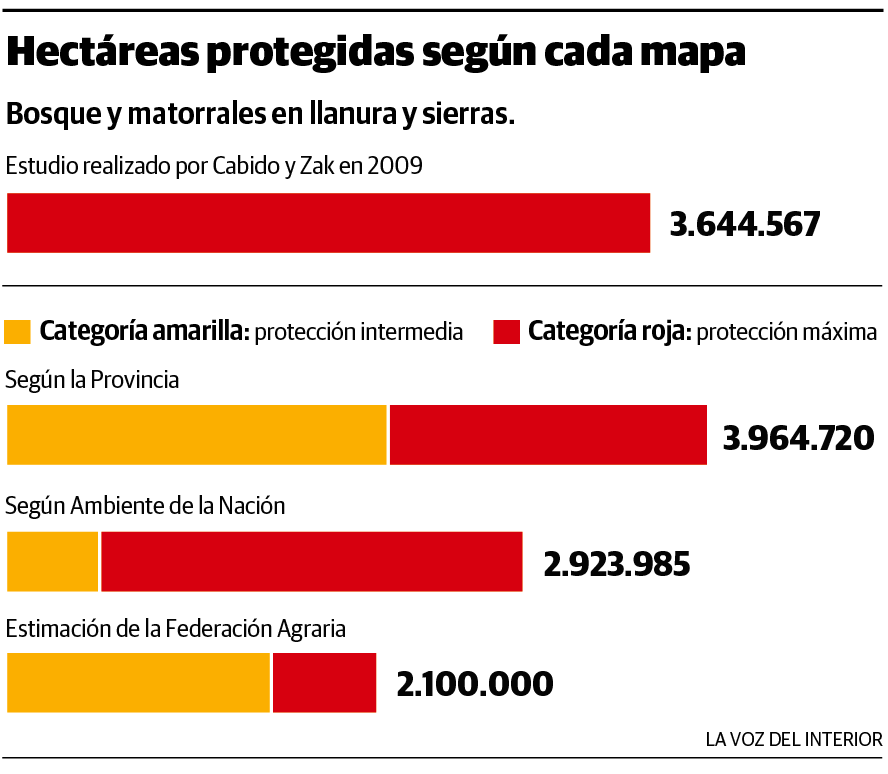
The work was carried out in 2009 by the ecologists Marcel Zak and Marcelo Cabido, and it is the scientific study of the native forest more detailed Cordobés to date. The count includes open forest, scrub in different states and halophyte ecosystems (saline environments).
The current provincial map adds four million hectares, that is 1.9 million hectares more than the idea of the FAA. “The very serious distortions that originated in the initial map and throughout the regulatory stage of the law plus arbitrary and discretionary management by the enforcement authority resulted in a misclassification of conservation categories,” they point out from the FAA.
One of the FAA’s arguments for reducing the protected area is the same as the one outlined by the Confederation of Rural Associations of the Third Zone (Cartez) a few weeks ago: the human being must manage the land with degraded autochthonous environments such as scrubland, For the forest to return.
Environmentalists argue that these shrubs provide most of the ecosystem services by which the law decided to protect forests such as maintaining soil fertility, regulating water and climate and sequestering carbon dioxide responsible for climate change.
“To want to exclude vegetation structures from the OTBN simply because they have not reached their state of maximum tree development is not correct, according to the criteria proposed by the different resolutions,” said a document signed by members of the Cordoba Environmental Forum, the Peasant Movement of Cordoba , The Foundation for the Development of Sustainable Policies (Fundeps), several institutes of the National University of Córdoba and the Conicet. They also argue that the law does not allow recategorization to classifications of lower value, as they propose from the rural sector.
The ruralists want silvopastoral production. Environmentalists argue that silvopastoral activity in the yellow zone should be subject to an environmental impact assessment process and that the law does not allow the selective clearing or implantation of exotic pastures.
Fuente: La Voz del Interior

Backwardness in gender policies
In the last decade, progress was made in the regulation and implementation of public policies on gender and communication. However, in the last year far from further progress these measures are in a serious state of uncertainty, with clear weakening.
“Below, we offer a google translate version of the original article in Spanish. This translation may not be accurate but serves as a general presentation of the article. For more accurate information, please switch to the Spanish version of the website. In addition, feel free to directly contact in English the person mentioned at the bottom of this article with regards to this topic.”
From the shadow report presented by the Foundation for the Development of Sustainable Policies (FUNDEPS) and the Civil Association Communication for Equality, the actions implemented to fight violence against women in the media were presented, based on the obligation Assumed Argentina to modify the sociocultural patterns that perpetuate discrimination against women.
After a long walk, starting in 2009, a new normative framework came into force that protects women from media and symbolic violence in the media. To this, the public policies generated by the Public Defender’s Office and the AFSCA, among other spaces, were added to combat these forms of inequality. This meant a clear breakthrough in the State’s role of guaranteeing rights, although it was still perfect in both standard and implementation.
However, in December 2015, as one of the first measures of the national government under management, the Executive Branch amended the Law on Audiovisual Communication Services (LSCA) and its implementing authority, pillars of the normative framework in communication and gender. Furthermore, the perspectives of the 17 Convergence Principles announced by the National Communications Entity (ENACOM and ex-AFSCA) with a view to drafting a new project to regulate communications and the National Plan of Action for Prevention, Assistance and Eradication of Violence against Women 2017-2019, are not very encouraging.
This is compounded by the uncertainty that exists over the continuity of the Public Defender’s Office, a body created for the protection of audiences by the Audiovisual Communication Services Act and recently recognized by the Inter-American Commission on Human Rights, since it is not foreseen Another similar in projections of the new legislation announced. In addition, the period of the current defender Cynthia Ottaviano ended on November 14 and has not been announced its renewal or any new designation.
In order to achieve a more just and equitable society, it is essential to ensure that content and media programming stop promoting a culture of discrimination and violence.
*Coordinator of the Human Rights Area-Gender and Sexual Diversity Axis of the Foundation for the Development of Sustainable Policies (FUNDEPS).
Source: “Backwardness in gender policies”, Página 12
From the PSol they demand a project of “Law of Forests” participatory
As part of the public hearing on the regulation of the Forests Law, held this Tuesday in the provincial legislature, the Solidarity Party of Cordoba issued a statement rejecting the draft of the Union for Cordoba (UPC) and demanding “the possibility of discussing A participatory Forest Law project, in open forums that ensure that all voices are heard”.
“Below, we offer a google translate version of the original article in Spanish. This translation may not be accurate but serves as a general presentation of the article. For more accurate information, please switch to the Spanish version of the website. In addition, feel free to directly contact in English the person mentioned at the bottom of this article with regards to this topic.”
Communiqué: From Solidarity Party Córdoba we have been collecting the concern of the neighbors and neighbors of the whole province before this attempt of the Government of the Province to approve a New Law of Forests, between roosters and midnight, behind the backs of the society. Our party does not endorse the voracious commercialization of the forests and their ecosystems that the pro-government project seeks to enable.
We live in a province that has already devoured 96% of its forests. We can not afford to compromise even further the future generations of Cordovan people in return for the profit of a very few, who curiously are the mentors and facilitators of this project. It is not possible to compensate for a rise in the rural property tax with laws that allow the exploitation of previously restricted areas. We ask our government not to pay political agreements with our forests and the biodiversity that lives in them.
We oppose the abolition of the arrest warrant for ginning. Reducing fines to forest looters by 33% also does not seem an option, when the current penalties are already in many cases assumed by the speculators who choose to commit a crime and charge the fine as a cost to their business project.
We warn the legislators that our province has already shown symptoms of the environmental disaster to which we are advancing on public policies that only contemplate the profits of large agricultural producers and real estate speculation: desertification and its land storms (we should say of Soil), the water crisis in some regions or the terrible floods that have claimed lives in others. All these phenomena that besides the environmental impact, have had a deep social effect that strikes, above all, the most unprotected.
We therefore call for the possibility of discussing a participatory Forest Law project in open forums to ensure that all voices are heard. We accompany the demands of the Peasant Movement of Cordoba in this regard. We endorse the criticism made to the CARTEZ project by the Córdoba Environmental Forum, the DiverSus Research Diversity and Sustainability Center, the Multidisciplinary Plant Biology Institute (CONICET-UNC), the IDEA Civil Association, the Institute of Diversity and Animal Ecology (CONICET And the Center for Ecology and Renewable Natural Resources (FCEFyN, UNC) and the Foundation for the Development of Sustainable Policies (FUNDEPS).
Source: Diario Tortuga
Bogotá: Workshop on Mechanisms for Accountability and Civil Society
On December 5, the Workshop on Mechanisms for Accountability and Civil Society was held in Bogotá. The workshop was jointly organized by the Independent Accountability Mechanisms (IAMs) of the Inter-American Development Bank (Independent Consultation and Investigation Mechanism / MICI) and the World Bank Group (Inspection Panel and Office of the Compliance Advisor Ombudsman CAO), in collaboration with civil society organizations (CSOs), Environment and Society Association, and the Regional Group on Financing and Infrastructure (GREFI).
“Below, we offer a google translate version of the original article in Spanish. This translation may not be accurate but serves as a general presentation of the article. For more accurate information, please switch to the Spanish version of the website. In addition, feel free to directly contact in English the person mentioned at the bottom of this article with regards to this topic”
Independent accountability mechanisms were established to address the grievances of people affected by environmental and social impacts of development projects funded by multilateral institutions. Since CSOs sometimes work to support affected communities through capacity-building efforts and support in access resources, IAMs carry out proactive public outreach in collaboration with CSOs throughout Latin America to publicize Their services with civil society networks and that both sides can broaden their perspectives.
In this sense, the three main objectives of the event were:
– Allow Colombian CSOs to become more familiar with the IAMs and the conflict resolution and enforcement services they provide;
– To allow IAMs to expand their relationship with CSOs in Colombia, especially with local organizations and communities that are in populations potentially affected by projects; Y
– Provide a space for dialogue between IAMs and CSOs, in order to exchange experiences, reflections and points of view on accountability issues related to public and private sector development projects in Colombia.
The one-day workshop included presentations by the different IAMs about their services and examples of their work; CSO presentations on their experiences with the activation of the mechanisms, as well as tools to access project information; Small discussion groups related to the access and work of the IAMs and a broader discussion on the trends of accountability in Colombia.
Source: Asociación Ambiente y Sociedad
Contact
Juan Carballo, <juanmcarballo@fundeps.org>
Climate Change and Open Government at the Global TAI Meeting
The 6th Global Meeting of The Access Initiative (TAI) was held in Paris on 5 and 6 December, in which representatives of civil society from around the world met to discuss the importance of open government in relation to The challenges of climate change.
“Below, we offer a google translate version of the original article in Spanish. This translation may not be accurate but serves as a general presentation of the article. For more accurate information, please switch to the Spanish version of the website. In addition, feel free to directly contact in English the person mentioned at the bottom of this article with regards to this topic”
In view of the Open Government Partnership (OGP) Summit, which takes place from 7 to 9 December in Paris, the TAI Network held its Global Meeting to explore the linkages between two agendas: climate change and open government. TO
During two days, experiences, opinions and ideas were exchanged between experts and experts on both issues, to strengthen the capacities of civil society to influence these issues. Among the issues that have emerged from this is the link between transparency, open data and participation with climate finance, Nationally Determined Projected Contributions (INDC) under the Paris Agreement, among others. In this context, issues that were transversal to the agendas of civil society, such as human rights, gender, environmental advocates, were also addressed.
The results of this meeting are expected to be reflected in the OGP Summit, which this year focuses on climate change. The priority is then to achieve the synergy between these two agendas, in order to be able to advocate for transversal public policies.
Contact
Carolina Tamagnini – carotamagnini@fundeps.org
Comentarios al Proyecto de Ley de Ordenamiento Territorial de Bosques Nativos – December 2016
Presentamos ante la Legislatura observaciones críticas al proyecto de ley de bosque nativo de la provincia de Córdoba, atento irregularidades en el proceso de participación y diversos puntos cuestionables en la redacción de su texto, lo que implicaría un retroceso en la protección de los bosques nativos.
Federation wants 1.9 million hectares less
The Province called a table to update the map of law 9.814. The different positions of the rural sectors and the environmentalist and ecological NGOs do not reach an agreement that allows to raise a project. According to expert studies, the province has 3.6 million hectares of native forest.
“Below, we offer a google translate version of the original article in Spanish. This translation may not be accurate but serves as a general presentation of the article. For more accurate information, please switch to the Spanish version of the website. In addition, feel free to directly contact in English the person mentioned at the bottom of this article with regards to this topic.”
As in 2009, when the law that created it was enacted, the territorial planning of the native forests (OTBN) of Cordoba continues to pose irreconcilable differences between the rural sector and environmentalism.
This year, the Province convened a table to update the map of Law 9.814, which paints these ecosystems in three colors, according to their state of conservation and permitted activities. But in this space, the different positions of the rural sectors and environmentalist NGOs and environmentalists do not reach an agreement that allows to raise a consensual project for the Legislature to approve.
A few days ago, the Argentine Agrarian Federation (FAA) made clear its position that Cordoba’s OTBN is “oversized” and requires a sincere.
“We believe that the forest cover ‘native forest’ in the province should not exceed two million hectares, corresponding to the red category between 500 thousand and 600 thousand, and to the yellow category around 1.5 million hectares,” a document Presented at this dialogue table. But according to expert studies, the province has 3.6 million hectares of native forest, or 1.6 million hectares more than the FAA.
The work was carried out in 2009 by the ecologists Marcel Zak and Marcelo Cabido, and it is the scientific study of the native forest more detailed Cordobés to date. The count includes open forest, scrub in different states and halophyte ecosystems (saline environments).
The current provincial map adds four million hectares, that is 1.9 million hectares more than the idea of the FAA. “The very serious distortions that originated in the initial map and throughout the regulatory stage of the law plus arbitrary and discretionary management by the enforcement authority resulted in a misclassification of conservation categories,” they point out from the FAA.
One of the FAA’s arguments for reducing the protected area is the same as the one outlined by the Confederation of Rural Associations of the Third Zone (Cartez) a few weeks ago: the human being must manage the land with degraded autochthonous environments such as scrubland, For the forest to return.
Environmentalists argue that these shrubs provide most of the ecosystem services by which the law decided to protect forests such as maintaining soil fertility, regulating water and climate and sequestering carbon dioxide responsible for climate change.
“To want to exclude vegetation structures from the OTBN simply because they have not reached their state of maximum tree development is not correct, according to the criteria proposed by the different resolutions,” said a document signed by members of the Cordoba Environmental Forum, the Peasant Movement of Cordoba , The Foundation for the Development of Sustainable Policies (Fundeps), several institutes of the National University of Córdoba and the Conicet. They also argue that the law does not allow recategorization to classifications of lower value, as they propose from the rural sector.
The ruralists want silvopastoral production. Environmentalists argue that silvopastoral activity in the yellow zone should be subject to an environmental impact assessment process and that the law does not allow the selective clearing or implantation of exotic pastures.
Fuente: La Voz del Interior
Participating in the ESCR-Net’s Global Strategy Meeting
On 15-19 November, 2016, over 100 social movements, civil society organizations and advocates will come together across more than 40 countries to confront global systems that perpetuate inequality, impoverishment and dispossession, explore alternatives that ensure collective well-being and build a global movement to make human rights and social justice a reality for all.
“Below, we offer a google translate version of the original article in Spanish. This translation may not be accurate but serves as a general presentation of the article. For more accurate information, please switch to the Spanish version of the website. In addition, feel free to directly contact in English the person mentioned at the bottom of this article with regards to this topic”
Human rights provide a vital source of political, moral and legal legitimacy for the pursuit of justice, self-determination and shared well-being. This framework unites ESCR-Net members in over 75 countries, where they work together to ensure accountability of governments and private actors, articulate alternative development models, promote substantive equality for women, advocate for rights Relating to land and natural resources, to strengthen litigation and implementation guided by affected communities, as well as to facilitate access and strategic use of information to promote ESCR.
Throughout this week, the different working groups of the network will discuss the challenges that the global context presents for the guarantee of ESCR. The growing impoverishment of citizenship, corporate capture of the state, growing inequality, degradation of ecosystems and repression of human rights activists; Are the faces of a system that still has a debt to human rights. The program gives an account of the variety of actions carried out by the network in the many countries in which it works.
On Tuesday, 15 November, the ESCR-Net opened its Global Strategy Meeting with more than 150 participants from more than 40 countries. The day highlighted the great responsibility of those who make up the ESCR-Net, in light of the common global conditions that pose a serious threat to human dignity and the potential of collective action throughout the world. Prior to defining the overall objectives of the Network for the next five years, participants assessed the collective work of the three previous ones through brief reports from the Corporate Accountability, Economic Policy, Monitoring, Strategic Litigation, and Women and ESCR, as well as the Solidarity System.
From FUNDEPS we participate in this meeting, seeking to coordinate our actions and strategies with those of the global network, aware that only a coordinated and collective effort will be able to face the great challenges of human rights, especially economic, social and cultural rights.
More information
– Website of the ESCR-Net Global Strategy Meeting
– Program of the ESCR-Net Global Strategy Meeting
– Participants of the ESCR-Net Global Strategy Meeting
Contact
Agustina Palencia – agustinapalencia@fundeps.org
Carolina Tamagnini – carotamagnini@fundeps.org
Agustina Mozzoni – agustinamozzoni@fundeps.org
Participation in the Regional Meeting of Subnational Entities by the Open Government
Last Thursday, November 10, the first meeting of subnational entities framed in the partnership for open government (Open Government Partnership) was held. Organized by the government of the city of Buenos Aires, it was attended by representatives of the OGP, government authorities and representatives of civil society.
“Below, we offer a google translate version of the original article in Spanish. This translation may not be accurate but serves as a general presentation of the article. For more accurate information, please switch to the Spanish version of the website. In addition, feel free to directly contact in English the person mentioned at the bottom of this article with regards to this topic.”
Within the framework of the Subnational Pilot Program of the Open Government Partnership, the government of the City of Buenos Aires together with the National Institute of Transparency, Access to Information and Protection of Personal Data (INAI Mexico); They organized a day that summons both governmental authorities of Argentina and other nations, as well as members representing civil society.
The pilot program allows OGP to drive successful innovations developed at the local level. The driving force of this project is the belief that the closeness that local governments have to citizenship will be able to boost open government initiatives at national levels. In April 2016, the selection of 15 local governments to participate in the program was announced, including the city of Buenos Aires. In the next two years participating governments will work together with local civil society organizations to develop specific commitments to open government.
Throughout the day, different speakers presented experiences, lessons learned and challenges in the future of the implementation of open government policies in local spaces. It was a day that allowed the different social actors to acquire new knowledge and debate about the future of new ways to build a more participatory and equitable democracy.
Contact:
Agustina Palencia – Coordinator of the Democratic Strengthening Area
agustinapalencia@fundeps.org
Call for nominations to form the ICIM External Consultative Group
The Independent Consultation and Investigation Mechanism (MICI – acronym in Spanish) of the Inter-American Development Bank Group (IDB Group) opened a calling on nominations for members of the Mechanism´s External Consultative Group (GCE – acronym in Spanish). Applications can be made until November 30, 2016.
On November 3, and after a period of consultations that extended over the last months, the Independent Consultation and Investigation Mechanism (MICI) of the Inter-American Development Bank (IDB Group) opened the call for nominations to form the External Advisory Group (GCE) of the Mechanism. The purpose of the CGE is to support the ICIM’s commitment to fulfilling its accountability mandate in a credible, effective and transparent manner.
The MICI distributed the GCE Conceptual Note in early June 2016 to a wide range of stakeholder groups, including representatives of civil society, government officials and civil society experts. From Fundeps we contributed in this process sending comments and participating in a series of consultations regarding the Concept Note. While we recognized and welcomed this initiative, in part, in response to the suggestions provided in the publication “Glass Half Full: The state of accountability in development finance“; We also make a number of recommendations and suggestions regarding the membership, composition and objectives and functions of the CGE (for full comments on the CCE Concept Note sent to the ICIM, access here)
The MICI recently released the Report on the Consultation Process for the CGE, which contains all the feedback received and the ICIM’s replies. In turn, this feedback was incorporated into the CGE’s Operating Procedures, which contain information about membership composition, member responsibility, and the process for selecting members, including selection criteria.
Candidates interested in applying for the CGE must submit the following information:
– Curriculum vitae.
– An Interest expression of a page expressing the reason why they wish to serve in the CGE and how their experience will add value to the group.
The application must be sent no later than November 30 to John Garrison of MICI at jgarrison@iadb.org. The names and profiles of those selected as members of the CGE will be published in mid-December.
More information:
– Operational Procedures – MICI External Advisory Group (GCE) – October 3, 2016
– Conceptual Note for External Consultative Group. Draft Proposal for Consultation – June 6, 2016
– Comments on the Draft Conceptual Note for the formation of an ICIM External Advisory Group – July 29, 2016
– Report of the Consultation Process on the ICIM External Consultative Group – September 30, 2016
– Glass Half Full. The state of accountability in development finance – January 2016
– MICI website
Contact
Gonzalo Roza / Coordinator of the Global Governance Area
gon.roza@fundeps.org
Public Hearing to develop the Office for Dialogue and Participation
Last Friday March, 18th in Cordoba, Argentina, the Provincial Parliament together with Fundeps organized a public hearing to discuss the Law project that intends to develop an ‘Office for Dialogue and Citizen Pariticipation in the National Congress’.

The conference began with a presentation by the Executive Director of FUNDEPS, César Murúa, who spoke briefly about the National Deputies present at the Hearing and explained the dynamic of the meeting.
The Deputy of the Civic Coalition (CC) Héctor “Toty” Flores, one of the bill’s signatories, explained clearly what it covered; he emphasized that the idea of the bill is to create a space within the scope of Congress which allows society a further tool for participation, seeking greater interaction between legislative activity and the issues on which they work with many Organizations throughout the country. At the same time, they are looking to strengthen the work of the national legislators by having a source of material and intellectual resources available from Civil Society.
The Deputy, Griselda Baldata (CC), amongst other questions, commented on a similar matter which was thwarted in the Province of Córdoba some years ago, which highlighted the importance of joining together and promoting this bill, in order to generate shockwaves which would see this Office replicated throughout the provinces of the Argentine Republic. The leader, Laura Judith Sesma (CC) made a particular point on the idea of embedding the creation of the Office within the Regulations of Congress, with the aim of making it more effective and efficient in carrying out its duties, through the guarantee afforded by the Internal Regulation of the two Chambers.
The representatives of the various Civil Organizations present explained their opinions in respect of the Bill proposing the creation of the Office.
To follow the Hearing process and keep up-to-date on the progress of the bill, click here.
To read the full text of Bill No. 4397-D-2010 on the “Creation of the Office for Dialogue, Participation and Citizen Relations with Congress, within the scope of the National Congress”,Click here.
Document:
Bill for the Creation of the Office of Dialogue and Citizen Participation in Congress
Translated by Katherine Wingfield-Dobbs
What left the VI Forum Our Cordoba: an agenda for metropolitan area
During the Tuesday November 1 it was held the VI Forum Our Cordoba organized by the Citizen Network Our Cordoba. The event brought together representatives of civil society organizations and government authorities to discuss the issues that the greatest impact on the metropolitan agenda of our city and province.
“Below, we offer a google translate version of the original article in Spanish. This translation may not be accurate but serves as a general presentation of the article. For more accurate information, please switch to the Spanish version of the website. In addition, feel free to directly contact in English the person mentioned at the bottom of this article with regards to this topic”
The event organized by the Citizen Network Córdoba Our purpose was to bring together representatives of civil society and government authorities to discuss those issues that have originated in the metropolitan sprawl of the city of Cordoba. With the form of panel discussions, issues relating to land use planning, management of municipal solid waste (MSW) and transport and mobility were discussed. Discussions were more than enlightening, and conclusions will then be amalgamated in a document that will be shared with municipal and provincial authorities.
Since FUNDEPS consider the consequences of the territorial and urban sprawl – metropolization turned-processes – necessarily require good governance and management of cities for social and economic progress. Also, the context is complex and requires coordination between actors to generate enough holistic policies and effective.
The peripheral growth of cities extends the urbanized beyond the limits of the municipal area, generating a great urban space that forces extend infrastructure networks, increases the costs of displacement of people and goods and production costs and maintenance of public services. In scenarios of decentralization to local levels – as has happened in our country – the complex task of transferring functions and resources generally weak institutions, it is bewildered with the problems of interjurisdictional coordination in providing services and managing the development of recent conurbations. These problems manifest themselves in a variety of areas that are crucial for economic development and welfare of the population relevance. Many of them were discussed in the day on November 1.
Discussions about the axis of land management resulted in the identification of urgency to achieve a concrete determination of municipal ejidos and plan urban expansion of the city. Also it joined the discussion an edge environmental court where the need to mitigate the impacts of the expansion, safeguard heritage (native forests) and establish clear regulations regarding the disposal of soils was detected.
As for the management of urban solid waste, complexity for interjurisdictional and intersectoral coordination was emphasized, while it is necessary to regulate the regulations regarding the RSU.
The results of the debate have been the mirror of the concerns of civil society around the management of the city of Cordoba and its metropolitan area. Urban planning and sustainable development of cities go hand in hand, and in line with it, good quality infrastructure and basic services becomes crucial.
More information:
– More discussions on the real estate project “Arts District” in the former Battalion 141 – FUNDEPS
– Participation in discussions on the legal framework of forest in Córdoba – FUNDEPS
– He began the work of trunk pipelines in Cordoba – FUNDEPS
Contact:
Agustina Palencia – Coordinator of the Democratic Strengthening
agustinapalencia@fundeps.org
Reporte sombra para el Comité de la CEDAW – Mujeres y consumo de tabaco – Noviembre 2016
Control del tabaco en Argentina: tareas pendientes para proteger la salud de las mujeres. Participamos y apoyamos la elaboración de un informe realizado por la Fundación Interamericana del Corazón, FEIM, ALIAR y el Instituto O’Neill de la Universidad de Georgetown, sobre las políticas públicas sobre control de tabaco que actualmente permiten el desarrollo de estrategias de la industria dirigidas especialmente a mujeres. El mismo fue presentado en la 65ª sesión del Comité para la Eliminación de la Discriminación contra la Mujer, con el propósito de destacar las obligaciones del Estado en la protección de la salud de las mujeres. El reporte aborda las falencias del Estado Argentino en la protección de las mujeres y niñas de las consecuencias de la epidemia del tabaquismo.