Tag Archive for: Care

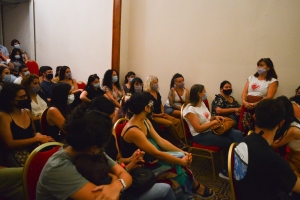
Fundeps participated in a meeting organized by the Córdoba Peasant Movement to exchange perspectives on the defense of life and territories in the face of the ecosocial crisis.

Last Wednesday, September 10, members of Fundeps took part in a day of exchange organized by the Córdoba Peasant Movement (Movimiento Campesino de Córdoba, MCC), within the framework of the visit to the province by the renowned Spanish ecofeminist leader Yayo Herrero. The meeting was held at the Faculty of Social Sciences of the National University of Córdoba and brought together social, academic, and territorial organizations from different provinces. Francisca Fernández Droguett, from Chile’s Movement for Water and Territories (Movimiento por el Agua y los Territorios, MAT), and Carolina Llorens, from the MCC, also participated.

During the event, participants addressed the main challenges posed by the ecosocial crisis and the strategies proposed by eco-territorial feminisms to place life at the center. The presentations invited reflection on the need to question existing power structures, create narratives that appeal to desire and hope, and build possible futures from the present.

In the collective working spaces, participants shared experiences and common concerns, such as the overload of struggles and urgent demands affecting territories, the lack of time for reflection and care, and the tensions between the discourse of a “just energy transition” and the extractivist logics that continue to prevail. In response to this context, the importance of strengthening community ties, sustaining collective spaces, and recognizing care as a political practice was emphasized.

Fundeps’ participation in this meeting is part of our commitment to weaving alliances and promoting dialogue among different agendas and social movements, with the aim of contributing to a just transition that incorporates the voices of those who defend territory and life.

Contact:
Mayca Balaguer, maycabalaguer@fundeps.org

During the months of August and October 2023, from Fundeps, together with the Córdoba Feminist Economy Space and with the support of the Heinrich Böell Foundation and the UPC Extension Secretariat, we carry out the Rethinking the Economy Training Cycle: a feminist perspective. From these meetings we built a guide for Reflection and Transformation.

“Below, we offer a google translate version of the original article in Spanish. This translation may not be accurate but serves as a general presentation of the article. For more accurate information, please switch to the Spanish version of the website. In addition, feel free to directly contact in English the person mentioned at the bottom of this article with regards to this topic”.

In this training cycle we met with a wide diversity of spaces to devise resistance alternatives that put the sustainability of life at the center, among them participated: self-managed organizations, enterprises, cooperatives, unions, academic spaces, workers in the field public-state, civil society organizations, social and feminist movements and interested people in the province.

From this enriching experience that consisted of six instances, we proposed to share a systematization with those interested in embarking on a path of (de)construction on the ways in which we understand and participate in the economy. From a critical perspective, this input seeks not only to understand reality from a complex perspective, but also to contribute to its transformation. To this end, we recover and organize both the theoretical and methodological contributions as well as the reflections, questions and dynamics from which the training meetings were built.

The pedagogical orientation of this guide was designed from a feminist perspective, integrating various tools of popular education, sensitivity and affectivity. It is divided into two parts: the first addresses fundamental conceptual categories to analyze the economy from a feminist perspective; The second includes annexes with activities designed to raise awareness and reinforce said contents. As a closing, some poems are presented that seek to connect the reflections and thoughts developed during the meetings, with our deepest and most sensitive emotions.

In this sense, the guide presents several fundamental conceptual and political contributions, among them: the sexual division of labor and its impact on the labor market; the social organization of care and the reproduction of inequalities; the reconfiguration of statehood from feminist perspectives, including the idea of an Open State. It also covers some bills that represent important precedents for the construction of proposals that could give rise to regulatory frameworks for the recognition of care work in community settings.

This guide, then, becomes a commitment and a political tool to socialize various critical and collective knowledge related to the construction of “another fairer economy” in which we can be participants. We hope that this resource will be useful to generate enriching dialogues between the conceptual assumptions of Feminist Economics and the vital and organizational experiences of those who consult it. We hope that this guide helps to question current living conditions and thus be able to build solid foundations that support and strengthen care practices for the sustainability of life.


DOWNLOAD THE GUIDE HERE


Author
Carola Bertona

Contact
Cecilia Bustos Moreschi, cecilia.bustos.moreschi@fundeps.org

This booklet is a compilation of what we worked on in six meetings held at the Provincial University of Córdoba (UPC) within the framework of the Rethinking the Economy training cycle: a feminist perspective. Between August and October 2023, from Fundeps and the Feminist Economy Space of Córdoba, we carry out this cycle in order to generate a space for mutual learning about the concepts and problems that the Feminist Economy brings us, to devise forms of resistance that put the sustainability of life at the center.

From August 5 to September 30 we will carry out a training cycle on Feminist Economics at the UPC. It is aimed at self-management organizations, enterprises, cooperatives, unions, academic spaces, civil society organizations, social and feminist movements and interested people in the Province of Córdoba.

“Below, we offer a google translate version of the original article in Spanish. This translation may not be accurate but serves as a general presentation of the article. For more accurate information, please switch to the Spanish version of the website. In addition, feel free to directly contact in English the person mentioned at the bottom of this article with regards to this topic”.

Did you know that women dedicate twice as much time as men to domestic and care work, and that this affects them, leading them to situations of greater precariousness and poverty?
We know this data from the contributions of Feminist Economics. This offers a critical perspective that allows us to discuss the limits of conventional economics, recognizing the activities that take place in the realm of “the private” and demonstrating that they are essential for life to happen. It contributes to reflections on the economic aspects of the lives of women and LGTBIQANoBi+ and how they are related to access to their rights.

The critical approach of Feminist Economics allows us to analyze the complexity of economic reality, not only to better understand it but also to transform it. That is why it is a commitment to establish the bases towards “another, fairer economy” in which we can participate.

For this reason, we invite you to participate in a training cycle for mutual learning and critical reflection from the tools provided by the Feminist Economy. It is aimed at self-managed organizations, enterprises and cooperatives, unions, academic spaces, civil society organizations, social and feminist movements and people interested in the subject of the Province of Córdoba.

We hope that this space generates powerful dialogues between the conceptual assumptions of this perspective and the life and organizational experiences themselves, to problematize the living conditions and build foundations that sustain and strengthen experiences that bet on the sustainability of life.

Schedule and contents
The cycle will take place in the City of Arts of the Provincial University of Córdoba, on Saturday August 5, 19 and 26 and September 9, 23 and 30. The meetings will be from 11 a.m. to 4 p.m.
The training is made up of 4 modules organized in a comprehensive and sequenced manner to be able to delve into specific topics and debates at each meeting.

For more information, download the content program 

Inscription
It is possible to enroll in the complete cycle as in 1 or more separate modules. We recommend participation in the entire cycle to have a full and deep understanding of the proposed themes.

Interested persons must register through the following form. We will prioritize the participation of feminized subjects and the LGTTTBIQ+ community.
The registration deadline is July 30 inclusive.

Transfer grants
We will provide transfer scholarships so that distance is not an impediment to participation from different parts of the province of Córdoba.
Because we have a quota of transfer scholarships, we will prioritize those who do not reside in the City of Córdoba and cannot afford transportation.
The application for these scholarships is made through the registration form. We will communicate directly with those who access the scholarship up to a week before the start of the cycle.

Accreditations
People who attend the training, either the full cycle or one of its modules, will receive the corresponding accreditation certificate endorsed by the Feminist Economics Space, Fundeps and the University Extension Secretariat of the Provincial University of Córdoba.

Organized by: Fundeps, Espacio de Economía Feminista and Fundación Heinrich Böll.
Support: Provincial University of Córdoba

More information

Together with the Córdoba Feminist Economy Space and with the support of the Heinrich Boll Foundation, we held the first Provincial Feminist Economy Meeting on September 16 and 17 at the Provincial University of Córdoba. We have the presence of various organizations and self-managed experiences of the Feminist, Popular, Social, Solidarity, and Ecological Economy.

“Below, we offer a google translate version of the original article in Spanish. This translation may not be accurate but serves as a general presentation of the article. For more accurate information, please switch to the Spanish version of the website. In addition, feel free to directly contact in English the person mentioned at the bottom of this article with regards to this topic”.

For two days, self-managed organizations and spaces from other economies shared instances of reflection and discussion around a central axis: Feminist economics and the networks that sustain us.

60 organizations from different locations in the province participated, including neighborhood organizations, enterprises, self-management spaces and women’s groups.

Pending debates, expected meetings

Friday the 16th in the afternoon was the first day that began with the opening of the Meeting. Then, organizations from the province of Córdoba linked to the Feminist, Social and Solidarity, Popular and Ecological Economy presented themselves and shared about their spaces and expectations of the Meeting.

The day closed with an open talk by Analía Ayala and members of the Córdoba Feminist Economy Space, where some guidelines and open debates on Feminist Economy were raised.

The next day, different instances of training, discussion and meeting were proposed through workshops designed by and for the organizations. Months before the Meeting, the members of self-managed organizations were consulted about their training needs and topics of debate in order to jointly create the agenda of workshops that the organizations themselves later dictated.

The day was organized in five workshops, built from the axes proposed by the organizations. The topics addressed were:

  • Introduction to the management of social networks by Aylen Corte and Agustina Ramos from Cortezas del Chañar. Workshop where a small theoretical – practical tour was seen to manage the Instagram of an enterprise. They talked about brand identity (logos, color palette, fonts) and tips to create content and not die trying. In addition, they shared planning tools, aesthetics, valuable content and ideas to upload the algorithms.
  • Self-management brings us together and cooperativism brings us together, energized by Guadalupe Fernández and Julieta Ferreyra from El Resaltador. Workshop that started from the premise “Self-managed spaces as fundamental actors to design and apply, together with the State, public policies that contain us.” and the question “How to generate networks that survive in this attempt?”
  • Transfeminisms and Inclusion: context and experiences of organizations in Córdoba. It was a conversation about the regional and national life context of transvestites, transgenders and transsexuals promoted by ATTTA – MundoSur. The “Diversxs y Segurxs” platform was presented and the actions carried out by ATTTA Córdoba in the framework of trans labor inclusion policies and the challenges still pending were shared.
  • Management tools and costing from a feminist perspective. Here, administrative tools were shared that allow ordering and promoting enterprises and organizations. It was energized by Meli Bossio and Estri Quijada.

Weave the nets that sustain us

Throughout the Meeting, the members of the different self-managed spaces were invited to reflect on cross-cutting questions such as: Why bet on alternative economies that put life at the center? What is an economy that puts life at the center? center? What practices in your space do you think are part of the Feminist Economy? These questions opened the doors to pending conversations and to weaving networks among those who bet day by day on fairer and more equitable ways of organizing work and production.

By way of closing and celebration, a fair was held in which the self-managed spaces that were sharing and building collectively during the two days of the Meeting participated. More than 70 vendors exhibited their products at the fair open to the general public on the UPC campus.

In parallel, Josefina Arroyuelo gave a self-defense workshop in the open air. Finally, the Naciente Candombe collective musicalized the space with drums, bass drums and dance.


Author

Irene Aguirre

Contact

Cecilia Bustos Moreschi, cecilia.bustos.moreschi@fundeps.org


We invite self-managed spaces and organizations from the Other economies to participate in the Provincial Meeting of Feminist Economy. It will be held on September 16 and 17 at the City of Arts (Provincial University of Córdoba).

“Below, we offer a google translate version of the original article in Spanish. This translation may not be accurate but serves as a general presentation of the article. For more accurate information, please switch to the Spanish version of the website. In addition, feel free to directly contact in English the person mentioned at the bottom of this article with regards to this topic”.

From our Feminist Economy agenda, we are committed to strengthening alternative economies that put life at the center, starting from a feminist approach and valuing forms of collective and democratic construction.

For this reason we invite organizations, self-managed spaces, enterprises and cooperatives from Córdoba to the Provincial Meeting of Feminist Economy.

We hope to generate a space that enables dialogues that allow us to recover, share and build knowledge and practices related to the Feminist Economy, in exchange with the Ecological, Popular and Social and Solidarity Economy from the paradigm of the sustainability of life.

Tentative timeline

The Meeting will be held on September 16 and 17 at the City of Arts.

Friday 09/16 – starts at 5:00 p.m.: we will share an instance of dialogue and exchange with referents of the Feminist Economy.

Saturday 09/17 – starts at 9am:
*Morning and siesta: workshops and exchange spaces (subject to change)
Topics: Management of social networks | Public policies (obstacles and opportunities) | Administrative tools for self-management | Transfeminisms | Digital gap*We close with a fair open to all public. Those who attend the meeting will be able to participate in a holiday.


Organize: Fundeps, Espacio de Economía Feminista y Fundación Heinrich Böll.

Support: Universidad Provincial de Córdoba

Adhere: El Resaltador, La Tinta, Ciscsa, Enfant Terrible, Mundo Sur, Unidad Central de Políticas de Género de la Universidad Nacional de Córdoba (UNICEPG), Incubadora Feminista Latinoamericana. 

More information: 

We started the Cooperativism and Labor Organization course within the framework of the Textile Diploma at the UPC (Provincial University of Córdoba).

“Below, we offer a google translate version of the original article in Spanish. This translation may not be accurate but serves as a general presentation of the article. For more accurate information, please switch to the Spanish version of the website. In addition, feel free to directly contact in English the person mentioned at the bottom of this article with regards to this topic”.

Last Tuesday, the first meeting of the workshop on “Cooperativism and Labor Organization” was held, which seeks to enable debates around the logic of labor organizations. Together with the UPC, the first module was given where, throughout the day, topics were presented to rethink the economy and vindicate the identity of the workers of the Social and Solidarity, Popular and Feminist Economy.

The Diploma in Collaborative Processes of Textile Production is an instance of learning, communication and collaboration for all people with an interest in getting involved in textile knowledge from a critical and cooperative perspective proposed in coordination with the Network of Textile Producers of the Province of Córdoba.

This training initiative aims to guide the people involved towards a social and sustainable link with the profession and the trade, providing them with tools for its realization and motivating them to reflect on their practices.

From the work experience of the organizations, we talked about the problems that arise when it comes to sustaining self-managed organization spaces, as well as the strategies used by the different organizations to face the socio-economic crisis.

Throughout the conference, topics related to labor organization will be worked on, such as: administrative and legal tools, tax aspects and more.

Registration is still open at the following link: Enrollment in the Diploma in Collaborative Textile Production Processes


More Information

Contact

Cecilia Bustos Moreschi, cecilia.bustos.moreschi@fundeps.org 


*Picture of Fashion Network

The Feminist Economy, together with the Ecological, Popular, Social and Solidarity Economy (the so-called Other economies) allow us to account for the unsustainability of the logics of inequality and looting that characterize the dominant capitalist and heterocis-patriarchal model. Also, it provides us with tools to identify, make visible and strengthen those that are committed to the sustainability of life.

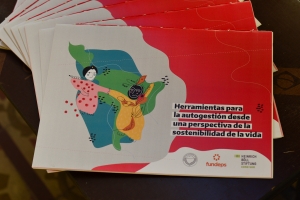
We launched a guide that offers steps and tools for self-managed organizations and enterprises to review their internal management processes and implement good practices with a view to achieving economic sustainability, from the sustainability of life approach.

Below, we offer a google translate version of the original article in Spanish. This translation may not be accurate but serves as a general presentation of the article. For more accurate information, please switch to the Spanish version of the website. In addition, feel free to directly contact in English the person mentioned at the bottom of this article with regards to this topic.

The Feminist Economy, together with the Ecological, Popular, Social and Solidarity Economy (the so-called Other economies) allow us to account for the unsustainability of the logics of inequality and looting that characterize the dominant capitalist and heterocis-patriarchal model. Also, it provides us with tools to identify, make visible and strengthen those that are committed to the sustainability of life.

Based on this position, during the year 2021, together with the Latin American Feminist Incubator and with the support of the Heinrich Böll Cono Sur Foundation, we carried out organizational and economic strengthening work aimed at 7 self-managed organizations and ventures from the Other economies of the province of Cordoba.

The goal was to help strengthen various self-managed experiences in our province through the design, implementation and collective evaluation of strategies and tools for economic sustainability. And thus promote the productive and reproductive processes and activities that they carry out and that aim, in a broader sense, at the sustainability of life.

In the different stages of this strengthening process, we used tools for the diagnosis, planning and management of resources (money, goods, services, time, contacts and networks, etc.) that could be adapted to the needs and forms of organization, and be useful for the evaluation and improvement of the management processes of self-managed organizations. Throughout this experience, we not only tested the proposed strategies and tools, but we were also able to identify interests and needs that require attention.

From this place we reaffirm our commitment to the transformation of situations of inequality through the strengthening of the various self-managed experiences made up mostly of femininity and dissidence and that are part of the Other Economies, in this case, providing resources for that purpose.

We have prepared this guide with tools aimed at self-managed spaces in Other Economies, so that they can review their forms of organization and internal management processes in order to achieve economic sustainability from the perspective of a Feminist Economy that is committed to the sustainability of life. . This material is proposed as a second booklet of resources that we have been making since 2020 in order to strengthen practices and reflections on the Other economies.

The guide is a proposal, a working hypothesis, not an imposition or a rigid structure. They are tools made available for each space to discuss, transform and adapt to their own needs.

An integral and sequenced process was thought of, although not necessarily linear. This allows each organization to choose where to start and what steps to follow, to advance in what they consider relevant or more adjusted to their needs.

We hope it will serve you.

Read resourcer


More information:

To access the first issue with administrative, tax and legal resources for self-managed organizations, read: Tools for self-management from a perspective of the sustainability of life.
Report “Other economies: self-management from a Life Sustainability perspective”.
Cycle Virtual meetings on Feminist Economy.
Audiovisual short films on Feminist Economy and Self-management.

Contact

Cecilia Bustos Moreschi, cecilia.bustos.moreschi@fundeps.org

On December 1, we presented the report “Other economies: self-management from a perspective of Sustainability of Life” together with the Feminist Economy Space of Córdoba and with the support of the Heinrich Böll Southern Cone Foundation. It was a year-end meeting in which we reflected on feminist economics and self-management together with various organizations.

“Below, we offer a google translate version of the original article in Spanish. This translation may not be accurate but serves as a general presentation of the article. For more accurate information, please switch to the Spanish version of the website. In addition, feel free to directly contact in English the person mentioned at the bottom of this article with regards to this topic”.

In the world in which we live, unjust logics of production, work organization and distribution of wealth predominate. They are founded on a neoliberal, colonial and hetero-patriarchal capitalism that legitimizes and sustains inequalities that benefit a few: a male, white, adult, bourgeois, Western, hetorosexual, cisgender around which the entire economy has been organized.Faced with this model that prioritizes markets and the unlimited accumulation of wealth in a few hands, the Other Economies arise. These are constituted, in different measure and form, in real alternatives, and are visible in self-managed organizations of the Feminist, Popular, Ecological, Social and Solidarity Economy. They are characterized by having practices based on mutual support; solidarity and sisterhood; collective support and cooperation; the valuation not only of productive work but also of the work of social reproduction and of life, the recognition of its indivisibility and of its historical feminization and invisibility; the inclusion and care of the life of its members and of nature, avoiding individualistic, selfish and competitive logics that threaten life.

With this north, as of 2020 we have carried out different activities together with organizations and spaces that are committed to a socioeconomic transformation.

2020 was a year of hard work, together with the Córdoba Feminist Economy Space, focused on the production of knowledge based on self-managed experiences and content aimed at making them visible. As a result, we produced the report “Other economies: self-management from a perspective of Sustainability of Life”. We also carry out a cycle of virtual meetings on Feminist Economics in which we reflect, together with organizations and specialists, on the obstacles and possibilities of carrying out and strengthening other logics of production, distribution, consumption and organization of work that are more equitable and focused on persons.

In addition, we built a resource with legal, administrative and tax tools for self-management and four audiovisual shorts. This year, together with the Latin American Feminist Incubator, we carried out a process of internal strengthening of 7 self-managed organizations of the Other Economies of the province of Córdoba, in order to build tools that serve them to advance towards their economic sustainability from a perspective of the Feminist Economics. This implies thinking, building and planning strategies so that, with the available resources, the spaces can carry out sustainable economic processes in the medium and long term, considering and respecting the times of nature as well as the times and needs of its members and of the communities in which they are found.

The event

On December 1, we met to present the aforementioned report “Other economies: self-management from a perspective of the sustainability of life.” This report is the product of a year of research carried out in the middle of the pandemic. Its objective is to begin to know and make visible a small part of the diverse universe of self-managed and community experiences of Córdoba, from the critical perspective that the Feminist Economy offers us, in dialogue with the Popular Economy, Ecological Economy and the Social and Solidarity Economy. That is, from a perspective that aims to subvert the economy and build another that guarantees the provision of everything that is needed for the sustainability of human and non-human life, through economic processes that preserve the planet and are respectful of dignity. human. This approach is that of the Sustainability of Life and we adopt it because it is multidimensional, holistic since it integrates all sustainability: economic, social, ecological, human and the complex and dynamic interrelationships that occur between all of them over time and in specific territories and experiences.

We believe that this perspective has transformative power by allowing us to identify, on the one hand, unequal relations, such as gender, class, racialization processes, among others, which are sustained from biocidal and androcentric logics. But on the other hand, it also helps us to recognize other types of experiences that carry out practices different from those of the dominant economy and that respond to logics typical of Other Economies.

From this place, we understand that the Feminist Economy appears to us as a necessary perspective to think, develop and strengthen alternatives in favor of the sustainability of life since:

  • It opens the debate around what are the limits of what we understand by economy, the role of gender in it and the consequent inequalities.
  • It broadens the concept of work and recognizes the importance of the works that make up the social and life reproduction, In this way it makes visible and puts at the center of the scene the care that makes life possible, proposes its fair distribution, at the same time that conceives us as interdependent people with each other.
  • It questions the foundations of the sexual division of labor.

The report that we present is a synthesis that includes our positioning and also the lines of action in relation to the Feminist Economy agenda that we are building. Agenda that we conceive as strategic and transversal to all of Fundeps since it touches and problematizes all aspects of our life; and from which we generate and strengthen alliances and joint work networks.

The sustainability of life as a path of transformation

We believe that this type of self-managed experiences can provide us with tools and practices to resolve in a more equitable way the inequalities that are sustained at the cost of the invisibility and exploitation of bodies and lives, mainly of feminized identities and sex-generic dissidences, which are deepened in this context of crisis that we are experiencing: climate, health, social, economic, civilizational and care crisis.

Its existence, strategies and forms of organization, production and consumption, have acquired essential importance in local economies, and are presented to a greater or lesser extent and in different ways, as a real alternative to a system based on violence, oppression , impoverishment and in gender, class, ethnic-racial, age, etc. inequalities.

This does not happen without tensions or nuances since there are different positions and actions taken by these spaces in relation to the State and the predominant capitalist logic. The universe of self-management is extremely broad and heterogeneous. These spaces, like any other, are not exempt from the logic of structural inequality that can even be reproduced inside. However, they have favorable conditions to carry out various practices oriented to the Sustainability of Life, by subverting these situations of looting and inequality.

If we want a democratic and more equitable solution, a transformation, a paradigm shift and a system change that recognizes and strengthens self-managed spaces with the logic of Other Economies that undertake feminized identities and dissidents is urgent and necessary, so that their lives and of their communities are dignified and sustainable. This implies a commitment to profoundly transformative proposals that commit all social actors.

For this, the articulation of local and regional initiatives that aim to this end, and that allow the generation of data, information gathering, visibility, organization, articulation and enhancement of their activities is relevant. We know that what sustains us are networks, so let’s expand, enhance and strengthen them.

Contact

Cecilia Bustos Moreschi, cecilia.bustos.moreschi@fundeps.org

Together with the Provincial University of Córdoba (UPC), we began a mapping of training needs of organizations of the Popular, Feminist, Social and Solidarity Economy of the province. The results will be reflected in training proposals adjusted to the requirements of these spaces.

“Below, we offer a google translate version of the original article in Spanish. This translation may not be accurate but serves as a general presentation of the article. For more accurate information, please switch to the Spanish version of the website. In addition, feel free to directly contact in English the person mentioned at the bottom of this article with regards to this topic”

In order to collect the most relevant and common problems that arise when sustaining these organizations, this survey will result in the design and delivery of training proposals that arise from their own needs.

We bet on the collective construction of knowledge and we value the situated proposals that are significant for organizations that build and sustain the local economy, from alternatives to the logics of looting and capital accumulation.

Therefore, if you are part of or know of any of these organizations, we invite you to complete and / or share the form. So that we can develop a relevant, meaningful and coherent training proposal with your needs.

ACCESS THE FORM

Contact

Cecilia Bustos Moreschi, cecilia.bustos.moreschi@fundeps.org
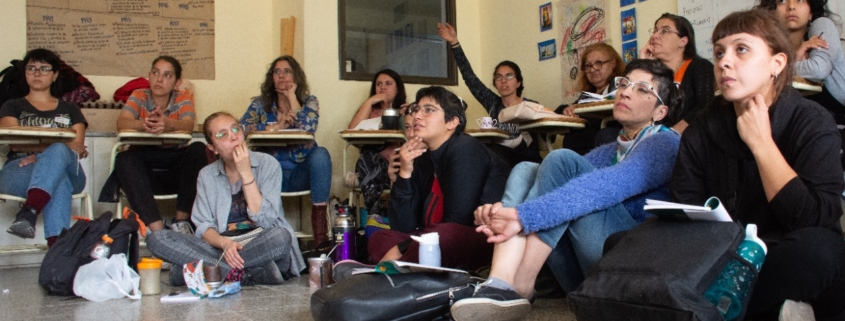
Together with the Latin American Feminist Incubator, we advanced in the process of strengthening the self-managed and community organizations of the province of Córdoba that were selected after the call for scholarships.

“Below, we offer a google translate version of the original article in Spanish. This translation may not be accurate but serves as a general presentation of the article. For more accurate information, please switch to the Spanish version of the website. In addition, feel free to directly contact in English the person mentioned at the bottom of this article with regards to this topic”

The call for scholarships to strengthen self-managed and community organizations in Córdoba ended on May 14 with 67 registered organizations from across the province. The number of organizations that applied for this call reveals two trends. On the one hand, the large number of self-managed spaces of the Popular, Feminist, Ecological, Social and Solidarity Economy that exist in the province and that show that Another economy exists and is possible. However, and here is the other trend, the need for comprehensive public policies that promote them is notable.

All the spaces that were nominated show a diversity of organizational forms and self-managed activities that represent a great contribution to the community and local economies, which made the selection process an arduous instance full of reviews and discussions.

Following the selection and priority criteria announced in the call, we selected 7 beneficiary organizations for a total grant: Aquelarre VCP, Comadres, Mercado Coop, MEPA, Hacé Pinta, Mokitas and Alternativa Marginal. We will be working together with them until October in an intense strengthening process.

Between May and June, we began a diagnostic process that consisted of a self-diagnosis survey and then a personal interview with each organization to identify their perceptions and realities regarding the obstacles and particular strengths that each of them has identified. This stage is fundamental as it allows to recognize, project, and build an economic sustainability plan based on the own experiences, desires, needs, realities and expectations of each organization.

From July to September, we will advance with the strengthening process itself, consisting of a series of trainings, practical application workshops, personalized meetings with members of each organization, and mentoring. This stage is the central node of the strengthening process for the economic sustainability of these organizations. Throughout this stage, spaces for meeting and joint construction will be generated, sharing interests, positions, projects and knowledge, in pursuit of the economic sustainability of the selected organizations.

We hope that, through this project and together with the different self-managed organizations selected, we can advance in the construction, implementation and evaluation of tools for the diagnosis, planning and management of resources so that a self-managed space not only sustains itself financially but also collaborate in the sustainability of the lives of its members.

More info:

Contact:
Cecilia Bustos Moreschi, cecilia.bustos.moreschi@fundeps.org
Incubadora Feminista, hola@incubadorafeminista.com