• ES
  • EN
Fundeps
  • About Fundeps
  • Team
  • Working areas
    • Environment
    • Democracy
    • Gender
    • Global Gorvernance
    • Health
  • News
  • Publications
  • DONATE
  • Click to open the search input field Click to open the search input field Search
  • Menu Menu
Media

Federation wants 1.9 million hectares less

The Province called a table to update the map of law 9.814. The different positions of the rural sectors and the environmentalist and ecological NGOs do not reach an agreement that allows to raise a project. According to expert studies, the province has 3.6 million hectares of native forest.

“Below, we offer a google translate version of the original article in Spanish. This translation may not be accurate but serves as a general presentation of the article. For more accurate information, please switch to the Spanish version of the website. In addition, feel free to directly contact in English the person mentioned at the bottom of this article with regards to this topic.”

As in 2009, when the law that created it was enacted, the territorial planning of the native forests (OTBN) of Cordoba continues to pose irreconcilable differences between the rural sector and environmentalism.

This year, the Province convened a table to update the map of Law 9.814, which paints these ecosystems in three colors, according to their state of conservation and permitted activities. But in this space, the different positions of the rural sectors and environmentalist NGOs and environmentalists do not reach an agreement that allows to raise a consensual project for the Legislature to approve.

A few days ago, the Argentine Agrarian Federation (FAA) made clear its position that Cordoba’s OTBN is “oversized” and requires a sincere.

“We believe that the forest cover ‘native forest’ in the province should not exceed two million hectares, corresponding to the red category between 500 thousand and 600 thousand, and to the yellow category around 1.5 million hectares,” a document Presented at this dialogue table. But according to expert studies, the province has 3.6 million hectares of native forest, or 1.6 million hectares more than the FAA.
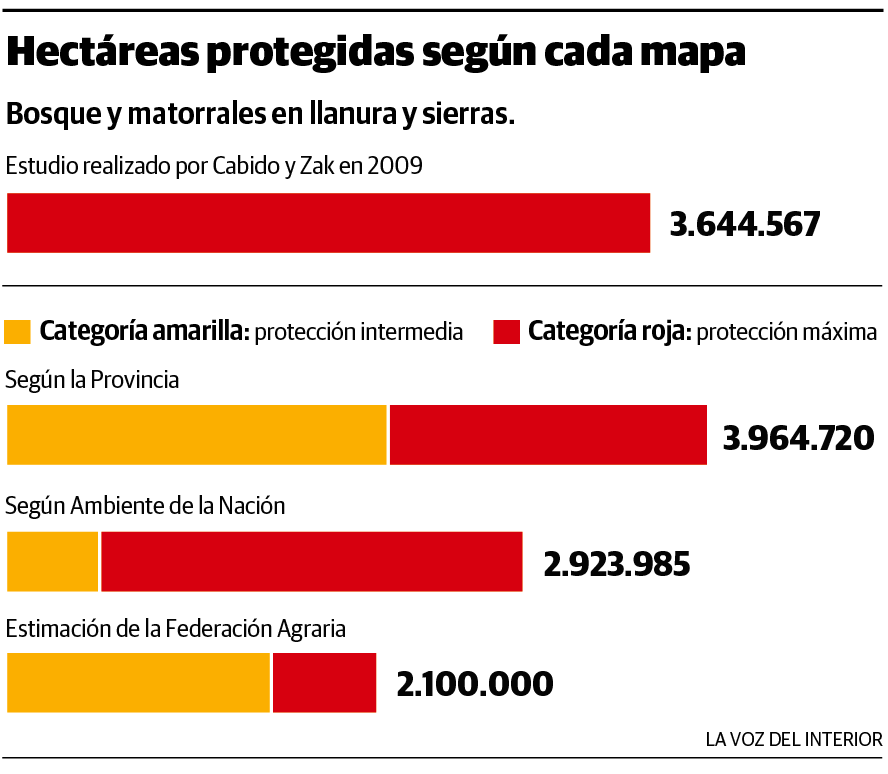
The work was carried out in 2009 by the ecologists Marcel Zak and Marcelo Cabido, and it is the scientific study of the native forest more detailed Cordobés to date. The count includes open forest, scrub in different states and halophyte ecosystems (saline environments).

The current provincial map adds four million hectares, that is 1.9 million hectares more than the idea of ​​the FAA. “The very serious distortions that originated in the initial map and throughout the regulatory stage of the law plus arbitrary and discretionary management by the enforcement authority resulted in a misclassification of conservation categories,” they point out from the FAA.

One of the FAA’s arguments for reducing the protected area is the same as the one outlined by the Confederation of Rural Associations of the Third Zone (Cartez) a few weeks ago: the human being must manage the land with degraded autochthonous environments such as scrubland, For the forest to return.

Environmentalists argue that these shrubs provide most of the ecosystem services by which the law decided to protect forests such as maintaining soil fertility, regulating water and climate and sequestering carbon dioxide responsible for climate change.

“To want to exclude vegetation structures from the OTBN simply because they have not reached their state of maximum tree development is not correct, according to the criteria proposed by the different resolutions,” said a document signed by members of the Cordoba Environmental Forum, the Peasant Movement of Cordoba , The Foundation for the Development of Sustainable Policies (Fundeps), several institutes of the National University of Córdoba and the Conicet. They also argue that the law does not allow recategorization to classifications of lower value, as they propose from the rural sector.

The ruralists want silvopastoral production. Environmentalists argue that silvopastoral activity in the yellow zone should be subject to an environmental impact assessment process and that the law does not allow the selective clearing or implantation of exotic pastures.

Fuente: La Voz del Interior

30 de November de 2016
https://fundeps.org/wp-content/uploads/2016/09/Federacion-Agraria-quiere-19-millones-de-hectareas-menos-1.jpg 400 772 Fundeps.org https://fundeps.org/wp-content/uploads/2026/04/logo-2026-300x120.png Fundeps.org2016-11-30 13:29:252024-06-30 17:35:21Federation wants 1.9 million hectares less
News

Participating in the ESCR-Net’s Global Strategy Meeting

On 15-19 November, 2016, over 100 social movements, civil society organizations and advocates will come together across more than 40 countries to confront global systems that perpetuate inequality, impoverishment and dispossession, explore alternatives that ensure collective well-being and build a global movement to make human rights and social justice a reality for all.

“Below, we offer a google translate version of the original article in Spanish. This translation may not be accurate but serves as a general presentation of the article. For more accurate information, please switch to the Spanish version of the website. In addition, feel free to directly contact in English the person mentioned at the bottom of this article with regards to this topic”

Human rights provide a vital source of political, moral and legal legitimacy for the pursuit of justice, self-determination and shared well-being. This framework unites ESCR-Net members in over 75 countries, where they work together to ensure accountability of governments and private actors, articulate alternative development models, promote substantive equality for women, advocate for rights Relating to land and natural resources, to strengthen litigation and implementation guided by affected communities, as well as to facilitate access and strategic use of information to promote ESCR.

Throughout this week, the different working groups of the network will discuss the challenges that the global context presents for the guarantee of ESCR. The growing impoverishment of citizenship, corporate capture of the state, growing inequality, degradation of ecosystems and repression of human rights activists; Are the faces of a system that still has a debt to human rights. The program gives an account of the variety of actions carried out by the network in the many countries in which it works.

On Tuesday, 15 November, the ESCR-Net opened its Global Strategy Meeting with more than 150 participants from more than 40 countries. The day highlighted the great responsibility of those who make up the ESCR-Net, in light of the common global conditions that pose a serious threat to human dignity and the potential of collective action throughout the world. Prior to defining the overall objectives of the Network for the next five years, participants assessed the collective work of the three previous ones through brief reports from the Corporate Accountability, Economic Policy, Monitoring, Strategic Litigation, and Women and ESCR, as well as the Solidarity System.

From FUNDEPS we participate in this meeting, seeking to coordinate our actions and strategies with those of the global network, aware that only a coordinated and collective effort will be able to face the great challenges of human rights, especially economic, social and cultural rights.

More information

– Website of the ESCR-Net Global Strategy Meeting

– Program of the ESCR-Net Global Strategy Meeting

– Participants of the ESCR-Net Global Strategy Meeting

Contact

Agustina Palencia – agustinapalencia@fundeps.org

Carolina Tamagnini – carotamagnini@fundeps.org

Agustina Mozzoni – agustinamozzoni@fundeps.org

17 de November de 2016
https://fundeps.org/wp-content/uploads/2016/11/c-1.jpg 330 750 Fundeps.org https://fundeps.org/wp-content/uploads/2026/04/logo-2026-300x120.png Fundeps.org2016-11-17 14:51:082024-06-30 16:04:12Participating in the ESCR-Net’s Global Strategy Meeting
Democracy, News

Participation in the Regional Meeting of Subnational Entities by the Open Government

Last Thursday, November 10, the first meeting of subnational entities framed in the partnership for open government (Open Government Partnership) was held. Organized by the government of the city of Buenos Aires, it was attended by representatives of the OGP, government authorities and representatives of civil society.

“Below, we offer a google translate version of the original article in Spanish. This translation may not be accurate but serves as a general presentation of the article. For more accurate information, please switch to the Spanish version of the website. In addition, feel free to directly contact in English the person mentioned at the bottom of this article with regards to this topic.”

Within the framework of the Subnational Pilot Program of the Open Government Partnership, the government of the City of Buenos Aires together with the National Institute of Transparency, Access to Information and Protection of Personal Data (INAI Mexico); They organized a day that summons both governmental authorities of Argentina and other nations, as well as members representing civil society.

The pilot program allows OGP to drive successful innovations developed at the local level. The driving force of this project is the belief that the closeness that local governments have to citizenship will be able to boost open government initiatives at national levels. In April 2016, the selection of 15 local governments to participate in the program was announced, including the city of Buenos Aires. In the next two years participating governments will work together with local civil society organizations to develop specific commitments to open government.

Throughout the day, different speakers presented experiences, lessons learned and challenges in the future of the implementation of open government policies in local spaces. It was a day that allowed the different social actors to acquire new knowledge and debate about the future of new ways to build a more participatory and equitable democracy.

Contact:

Agustina Palencia – Coordinator of the Democratic Strengthening Area

agustinapalencia@fundeps.org

13 de November de 2016
https://fundeps.org/wp-content/uploads/2017/06/5-1.jpg 330 750 Fundeps.org https://fundeps.org/wp-content/uploads/2026/04/logo-2026-300x120.png Fundeps.org2016-11-13 18:32:522024-06-30 16:04:12Participation in the Regional Meeting of Subnational Entities by the Open Government
Global Governance, News

Call for nominations to form the ICIM External Consultative Group

The Independent Consultation and Investigation Mechanism (MICI – acronym in Spanish) of the Inter-American Development Bank Group (IDB Group) opened a calling on nominations for members of the Mechanism´s External Consultative Group (GCE – acronym in Spanish). Applications can be made until November 30, 2016.

“Below, we offer a google translate version of the original article in Spanish. This translation may not be accurate but serves as a general presentation of the article. For more accurate information, please switch to the Spanish version of the website. In addition, feel free to directly contact in English the person mentioned at the bottom of this article with regards to this topic”

On November 3, and after a period of consultations that extended over the last months, the Independent Consultation and Investigation Mechanism (MICI) of the Inter-American Development Bank (IDB Group) opened the call for nominations to form the External Advisory Group (GCE) of the Mechanism. The purpose of the CGE is to support the ICIM’s commitment to fulfilling its accountability mandate in a credible, effective and transparent manner.

The MICI distributed the GCE Conceptual Note in early June 2016 to a wide range of stakeholder groups, including representatives of civil society, government officials and civil society experts. From Fundeps we contributed in this process sending comments and participating in a series of consultations regarding the Concept Note. While we recognized and welcomed this initiative, in part, in response to the suggestions provided in the publication “Glass Half Full: The state of accountability in development finance“; We also make a number of recommendations and suggestions regarding the membership, composition and objectives and functions of the CGE (for full comments on the CCE Concept Note sent to the ICIM, access here)

The MICI recently released the Report on the Consultation Process for the CGE, which contains all the feedback received and the ICIM’s replies. In turn, this feedback was incorporated into the CGE’s Operating Procedures, which contain information about membership composition, member responsibility, and the process for selecting members, including selection criteria.

Candidates interested in applying for the CGE must submit the following information:

– Curriculum vitae.

– An Interest expression of a page expressing the reason why they wish to serve in the CGE and how their experience will add value to the group.

The application must be sent no later than November 30 to John Garrison of MICI at jgarrison@iadb.org. The names and profiles of those selected as members of the CGE will be published in mid-December.

More information:

– Operational Procedures – MICI External Advisory Group (GCE) – October 3, 2016

– Conceptual Note for External Consultative Group. Draft Proposal for Consultation – June 6, 2016

– Comments on the Draft Conceptual Note for the formation of an ICIM External Advisory Group – July 29, 2016

– Report of the Consultation Process on the ICIM External Consultative Group – September 30, 2016

– Glass Half Full. The state of accountability in development finance – January 2016

– MICI website

Contact

Gonzalo Roza / Coordinator of the Global Governance Area

gon.roza@fundeps.org

10 de November de 2016
https://fundeps.org/wp-content/uploads/2017/06/bid-1.jpg 330 750 Fundeps.org https://fundeps.org/wp-content/uploads/2026/04/logo-2026-300x120.png Fundeps.org2016-11-10 18:14:502024-06-30 16:04:12Call for nominations to form the ICIM External Consultative Group
News

Public Hearing to develop the Office for Dialogue and Participation

Last Friday March, 18th in Cordoba, Argentina, the Provincial Parliament together with Fundeps organized a public hearing to discuss the Law project that intends to develop an ‘Office for Dialogue and Citizen Pariticipation in the National Congress’.

The conference began with a presentation by the Executive Director of FUNDEPS, César Murúa, who spoke briefly about the National Deputies present at the Hearing and explained the dynamic of the meeting.

The Deputy of the Civic Coalition (CC) Héctor “Toty” Flores, one of the bill’s signatories, explained clearly what it covered; he emphasized that the idea of the bill is to create a space within the scope of Congress which allows society a further tool for participation, seeking greater interaction between legislative activity and the issues on which they work with many Organizations throughout the country.  At the same time, they are looking to strengthen the work of the national legislators by having a source of material and intellectual resources available from Civil Society.

The Deputy, Griselda Baldata (CC), amongst other questions, commented on a similar matter which was thwarted in the Province of Córdoba some years ago, which highlighted the importance of joining together and promoting this bill, in order to generate shockwaves which would see this Office replicated throughout the provinces of the Argentine Republic. The leader, Laura Judith Sesma (CC) made a particular point on the idea of embedding the creation of the Office within the Regulations of Congress, with the aim of making it more effective and efficient in carrying out its duties, through the guarantee afforded by the Internal Regulation of the two Chambers.

The representatives of the various Civil Organizations present explained their opinions in respect of the Bill proposing the creation of the Office.

The Hearing is part of a framework of hearings and meetings to be carried out with various organisations and academic bodies in order to improve and enhance the content of the bill, making suggestions and proposals on the text already produced.  The first hearing took place in December 2010 in Congress.  More than 250 people, representing more than 90 organizations, took part in this hearing.

To follow the Hearing process and keep up-to-date on the progress of the bill, click here.

To read the full text of Bill No. 4397-D-2010 on the “Creation of the Office for Dialogue, Participation and Citizen Relations with Congress, within the scope of the National Congress”,Click here.

Document:

Bill for the Creation of the Office of Dialogue and Citizen Participation in Congress

Translated by Katherine Wingfield-Dobbs

8 de November de 2016
0 0 Fundeps.org https://fundeps.org/wp-content/uploads/2026/04/logo-2026-300x120.png Fundeps.org2016-11-08 17:51:202024-06-30 16:04:12Public Hearing to develop the Office for Dialogue and Participation
Democracy, News

What left the VI Forum Our Cordoba: an agenda for metropolitan area

During the Tuesday November 1 it was held the VI Forum Our Cordoba organized by the Citizen Network Our Cordoba. The event brought together representatives of civil society organizations and government authorities to discuss the issues that the greatest impact on the metropolitan agenda of our city and province.

“Below, we offer a google translate version of the original article in Spanish. This translation may not be accurate but serves as a general presentation of the article. For more accurate information, please switch to the Spanish version of the website. In addition, feel free to directly contact in English the person mentioned at the bottom of this article with regards to this topic”
The event organized by the Citizen Network Córdoba Our purpose was to bring together representatives of civil society and government authorities to discuss those issues that have originated in the metropolitan sprawl of the city of Cordoba. With the form of panel discussions, issues relating to land use planning, management of municipal solid waste (MSW) and transport and mobility were discussed. Discussions were more than enlightening, and conclusions will then be amalgamated in a document that will be shared with municipal and provincial authorities.

Since FUNDEPS consider the consequences of the territorial and urban sprawl – metropolization turned-processes – necessarily require good governance and management of cities for social and economic progress. Also, the context is complex and requires coordination between actors to generate enough holistic policies and effective.

The peripheral growth of cities extends the urbanized beyond the limits of the municipal area, generating a great urban space that forces extend infrastructure networks, increases the costs of displacement of people and goods and production costs and maintenance of public services. In scenarios of decentralization to local levels – as has happened in our country – the complex task of transferring functions and resources generally weak institutions, it is bewildered with the problems of interjurisdictional coordination in providing services and managing the development of recent conurbations. These problems manifest themselves in a variety of areas that are crucial for economic development and welfare of the population relevance. Many of them were discussed in the day on November 1.

Discussions about the axis of land management resulted in the identification of urgency to achieve a concrete determination of municipal ejidos and plan urban expansion of the city. Also it joined the discussion an edge environmental court where the need to mitigate the impacts of the expansion, safeguard heritage (native forests) and establish clear regulations regarding the disposal of soils was detected.

As for the management of urban solid waste, complexity for interjurisdictional and intersectoral coordination was emphasized, while it is necessary to regulate the regulations regarding the RSU.

The results of the debate have been the mirror of the concerns of civil society around the management of the city of Cordoba and its metropolitan area. Urban planning and sustainable development of cities go hand in hand, and in line with it, good quality infrastructure and basic services becomes crucial.

More information:

– More discussions on the real estate project “Arts District” in the former Battalion 141 – FUNDEPS

– Participation in discussions on the legal framework of forest in Córdoba – FUNDEPS

– He began the work of trunk pipelines in Cordoba – FUNDEPS

Contact:

Agustina Palencia – Coordinator of the Democratic Strengthening

agustinapalencia@fundeps.org

4 de November de 2016
https://fundeps.org/wp-content/uploads/2017/06/xz-1.jpg 330 750 Fundeps.org https://fundeps.org/wp-content/uploads/2026/04/logo-2026-300x120.png Fundeps.org2016-11-04 20:10:352024-06-30 16:04:12What left the VI Forum Our Cordoba: an agenda for metropolitan area
Health, Publications

Reporte sombra para el Comité de la CEDAW – Mujeres y consumo de tabaco – Noviembre 2016

Control del tabaco en Argentina: tareas pendientes para proteger la salud de las mujeres. Participamos y apoyamos la elaboración de un informe realizado por la Fundación Interamericana del Corazón, FEIM, ALIAR y el Instituto O’Neill de la Universidad de Georgetown, sobre las políticas públicas sobre control de tabaco que actualmente permiten el desarrollo de estrategias de la industria dirigidas especialmente a mujeres. El mismo fue presentado en la 65ª sesión del Comité para la Eliminación de la Discriminación contra la Mujer, con el propósito de destacar las obligaciones del Estado en la protección de la salud de las mujeres. El reporte aborda las falencias del Estado Argentino en la protección de las mujeres y niñas de las consecuencias de la epidemia del tabaquismo.

Descargar Documento / Download File
1 de November de 2016
https://fundeps.org/wp-content/uploads/2017/09/resumen-cedaw-espanol.cdr_-1.png 390 976 Fundeps.org https://fundeps.org/wp-content/uploads/2026/04/logo-2026-300x120.png Fundeps.org2016-11-01 22:22:382024-06-30 15:56:10Reporte sombra para el Comité de la CEDAW – Mujeres y consumo de tabaco – Noviembre 2016
Gender

Reporte sombra para el Comité de la CEDAW – Mujeres rurales e indígenas – November 2016

Acceso a los recursos naturales de las mujeres rurales en la región del Gran Chaco Argentino. Participamos y apoyamos la elaboración de un informe realizado por la Fundación Plurales, en coalición con Fundapaz, Redes Chaco y otras, sobre el acceso a los recursos naturales de las mujeres rurales y campesinas del Gran Chaco Americano, contemplando su vinculación con otros derechos interrelacionados. El mismo fue presentado en la 65ª sesión del Comité para la Eliminación de la Discriminación contra la Mujer.

Descargar Documento / Download File
1 de November de 2016
https://fundeps.org/wp-content/uploads/2017/09/Reporte-sombra-para-el-Comite-de-la-CEDAW-Mujeres-rurales-e-indigenas-1.jpg 831 988 Fundeps.org https://fundeps.org/wp-content/uploads/2026/04/logo-2026-300x120.png Fundeps.org2016-11-01 22:19:502024-06-30 15:44:58Reporte sombra para el Comité de la CEDAW – Mujeres rurales e indígenas – November 2016
Gender

Reporte sombra para el Comité de la CEDAW – Violencia Mediática – November 2016

Estuvimos presentes en la 65ª sesión del Comité para la Eliminación de la Discriminación contra la Mujer, en la que se presentó el resultado del trabajo realizado sobre violencia de género y políticas públicas de comunicación. Este informe fue realizao por FUNDEPS, junto con la Asociación Civil Comunicación para la Igualdad, enfocándose en el grado de cumplimiento de Argentina del artículo 5 de la Convención, que compromete a los Estados a la eliminación de los patrones socioculturales que perpetúen la inferioridad de la mujer en comparación al hombre.

Descargar Documento / Download File
1 de November de 2016
https://fundeps.org/wp-content/uploads/2017/09/Reporte-sombra-para-el-Comite-de-la-CEDAW-Violencia-Mediatica-1.jpg 831 988 Fundeps.org https://fundeps.org/wp-content/uploads/2026/04/logo-2026-300x120.png Fundeps.org2016-11-01 22:16:462024-08-06 23:11:27Reporte sombra para el Comité de la CEDAW – Violencia Mediática – November 2016
Environment, News

Participation in discussions on the legal framework of native forests in Córdoba

As part of Environment Forum Cordoba, FUNDEPS participated with other institutions recognized technical, in preparing a proposal on updating of native forests in the province of Cordoba, which seeks to overcome the weak arguments proposal Cartez (Confederation of Rural Associations Third Zone).

“Below, we offer a google translate version of the original article in Spanish. This translation may not be accurate but serves as a general presentation of the article. For more accurate information, please switch to the Spanish version of the website. In addition, feel free to directly contact in English the person mentioned at the bottom of this article with regards to this topic”

As the National Law No. 26,331 of Minimum Standards for Environmental Protection of Native Forests and its Regulatory Decree No. 91/2009, each province should make its Native Forest Planning and updated every five years through a participatory process and according to environmental sustainability criteria set out in its articles and annex.

The province of Cordoba sanctioned the Provincial Land Use Law of Native Forests No. 9814 on August 5, 2010, in a process in which the participatory body that guaranteed the national law was not respected. The maturity of these regulations occurred on 5 August 2015. Our province faces a duty to update its regulations, seize the moment to meet the minimum standards established by national law; and ensure wide participation of different social actors in this new process of building the land management of native forests.

This process is strictly in updating the vector map approved by Law 9814, which recognize that the amount of remaining native forests in the province, establishing different conservation categories (Category I (red), Category II (yellow) and Category III (green)). This categorization will be done depending on the environmental value of the different units of native forest and environmental services they provide, such as avoiding floods, desertification of soils, elevation of groundwater, drought, effects and impacts of climate change, extinction of native flora and fauna, etc.

The proposal made with Environment Forum Cordoba, Core DiverSus Research on Diversity and Sustainability, the Multidisciplinary Institute of Plant Biology (CONICET-UNC), the IDEA Civil Association, the Institute for Diversity and Animal Ecology (CONICET-UNC) and the Centre Ecology and Renewable Natural Resources (FCEFyN, UNC) is entitled “Why is it necessary to keep the surface of native forests with Category I (Red) in the province of Cordoba as the vector map of the Act 9814? critical analysis of the proposal Land Management of Native Forests for the Northwest Córdoba arc “produce Store preserving and producing” developed by Cartez “. The aim in the document is to refute environmental, legal and social foundations proposal Cartez unreasonably argues that the Category II (yellow) is better than Category I (red) to protect and preserve the native forest, starting this proposal a conceptual interpretation is all wrong and contrary to the objectives and budgets of the National Law 26,331 and the Provincial Law 9814 lights.

From FUNDEPS, we hope that this process involves as many actors in society because of the importance that implies the protection and conservation of native forests. We also hope that the upgrade process guarantees the principle of non-environmental regressivity and respect for the rights of environmental democracy, including access to information and citizen participation enshrined in the Rio Declaration on Environment and development 1992.

More information:

– Working Paper: Why is it necessary to keep the surface of native forests with Category I (Red) in the province of Cordoba as the vector map of the Act 9814?

– La Voz del Interior: “Again the debate on how much can be removed hardens” (10/28/2016)

– Response to FAA on OTBN – Cordoba Environmental Forum (November 2016)

Contact:

María Elena Martínez Espeche, Coordinadora del Eje Ambiente.

malemartinez@fundeps.org

31 de October de 2016
https://fundeps.org/wp-content/uploads/2017/06/bosques_4-1.jpg 330 750 Fundeps.org https://fundeps.org/wp-content/uploads/2026/04/logo-2026-300x120.png Fundeps.org2016-10-31 15:51:592024-06-30 16:04:13Participation in discussions on the legal framework of native forests in Córdoba
News

FUNDEPS presented report at the 65th session of the United Nations CEDAW Committee

Our team will be present at the 65th session of the Committee on the Elimination of Discrimination against Women, in which the result of work done on gender violence and public policy communication will be presented.

The Committee on the Elimination of Discrimination against Women is a body of independent United Nations experts that monitors implementation of the Convention on the Elimination of All Forms of Discrimination Against Women (CEDAW English). All States parties must submit periodic reports to the Committee to account for compliance with international obligations assumed by signing CEDAW.

Organizations of each country, according to their experience and work performed, can submit a “shadow report” to account for the reality of women in the state, so that the Committee have the necessary for the development of tools the final recommendations made.

The report presented by FUNDEPS, along with the Civil Association for Equality Communication, focuses on the degree of compliance of Argentina Article 5 of the Convention, which commits States to “Modify the social and cultural patterns of conduct of men and women, with a view to achieving the elimination of prejudices and customary and all other practices which are based on the idea of ​​the inferiority or superiority of either of the sexes or on stereotyped roles practices of men and women. ”

The data provided in this “report shadow” are the result of monitoring of public communication policies and gender, in force in Argentina, which was made using requests for access to information, surveys and interviews with members of organizations, and monitoring media by the signatory organizations. This monitoring was reflected in the publication entitled “Gender violence and public communication policies“.

Also, our teams participated in and supported the development of two reports: one submitted by the InterAmerican Heart Foundation, FEIM and other organizations on public policy on the control of snuff that currently allow the development of industry strategies aimed specifically at women; and another by the Plurales Foundation in coalition with Fundapaz, Chaco and other networks on access to natural resources by rural and peasant women of the Gran Chaco.

More information:

– Publication: “Gender violence and public communication policies”

– Shadow report to the CEDAW Committee

Contact:

Virginia Pedraza – Coordinadora del Área de Derechos Humanos – Eje de género y diversidad sexual

vir.pedraza@fundeps.org

28 de October de 2016
https://fundeps.org/wp-content/uploads/2017/06/informe_sombra_para_el_comite_de_la_cedaw-1.jpg 330 750 Fundeps.org https://fundeps.org/wp-content/uploads/2026/04/logo-2026-300x120.png Fundeps.org2016-10-28 13:20:142024-06-30 16:04:13FUNDEPS presented report at the 65th session of the United Nations CEDAW Committee
News

Lack of information from the World Bank Project on non-communicable diseases

On June 11, 2015, the World Bank Board approved a project to Argentina for a 350 million dollars in the health area. This project focused on the Protection of Vulnerable Population against NCDs, supported the strategy of the Ministry of Health for these diseases, in search of improved the access to prevention and control services to 3.2 million adults between 40 and 60 years who takes greater risks. We presented a request for information to the World Bank because of the lack of official information project and the non-reply from the Ministry of Health of the Nation and the province of Cordoba.

“Below, we offer a google translate version of the original article in Spanish. This translation may not be accurate but serves as a general presentation of the article. For more accurate information, please switch to the Spanish version of the website. In addition, feel free to directly contact in English the person mentioned at the bottom of this article with regards to this topic”

Noncommunicable diseases such as cardiovascular disease, cancer and chronic respiratory diseases are responsible for 81% of deaths in Argentina. However, a considerable part of these diseases can be prevented or controlled, reducing risk factors, among which we can find: a diet with excess sugars, refined flour, fat and salt, and low fiber intake; overweight and obesity; snuff consumption; hypertension; and a high level of blood glucose.

The project aims to work to improve the capacity of primary care to provide quality services in early detection and continuous monitoring of obesity, hypertension, diabetes and chronic obstructive pulmonary disease. Added to that, at provincial and municipal level are expected to perform aimed at promoting healthy diets, promoting physical activity and consumption of snuff control interventions.

Despite the importance of the project from the Ministry of Health of the Nation, it has only produced an early report, but it has not been updated, or have incorporated references to the way it is being implemented.

In this context, from FUNDEPS -together with FIC Argentina- present public information requests to the agencies of the Ministry of Health of the Nation, to learn about the progress of the project. Likewise, we consulted about the existence of instances of citizen participation and if the project monitoring mechanisms are foreseen by Civil Society Organizations.

In addition, information particularly referred to the contribution of funds requested by YPF, as expressed in the portal of the Government of the Province of Tierra del Fuego.

Finally, given the lack of response by the Ministry of Health of the Nation, we request the information by the means provided to apply directly to the World Bank, financer of the project.

Lack of information undermines its objectives and hinders proper coordination with provincial authorities. Of journalistic sources it is known that some governments have deposited more funds are not enabled to run.

From FUNDEPS as members of the Argentina Coalition for the Prevention of Non-Communicable Chronic Diseases with other organizations that share the mission to work in preventing these diseases from different perspectives (medical, consumer, human rights, advocacy, academic ) we are monitoring this project.

More information:

– The Minister of Health of the Nation received the Governor of Tierra del Fuego (Prensa Tierra del Fuego – 19/05)

– Ricardo Cardozo manages resources to the nation for the Province (Diario La Republica 13/09)

– Investment of U $ S 437 million in protection against chronic noncommunicable diseases (Telam 08/10)

Contact:

Franco De Grandis, francodegrandis@fundeps.org

María Victoria Gerbaldo, victoriagerbaldo@fundeps.org

27 de October de 2016
https://fundeps.org/wp-content/uploads/2017/06/15285_imagen-1.jpg 330 750 Fundeps.org https://fundeps.org/wp-content/uploads/2026/04/logo-2026-300x120.png Fundeps.org2016-10-27 13:17:132024-06-30 16:04:13Lack of information from the World Bank Project on non-communicable diseases
Page 2 of 41234

Tags

Access to Information Access to Justice BID Chinese Investments Citizen Participation Democracy ENTs Environment Environmental Democracy Gender Global Governance Health Healthy nutrition IFIs Infrastructure Financing Legal Interruption of Pregnancy Sexual and Reproductive Rights Social and Environmental Standards Tobacco Control Transparency
See all tags

Acuerdo de Escazú

Emergencia Agroquímica

MOCI - monitoreo ciudadano en proyectos de infraestructura

{el entramado} Contamos historias. Acercamos Realidades.

Instagram

fundepsargentina

Trabajamos para que se garanticen los derechos humanos 🌱⚖️🗣️🌈💜🚭🍎
Promovemos la equidad de #genero, el derecho a la #salud y un #ambiente sano.

Este viernes 31 de julio realizamos un nuevo encue Este viernes 31 de julio realizamos un nuevo encuentro de formación en derechos sexuales y (no) reproductivos. 

En articulación con el Consultorio de Salud Integral y con el aval de la DAJA, compartimos la jornada de capacitación con profesionales del Hospital Vicente Agüero de Jesús María.

Más de 15 profesionales de diversas disciplinas se dieron cita, para conocer diferentes aspectos de la práctica de AMEU y fortalecer su trabajo diario, en pos del acceso al aborto legal, seguro y gratuito.

Como en cada instancia, celebramos el compromiso de cada participante y agradecemos especialmente a la Dra. Kenia Torres y al Director del Hospital, Dr. Javier Díaz, por la predisposición para recibirnos.
La información como herramienta ya está disponible La información como herramienta ya está disponible en Aprender con Fundeps.

Aprendé a ejercer el derecho de acceso a la información pública y a usarlo para defender derechos, monitorear decisiones e impulsar procesos de incidencia.

En este curso vas a aprender:

📌 Cómo hacer solicitudes de acceso a la información pública.
📌 Qué hacer cuando un organismo no responde.
📌 Cómo acceder a información sobre proyectos financiados por organismos internacionales.

💻 Curso virtual, gratuito y autoadministrado.
🔗 Inscribite en aprender.fundeps.org
🌎 Hace un año, la @corteidhoficial emitió su histó 🌎 Hace un año, la @corteidhoficial emitió su histórica Opinión Consultiva sobre la emergencia climática.

✊ Una victoria para quienes defienden el ambiente en América Latina y el Caribe: la Corte confirmó que proteger a las personas defensoras del ambiente no es opcional. Es una obligación legal.

⚖️ Para explicar qué exige esa protección, la Corte se apoyó en el Acuerdo de Escazú. Resultado: la gran mayoría de Estados de América Latina y el Caribe no pueden ignorar los estándares de Escazú, incluso si aún no han ratificado el tratado.

🔎 La implicación es clara: los países de la región deben fortalecer el acceso a la información, la participación pública, la justicia ambiental y la protección de quienes defienden el ambiente. 

📝 La Opinión abre nuevas rutas para frenar la criminalización de personas defensoras, responder a las restricciones al espacio cívico y defender la participación pública en países como Costa Rica, Guatemala y Perú. Compartimos el análisis de  @manizalmigrante del @ciel_org

📣 La discusión ya no es si los países de América Latina y el Caribe deben proteger a quienes defienden el ambiente. Eso ya está claro. Ahora hay que usar la Opinión: en tribunales, reformas, debates públicos y procesos de movilización para exigir mejores garantías y mayor protección.

🔗 Lee el análisis completo en el link en www.ciel.org/corte-idh-escazu-personas-defensoras/
Seguimos compartiendo algunos momentos del 3° Encu Seguimos compartiendo algunos momentos del 3° Encuentro Provincial de Redes de Compromiso y Cuidados 🧡

Creemos que no hay mejor manera de cerrar una jornada de formación, intercambio y construcción colectiva que encontrándonos también desde el arte. Porque la música y la poesía también nos invitan a imaginar otros mundos posibles.

Así vivimos Revuelo Sur, Íntimas, el espectáculo de Susy Shock junto al Dúo Bazán-Bonillo, que acompañó el cierre de este encuentro.

Gracias a todas las personas que se acercaron y fueron parte de esta jornada.
Follow on Instagram

Twitter

Tweets por @fundeps

Newsletter Subscription

    Fundeps. Córdoba (CP X5000JZH), Argentina. info@fundeps.org
    • Link to X
    • Link to Facebook
    • Link to Instagram
    • Link to Mail
    • Link to Youtube
    • Link to LinkedIn
    • Link to TikTok
    Scroll to top Scroll to top Scroll to top